

Introduction
In the veterinary and animal health sector, packaging is far more than a container for medicine or pet supplements. For vaccines, tablets, powders, oral liquids, parasite treatments and nutritional additives, packaging acts as an extension of the formulation itself: it preserves active ingredients, prevents misuse and supports regulatory traceability.
Unlike ordinary food packaging, animal health packaging must prioritize drug stability, tamper evidence and compliance first, with appearance as a secondary concern.
Main Risks That Animal Health Packaging Must Control
Animal health products cover vaccines, oral tablets, antibiotic powders, parasite drops, oral liquids, vitamin and mineral supplements, aquaculture medicines and livestock or poultry veterinary drugs. Different dosage forms face very different protection requirements, but several threats are universal.
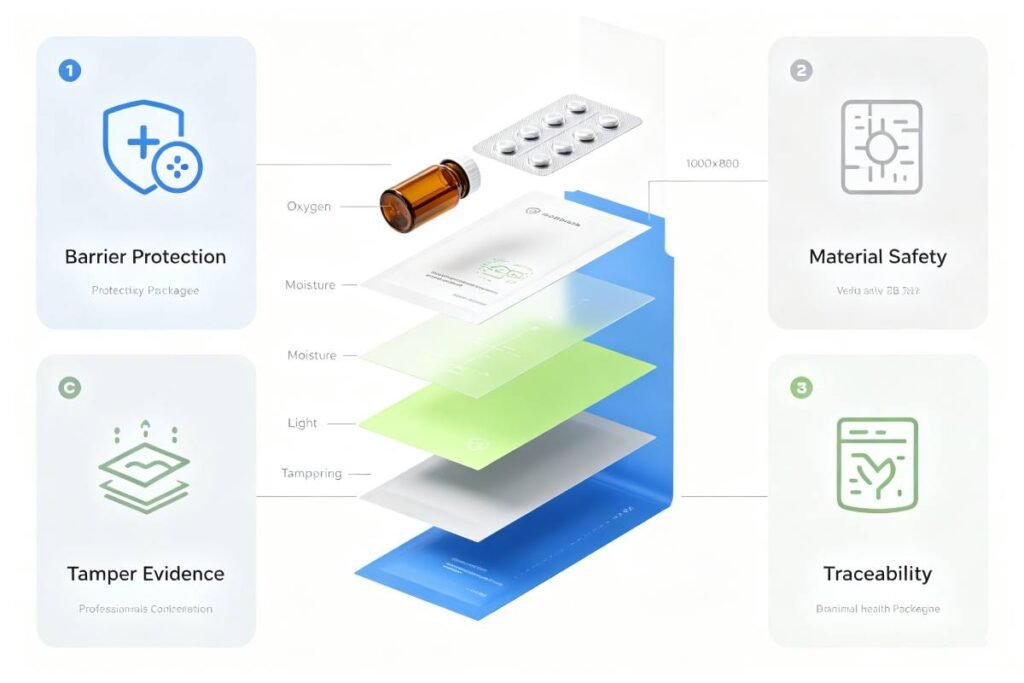
Oxygen and moisture: powders, vitamins and fish oil supplements oxidize, absorb moisture and cake easily, losing active potency over time. High-barrier materials such as multilayer films, EVOH, aluminum foil and high-barrier HDPE are used to lower oxygen and moisture transmission rates. Light exposure: vaccines and some antibiotics and light-sensitive liquids decompose under UV light, so amber light-protective bottles and opaque aluminum foil blisters are standard choices.
Chemical migration and interaction: packaging must not react with the liquid or powder inside, and no harmful substances should migrate out of the material. This is why veterinary packaging requires pharmaceutical-grade raw materials instead of ordinary recycled plastic. Transport damage and leakage: livestock and veterinary products often travel long distances across regions, and cold-chain vaccines also face temperature fluctuation. The packaging must resist impact and remain leak-proof, while cold-chain items need insulated outer boxes. Tamper and accidental access risk: child-resistant closures, tamper-evident seals and film closures help prevent accidental ingestion by pets or children and stop unauthorized opening or substitution during distribution.
Common Packaging Forms for Animal Health Products
Rigid plastic bottles (HDPE / amber PET): the most universal format, suitable for powders, granules and oral liquids. They provide moisture and light protection at a controllable cost, and are widely used for veterinary medicines and pet nutritional supplements.
Blister packs: single-dose sealed tablets or parasite pills, one tablet per dose, convenient for controlled dosing, moisture isolation and for vets or farmers to record the medication cycle. Aluminum foil bags, stand-up pouches and spout pouches: suitable for powders, pastes and suspensions with high-barrier aluminum foil structures, used for trial packs, aquaculture medicines and farm bulk packaging.
Dropper and measuring bottles: parasite drops and oral liquid supplements with built-in dosing structures, allowing accurate dosing by animal body weight and reducing dosage errors. Cold-chain dedicated packaging: a separate format for vaccines and biological preparations, paired with phase-change cooling materials to maintain temperature throughout transport and meet customs and surveillance traceability requirements.
Export Compliance: The Entry Ticket for Animal Health Packaging
For export, compliance thresholds for animal health packaging are far higher than for ordinary food packaging. The EU and the US apply dedicated pharmaceutical packaging controls to veterinary drug materials; holding a food contact Declaration of Conformity alone is not sufficient.
First, material safety evidence: material declarations and migration test reports are required to prove the material does not react with the drug and releases no harmful substances. Second, labeling: drug name, active ingredients, administration method, withdrawal period, storage conditions, batch number, expiry date and manufacturer information must be complete and clear, with prescription and non-prescription products marked separately.
Third, tamper evidence and traceability: many countries are moving toward serialization and one-item-one-code, enabling full traceability from factory, distributor and vet clinic to the end farmer or pet owner, to fight counterfeit and parallel-traded products. A common supplier mistake is to directly reuse food-grade packaging for veterinary products. Food packaging barrier performance and chemical stability may not meet long-term veterinary storage requirements, and can easily lead to customs detention or market recall during sampling.
Design That Fits Vets, Farmers and Pet Owners
Compliance and protection are the baseline, but good animal health packaging should also reduce dosing errors. For large farms and vets, labels must be clear, batch numbers and expiry dates easy to read, and bulk packs convenient for storage and dispensing. For end consumers, especially pet owners, the dosage should be easy to identify, the closure safe to open and child-resistant, and the administration instructions simple to understand.
Overseas brands are also paying growing attention to sustainability: recyclable pharmaceutical-grade plastic and non-aluminum high-barrier recyclable films reduce environmental burden without sacrificing barrier performance, matching the ESG requirements of European and American buyers.
Industry Trend: Smart Packaging Is Emerging
Traditional packaging only provides passive protection. The new generation of animal health packaging is becoming an information carrier: NFC chips, QR codes for traceability and temperature indicator labels. Temperature labels show at a glance whether a vaccine broke the cold chain or overheated in transit, while scanning a code brings up test reports, instructions and traceability information, helping vets and regulators verify authenticity quickly.
This trend also raises the bar for packaging suppliers: the role is no longer just supplying containers, but providing an integrated solution covering material testing, labeling compliance and traceability support.
FAQ
Can food contact packaging material be used directly for animal health products?
It is not recommended to transfer food packaging directly. Food materials only meet food contact migration standards. Veterinary products are in long-term contact with active pharmaceutical ingredients, so additional compatibility testing is needed to confirm there is no adsorption, reaction or degradation of the drug effect. Some veterinary categories require dedicated pharmaceutical packaging qualification.
Does an amber bottle guarantee safe storage of light-sensitive veterinary medicine?
An amber bottle is only basic protection. For highly sensitive vaccines and biological preparations, the bottle should be paired with an aluminum foil outer pouch and cold-chain temperature control; the bottle alone is not enough to guarantee drug stability.
What documents are required for animal health supplement packaging exported to the EU?
The basic documents are material declarations, migration test reports and a Declaration of Conformity. If the product falls under veterinary medicinal products, it must also comply with EU veterinary drug regulations, and the packaging label and instructions must be consistent with the submitted registration dossier.
Get Your Wholesale Packaging Bottle Inquiry Solution
Tell us your requirement for capacity, color, logo printing. We will reply you within 24 working hours.