
Introduction
Leakage is one of the most frequent complaints for plastic bottle packaging, especially for food, sauce, and beverage containers. Even high-quality HDPE, PET or PP bottles may leak if the cap design, manufacturing or assembly is not handled properly. For bulk buyers, leaking caps lead to product waste, damaged shipments, customer claims and extra cost. In this article, we break down the main reasons for cap leakage and practical ways to prevent it.
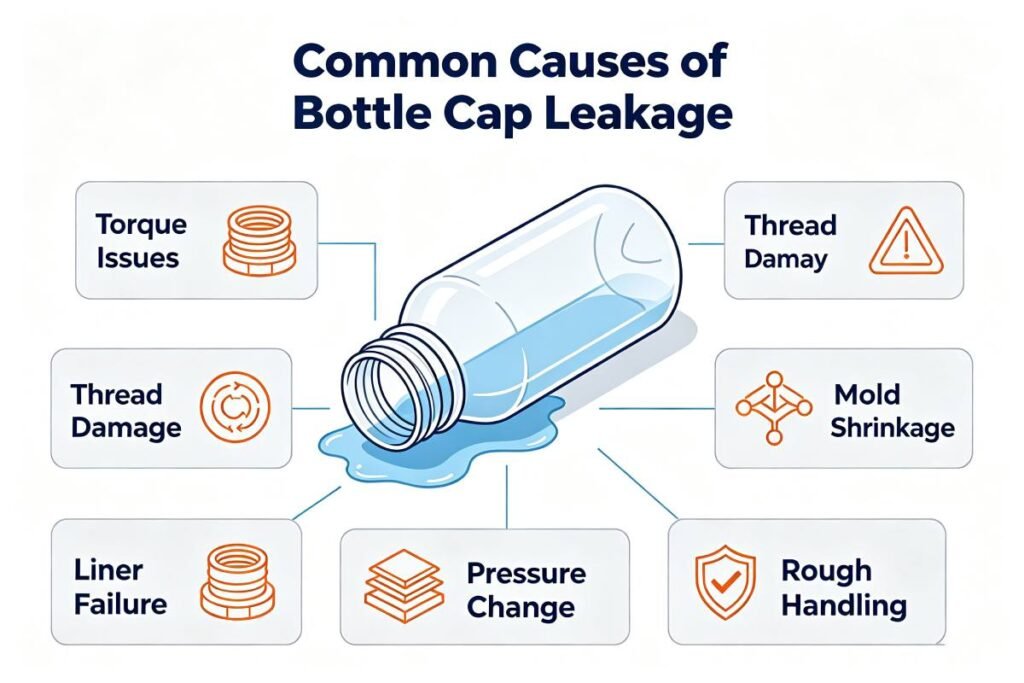
1. Improper Cap Torque During Capping
Torque is the tightness when screwing the cap onto the bottle neck.
- Too loose: The cap cannot fully compress the liner, liquid will seep out during transport.
- Too tight: Over-torque deforms the cap, liner or bottle neck, creates cracks or permanent distortion, which also causes leakage.Different bottle & cap combinations need a fixed torque value. It is not “the tighter the better”.
2. Damaged or Mismatched Bottle Neck and Cap Threads
Thread matching is critical.If the bottle neck thread and cap inner thread are not produced with the same mold standard, they will not fit perfectly.
Scratches, burrs, flash or deformation on threads from injection molding will create gaps.
Even a tiny gap allows liquid to leak out under pressure or vibration in transit.
3. Liner / Gasket Failure
Most leak-proof caps rely on a liner inside the cap.
- Wrong liner material: Not compatible with your content (oil, acid sauce, alcohol). Chemical erosion makes liner swell or shrink.
- Liner missing, misaligned or broken during cap assembly.
- Liner aging after long storage, losing elasticity and sealing ability.
4. Material & Shrinkage Issues from Injection Molding
Caps are injection molded plastic parts. Plastic will shrink after cooling.
If mold temperature, cycle time or raw material formula is not well controlled, the cap will have uneven shrinkage, resulting in warpage. A warped cap cannot sit flat on the bottle mouth, leaving a sealing gap.
5. Pressure & Temperature Changes During Shipping
- When goods travel by sea or air, temperature fluctuates.
- Liquid inside expands, building internal pressure inside the bottle. If the cap seal is weak, pressure pushes liquid through the sealing interface. This is very common for squeeze sauce bottles and liquid food packaging.
6. Rough Handling & Physical Deformation
Heavy stacking, impact and squeezing during logistics can bend the bottle neck or deform caps. The sealing structure will be damaged, and leakage occurs, even if the product passed the factory leak test.
How to Prevent Bottle Cap Leakage
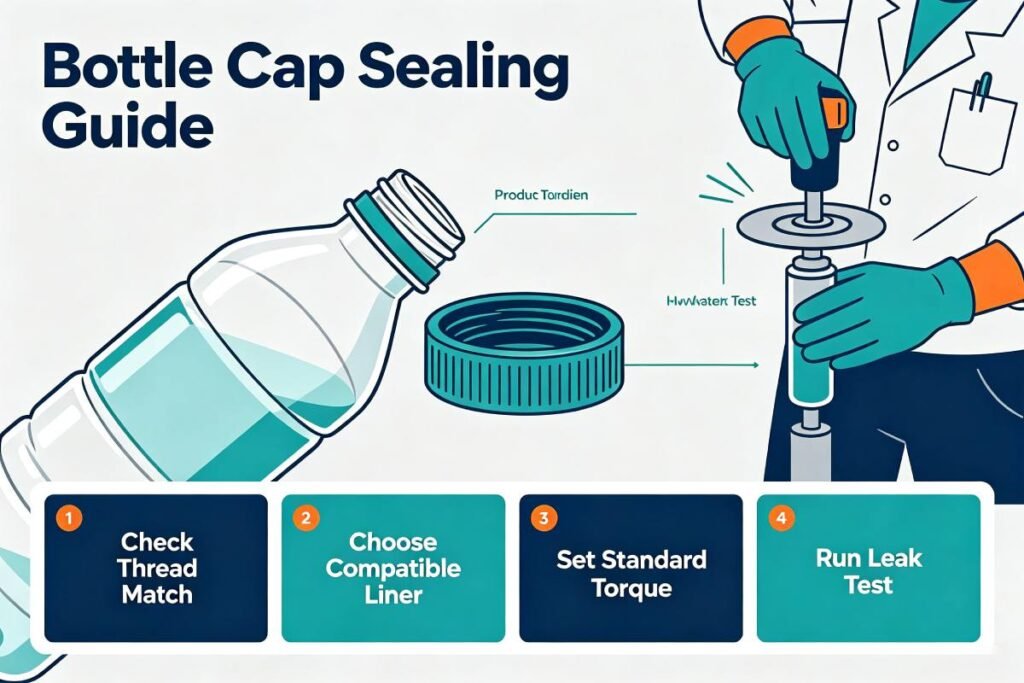
- Confirm thread specs of bottle neck and cap before mass production, use matched molds.
- Select compatible liner material according to your filling liquid.
- Set standard capping torque on filling machines and do batch leak tests.
- Do vacuum or water bath leak test for samples before shipment.
- Avoid over-stacking finished packages during transport. Choose food-grade raw materials with stable shrinkage performance.
FAQ
Q: Can leakage be fixed by just tightening the cap harder?
A: Usually no. Over-tightening may deform the cap or bottle neck and make the leak worse. You need to adjust capping torque or check the liner and thread matching.
Q: Are food-grade plastic caps guaranteed leak-proof?
A: Food grade only means the material meets food contact safety standards. It does not automatically guarantee leak resistance. Sealing performance depends on liner, thread precision and assembly.
Q: Why do some caps pass factory test but leak after sea shipping?
A: Temperature change and air pressure during ocean transport create internal pressure inside bottles. Minor sealing defects that do not show in simple water tests will leak under pressure.
Q: What test can I use to check cap leakage?
A: Common methods include water bath vacuum leak test, pressure decay test, and upside-down storage test for 24–72 hours to simulate transport.
Q: Can I use the same cap for different liquids like sauce and water?
A: Not always. Oily or acidic sauce requires specific liner materials. The same cap may seal water well but fail when contacting oil or acid.
Get Your Wholesale Packaging Bottle Inquiry Solution
Tell us your requirement for capacity, color, logo printing. We will reply you within 24 working hours.