
Introduction
When purchasing food-grade plastic bottles for food storage, sauce packaging, beverage filling, or daily food container use, many buyers focus only on appearance, capacity, and price. However, food-grade safety standards are the most critical factor that determines product compliance, market sales, and customer trust.
For food brands and packaging suppliers, choosing the right food-grade plastic bottles is about more than selecting a container. It is about ensuring regulatory compliance, protecting product freshness, and building a reliable brand image in competitive domestic and international markets.
Not All Plastic Bottles Are Suitable for Food Contact
Not all plastic bottles can be used for food contact. Many cosmetic-grade bottles look beautiful with matte finishing, electroplated caps, and smooth touch surfaces, but they are not manufactured under food-safe production standards.
These cosmetic packaging molds and production lines are dedicated to skincare and beauty products, which may carry residual additives, colorants, and cosmetic raw material residues. Even if the plastic particles themselves are qualified, the whole product cannot pass food-grade certification.
For food packaging buyers, this means that visual appeal alone is never a sufficient purchasing criterion. Production environment, material traceability, certification scope, and inner-contact-layer safety must all be verified before use.
True Food-Grade Bottles Follow Strict Contact Regulations
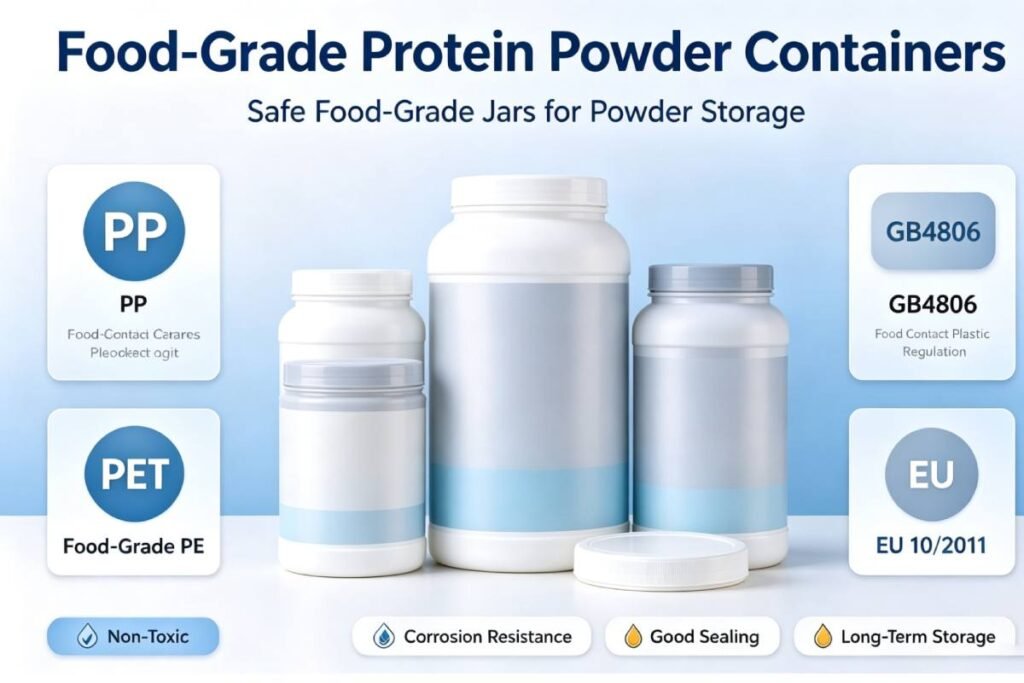
True food-grade plastic bottles strictly follow food contact regulations such as GB4806 in China and EU 10/2011 standards. The entire production process is completed in a dust-free and independent workshop without mixed production with cosmetic products.
No unsafe surface spraying, electroplating, or chemical coating is applied on the inner contact layer, ensuring no substance migration during food filling, high-temperature storage, or long-term preservation.
This level of control is especially important for products that remain in contact with packaging for extended periods, including:
- Protein powder containers
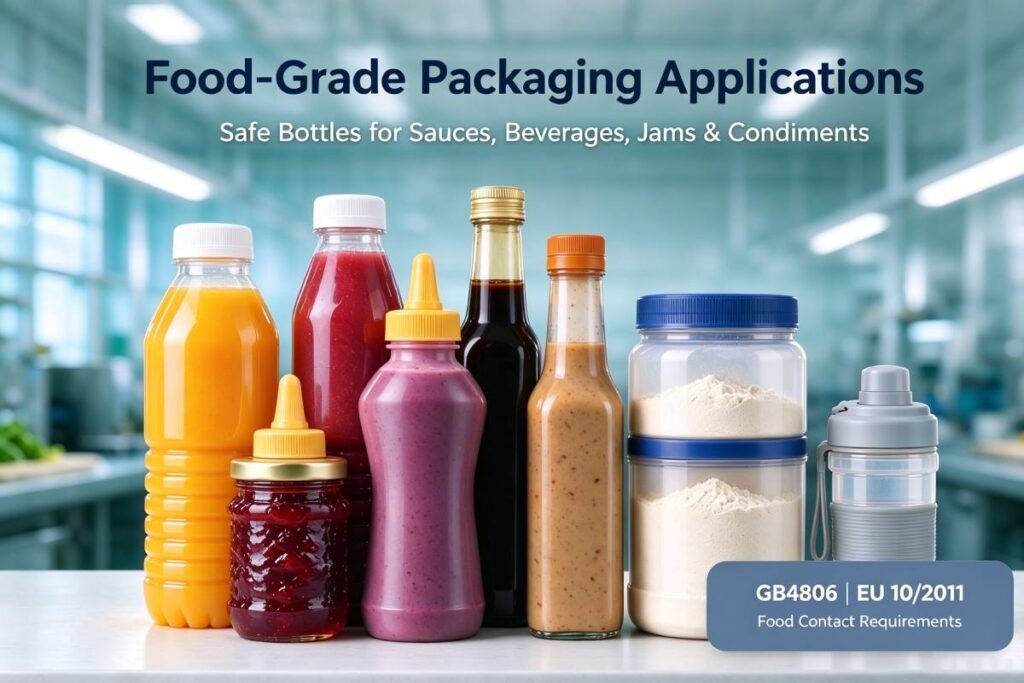
- Juice and beverage bottles
- Jam and honey jars
- Sauce and condiment bottles
- Travel food storage containers
Common Food-Safe Materials for Food Bottles
Common food-safe materials for daily food bottles include PP, PET, and food-grade PE. These materials feature non-toxicity, corrosion resistance, low-temperature resistance, and good sealing performance.
Each material can serve different packaging needs depending on the product formula, filling method, shelf-life requirements, and market destination.
PP (Polypropylene)
PP is widely used in food packaging because of its good heat resistance, chemical stability, and durability. It is suitable for containers that require structural strength and reliable sealing.
PET (Polyethylene Terephthalate)
PET is lightweight, transparent, and widely accepted in beverage and food packaging. It is commonly used for juice bottles, water bottles, salad dressing bottles, and other products where clarity and shelf visibility are important.
Food-Grade PE
Food-grade PE is often used in food storage and daily container applications. It offers good low-temperature resistance and is suitable for certain types of food storage bottles and jars.
Three Core Advantages of Qualified Food-Grade Packaging
For food brands, choosing qualified food-grade packaging brings three core advantages:
1. Market Compliance
Supermarkets, cross-border e-commerce platforms, and offline physical stores require complete food-grade test reports. Unqualified packaging will lead to product removal, customs detention, or return orders.
Compliance failures can damage not only a single shipment but also a brand’s access to important sales channels.
2. Consumer Safety Trust
Food-safe bottles avoid chemical precipitation, ensure food freshness, and greatly reduce customer complaints and after-sales risks.
When consumers trust the packaging, they are more likely to trust the brand itself. Food-grade safety therefore becomes an important part of product experience and repeat purchase behavior.
3. Long-Term Brand Reputation
Stable and standardized food packaging helps brands build a safe, professional, and reliable image in the global food packaging market.
For wholesalers and distributors, supplying certified food-grade bottles also helps strengthen long-term partnerships with food brand customers.
Customized Food-Grade Plastic Bottles for Global Brands
If you need customized food-grade plastic bottles with stable quality, complete certification, various capacities, and professional OEM service, our factory provides one-stop food packaging solutions for global food brand wholesalers and distributors.
We support customized logos, personalized surface treatments, exclusive mold development, and strict food-grade quality inspection for every batch of goods.
Whether you are developing a new protein powder container, juice bottle, sauce squeeze bottle, condiment jar, or travel food storage bottle, we can help you select the right material, structure, and production standard for your market.
Contact Us for Your Food-Grade Packaging Solution
Get in touch today to discuss your food-grade plastic bottle requirements.
We can provide:
- Food-grade PP, PET, and PE bottles
- Custom capacity and shape design
- Logo printing and surface treatment
- Food-grade certification support
- Bulk supply for wholesalers and distributors
- OEM manufacturing for food brand customers
Your reliable supplier of safe, compliant, and customized food packaging bottles.
FAQs About Food-Grade Plastic Bottles
Q: What is the difference between food-grade plastic bottles and cosmetic-grade plastic bottles?
A: Food-grade plastic bottles are manufactured in independent dust-free workshops, complying with GB4806 and EU 10/2011 food contact standards. They cannot be mixed-produced with cosmetic packaging. Cosmetic-grade bottles may contain additive residues, which may cause substance migration and cannot be used for food filling.
Q: Which plastic materials are suitable for food packaging bottles?
A: PP, PET and food-grade PE are our mainstream food-safe materials. They are non-toxic, corrosion-resistant and good in sealing. Widely used for protein powder cans, sauce squeeze bottles, beverage bottles and condiment packaging.
Q: Can you supply test reports for GB4806 and EU 10/2011?
A: Yes. We can provide full food-grade test reports for each batch. These documents help you for customs clearance, supermarket entry and cross-border platform sales.
Q: Do you accept OEM custom food-grade plastic bottles?
A: Yes. We support custom logo printing, surface finishing, custom capacity and exclusive mold development. Every batch will pass strict food safety inspection before shipment.
Q: Is PP protein powder container heat resistant?
A: Yes. PP material has good heat resistance. PET and PE bottles are more suitable for normal temperature food storage. We will recommend proper material according to your filling product and storage environment.
Get Your Wholesale Packaging Bottle Inquiry Solution
Tell us your requirement for capacity, color, logo printing. We will reply you within 24 working hours.