
Introduction
A Declaration of Conformity (DoC) is the core compliance document for food contact plastic packaging sold in the EU. Many exporters and importers treat it as a simple formality, but an invalid DoC can trigger serious enforcement actions.
This article covers common DoC failures, border and market surveillance consequences, liability allocation and FAQs for packaging suppliers and buyers.
What Makes a DoC Invalid
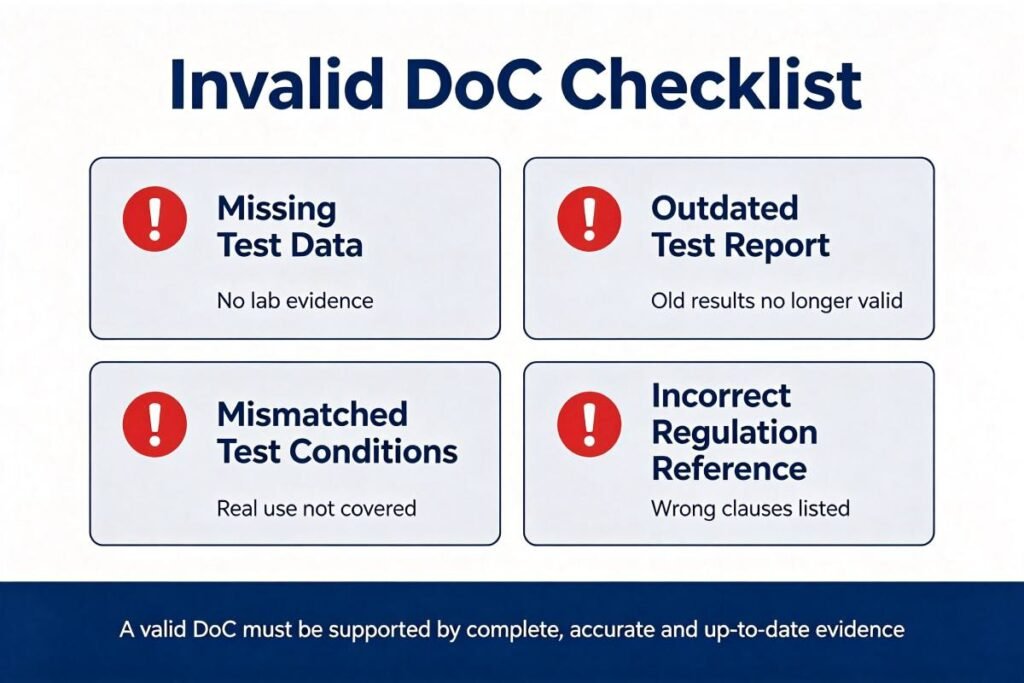
A DoC is not valid just because it has a signature. It becomes invalid when key information is missing, mismatched or unsupported. Common issues include outdated test reports, test conditions that do not match real food contact scenarios, missing material descriptions, unlisted additives, incorrect regulation references, and test data that cannot back up the stated migration limits.
Other frequent flaws: wrong manufacturer or importer details, no unique batch identification, and test reports from unqualified laboratories. Even a typo on food contact regulation clauses can be grounds for authorities to reject the document during inspection.
Border Detention and Sampling
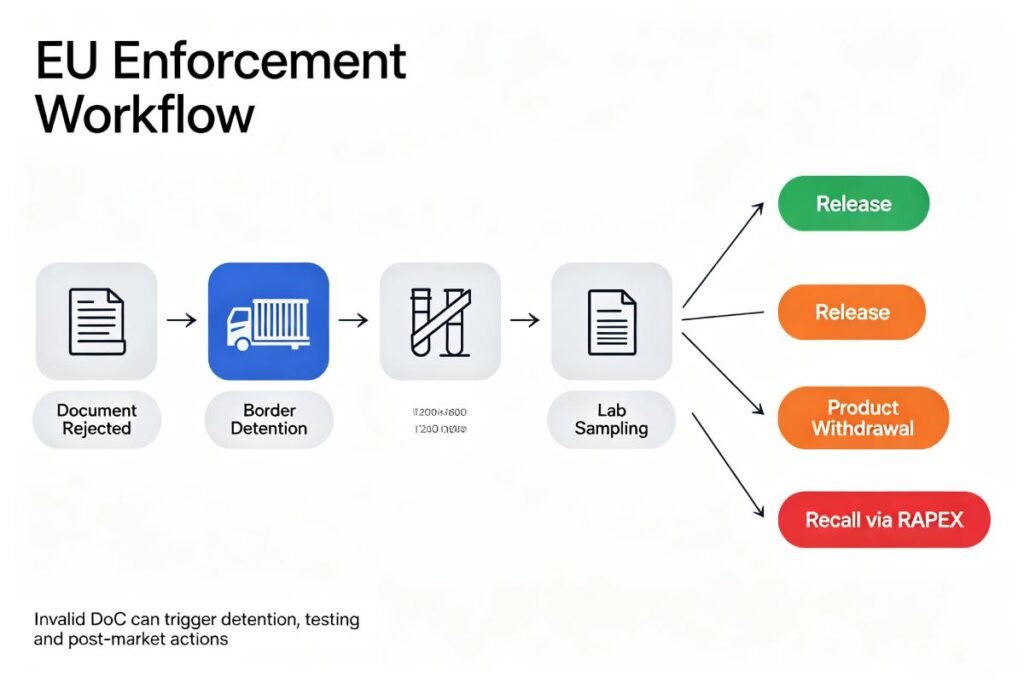
Customs or market surveillance authorities may hold your shipment at the border if the DoC appears invalid. The goods will not be released until you provide complete, compliant supporting evidence. Officials often order laboratory sampling for migration testing while the cargo is detained.
Detention creates extra costs: port storage fees, freight delays, missed delivery windows and penalties. If lab results fail compliance limits, the shipment can be refused entry, ordered for destruction or returned to the origin country at the exporter’s expense.
Market Recall and Product Withdrawal
Even after goods clear customs and enter the market, an invalid DoC can still trigger post-market enforcement. Once surveillance finds non-compliance linked to the defective DoC, authorities can force product withdrawal from warehouses and retail shelves.
In serious cases where there is a potential health risk, a formal recall will be launched and notified via RAPEX. A RAPEX alert affects all EU member states, damaging both the importer’s reputation and the supplier’s qualification for future European orders.
Liability Chain: Manufacturer vs Importer
Under EU food contact rules, the importer is the primary responsible party for verifying the DoC before placing goods on the EU market. The importer must confirm the manufacturer has proper test records and traceability, even if the supplier provided the DoC.
The manufacturer holds responsibility for the accuracy of material formulation and test data. If the manufacturer falsifies the DoC, they face supplier-side sanctions. However, the importer cannot shift all blame; failure to carry out due diligence will still result in fines and restrictions on their business.
FAQ
Can you revise and reissue an invalid DoC?
Yes. If the DoC is invalid due to clerical errors, missing information or outdated supporting tests, the manufacturer can update and reissue a corrected DoC paired with valid lab evidence. But reissuing only works if the packaging itself meets regulatory limits. If the material fails migration testing, a new DoC will not make the product legal.
Does an expired DoC automatically make goods illegal?
Not automatically. The DoC itself does not have a fixed expiry date in most EU rules. The critical factor is whether the supporting test reports remain valid for the material and intended use. If raw material formulation or production process has changed, old test data and the linked DoC become invalid, even if no printed expiry date exists.
Get Your Wholesale Packaging Bottle Inquiry Solution
Tell us your requirement for capacity, color, logo printing. We will reply you within 24 working hours.