

Introduction
For food-grade PET bottles, wall thickness is one of the most direct variables controlling barrier performance, structural strength and production cost. A thicker wall can slow down oxygen and moisture permeation, but it also increases resin weight, freight cost and carbon footprint.
Finding the right balance requires understanding how permeation works, where thin-wall weaknesses appear in long shelf-life products, and which structural or material optimizations can improve barrier without simply over-thickening the bottle.
Oxygen and Water Vapor Transfer
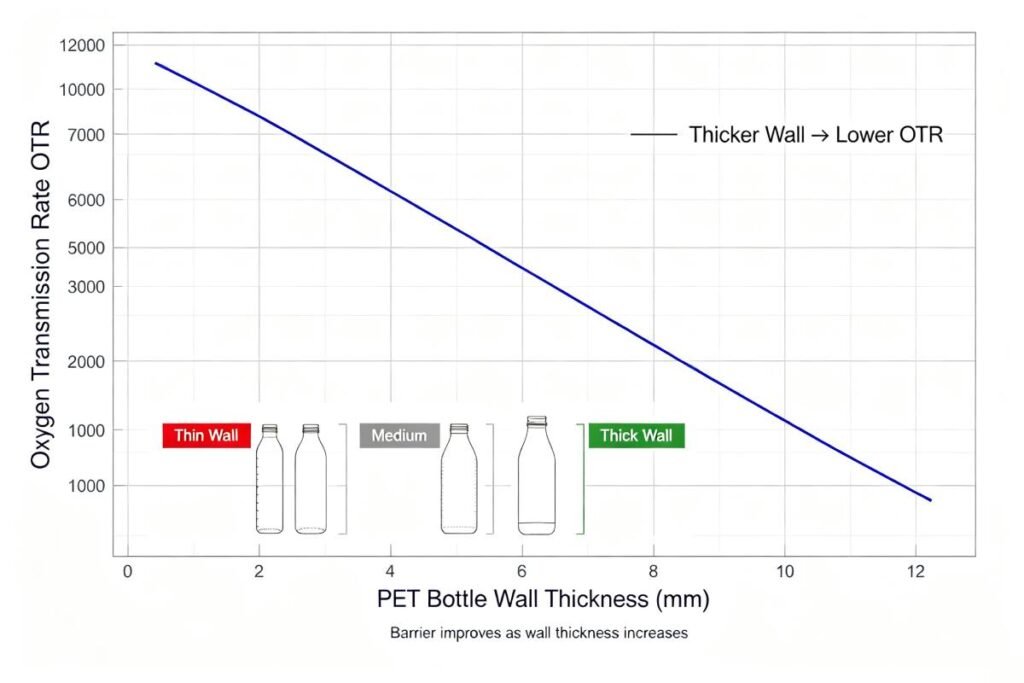
Barrier performance in PET bottles does not increase in a simple one-to-one ratio with wall thickness. Under the same resin grade, temperature and humidity conditions, a thicker wall reduces oxygen transmission rate (OTR) and water vapor transmission rate (WVTR), slowing down oxygen ingress and moisture exchange with the outside environment.
The improvement follows a permeation curve rather than a straight line. Additional thickness delays oxidation, flavor loss and moisture gain or loss, which matters for sauces, oils, dry blends, nuts and long shelf-life beverages. However, standard PET has a moderate inherent barrier, and wall thickening alone can only raise it to a limited level. For demanding products, barrier coatings, multilayer structures or oxygen scavengers may still be required.
Thickness vs Weight and Cost
Wall thickness directly determines how much resin goes into each bottle. Every increase in thickness raises bottle weight, which in turn increases raw material cost, unit freight cost and the number of bottles that fit into a shipping container.
Moderate thickening is a low-barrier solution: it usually needs little change to existing tooling and no extra process equipment. Beyond a certain point, however, over-thickening quickly pushes up resin consumption and total packaging cost, which can hurt margin on price-sensitive fast-moving consumer goods. A common mistake is to add more wall material to improve barrier without checking whether the sealing system, resin grade or bottle shape is the real limiting factor.
Thin Wall Risks for Long Shelf Life Products
Lightweight thin-wall PET bottles are an industry trend, but they carry clear risks for products requiring a long shelf life.
First, thinner walls allow oxygen and moisture to pass through faster, so the bottle may not meet the target shelf-life requirement. Second, thin sections are more likely to deform, dent, buckle or develop stress cracking during filling, stacking and transport. Third, thin-wall molding can create uneven wall distribution, local thin spots, crystallization marks or residual stress that further weakens barrier and mechanical performance.
Sauces, oils, probiotics, dry meal replacements and other products with a 6–18 month shelf life should not pursue weight reduction blindly. The wall design must be checked against the required shelf life, filling temperature and distribution conditions.
Design Optimizations Instead of Over Thickening
Before simply increasing wall thickness, engineers should look at other ways to improve barrier and structural stability.
Structural design: add reinforcing ribs, curved transitions and bottom support geometry to resist deformation without extra resin. Resin modification: use barrier masterbatch or oxygen scavenger additives to improve intrinsic barrier. Surface treatment: apply SiO₂ or Al₂O₃ coating to boost barrier while keeping the bottle lightweight. Process control: keep wall distribution uniform during blow molding; even wall thickness is often more important than raising the average wall thickness. Sealing system: the cap and induction liner seal can have a larger impact on shelf life than the bottle wall itself.
FAQ
Does doubling wall thickness double barrier performance?
No. Barrier follows the law of permeation: doubling the wall thickness roughly halves the permeation rate, but the relationship is not perfectly linear in real production. Other factors such as PET intrinsic viscosity, crystallinity, temperature and storage humidity also affect the result. Thickening adds weight and cost, and beyond a certain point it is no longer an efficient way to improve barrier.
Can uneven wall thickness cause migration risk?
Yes. Uneven wall thickness creates two risks. Local thin spots have higher oxygen and moisture permeation, leading to faster product degradation in those areas. Over-thick areas with high residual stress are more prone to stress cracking, and improper processing can raise migration risk under hot filling or long-term storage. Consistent wall distribution is therefore essential for food contact PET bottles.
Get Your Wholesale Packaging Bottle Inquiry Solution
Tell us your requirement for capacity, color, logo printing. We will reply you within 24 working hours.