
Introduction
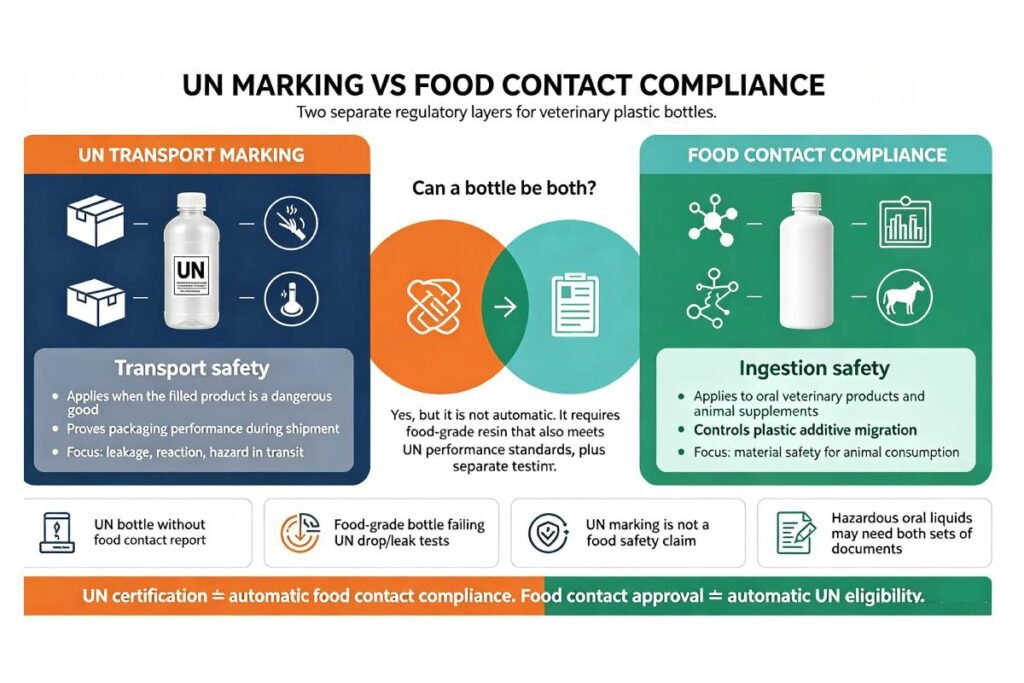
UN transport marking and food contact compliance are two independent regulatory frameworks, serving completely different purposes for veterinary plastic bottles.
UN marking follows the UN Recommendations on the Transport of Dangerous Goods. It is a transport safety requirement, focusing on the risks of the filled contents during shipment. Its core goal is to avoid leakage, chemical reactions and safety hazards in transit, and it assesses the packaging’s physical performance for dangerous goods transport.
Food contact compliance is governed by feed and food contact material regulations such as FDA 21 CFR, EU 10/2011 and GB 4806.7. It is an ingestion safety rule. It restricts the migration of plastic additives into the contents, to prevent contamination when animals take oral veterinary products. It mainly evaluates the material safety for consumption.
A bottle can satisfy one rule while failing the other. UN certification does not equal food/feed contact compliance, and food-contact approval does not automatically qualify a bottle for UN dangerous goods transport.
When UN Certification Applies
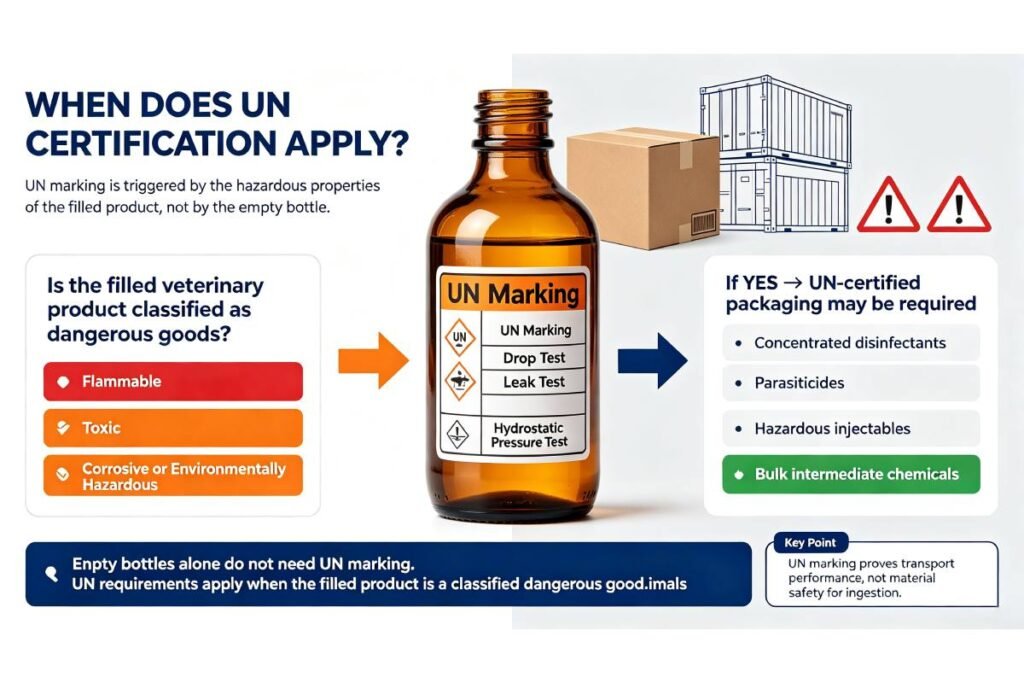
UN marking is only mandatory when the finished veterinary product inside is classified as a dangerous good under UN transport rules.
Common cases requiring UN-certified bottles with UN marking:
– Liquid veterinary formulations classified as flammable, toxic, corrosive or environmentally hazardous substances
– Concentrated disinfectants, parasiticides and hazardous injectable veterinary medicines
– Bulk intermediate veterinary chemicals packed in plastic bottles
Important point: UN requirements depend on the content, not the empty bottle itself. Empty plastic bottles do not need UN marking. UN certification is only needed when the bottle is used as approved packaging for classified hazardous goods. UN packaging must pass strict performance tests including drop test, leak test and hydrostatic pressure test to prove it can hold hazardous substances safely during transport.
Food Contact Rules for Oral Veterinary Products
Food contact regulations apply to oral veterinary preparations and animal supplements that will be ingested by animals.
The regulatory logic is clear: oral veterinary drugs and feed supplements fall under feed contact material rules in most regions, even though they are for animals instead of humans.
Key requirements include:
– Approved plastic resins such as PET, HDPE and PP
– Controlled limits for heavy metals, plasticizers, residual monomers and additive migration
– Controlled production conditions to avoid cross-contamination
– Supporting documents: compliance declarations, migration test reports and material formulation records
This requirement applies regardless of whether the product is dangerous for transport. Even non-hazardous animal supplement bottles usually need food/feed contact compliance.
Note: Injectable veterinary packaging generally follows dedicated pharmaceutical GMP standards rather than standard food contact rules.
Common Conflicts Buyers Encounter
1. UN-certified bottles without valid food contact test reports
The packaging passes dangerous goods transport performance tests, but the plastic raw material uses non-food-grade additives, so migration requirements cannot be met. This is a common pain point for hazardous oral veterinary liquids.
2. Food-contact grade bottles cannot obtain UN certification
Food-grade resin may not meet the mechanical strength, leak resistance or chemical compatibility standards for UN packaging. The material passes migration tests but fails UN drop or leakage tests.
3. Misconception: UN marking means safe for animal consumption
Many buyers confuse UN marking with ingestion safety proof. UN only verifies packaging integrity in transport, not chemical migration safety.
4. Double documentation burden
For hazardous oral veterinary liquids, buyers need two separate sets of paperwork: UN packaging approval certificate and food/feed contact compliance report. Many packaging suppliers only specialise in one certification.
FAQ
Can a vet bottle be both UN certified and food contact compliant?
Yes. But it is not a standard off-the-shelf product. Manufacturers have to use food-grade resin formulations that also meet UN dangerous goods packaging performance standards, and complete both UN performance testing and food contact migration testing. This is the ideal option for hazardous oral veterinary liquids.
Are all animal supplement bottles UN required?
No. Most regular oral animal supplements, non-hazardous liquid feed additives and non-toxic nutritional liquids are not classified as dangerous goods. Their plastic bottles only need food/feed contact compliance and do not require UN marking or UN certification.
Get Your Wholesale Packaging Bottle Inquiry Solution
Tell us your requirement for capacity, color, logo printing. We will reply you within 24 working hours.