
Introduction
Sauce and condiment packaging has unique demands: the bottle must squeeze smoothly, resist leakage, stay compatible with oily or acidic fillings, and look clean on retail shelves. Many importers and brand owners end up with leaking caps, deformed bodies, or material reactions simply because they picked the wrong squeeze bottle design. This guide walks through the key factors B2B buyers should check before ordering plastic squeeze bottles for sauces, condiments, syrups and thick gels.
You can download our available mold list as below to check in-stock molds and save your tooling cost.
How to Choose the Right Plastic Squeeze Bottle for Sauces and Condiments
Sauce and condiment packaging has unique demands: the bottle must squeeze smoothly, resist leakage, stay compatible with oily or acidic fillings, and look clean on retail shelves. Many importers and brand owners end up with leaking caps, deformed bodies, or material reactions simply because they picked the wrong squeeze bottle design. This guide walks through the key factors B2B buyers should check before ordering plastic squeeze bottles for sauces, condiments, syrups and thick gels.
1. Start with Material Compatibility
The first check is whether the plastic material suits your filling. HDPE is the most common choice for thick sauces, mayonnaise, mustard and condiments: it resists grease, chemicals and impact well, and it squeezes with a soft, controllable feel. PET looks clearer and brighter for retail display, but it has limits with high-fat, oily or hot-filled products. For acidic sauces such as vinegar-based dressings, confirm chemical resistance before bulk production.
Always share your actual filling with the supplier and ask for a compatibility check. A bottle that works for water-thin sauce may react, soften or change flavour when filled with oil-based or acidic condiments. Food-grade raw material should also meet the target market’s food contact regulations, such as EU 10/2011, FDA or local standards.
2. Match the Nozzle and Cap to Your Sauce Flow
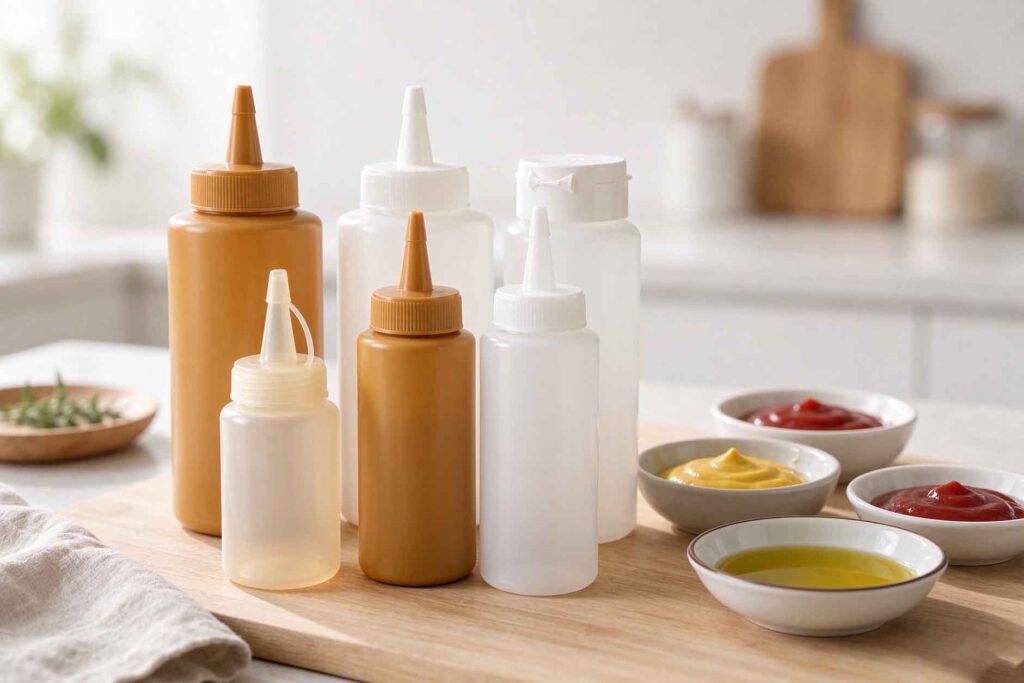
Not every dispensing cap fits every sauce. Pointed nozzle tips suit thin to medium sauces and allow precise, clean lines. Push-pull caps work well for ketchup, mustard and dressings, letting users open and close the flow easily. Wide mouth caps are better for thick pastes and gels that need to be scooped or filled from a jar.
Anti-drip design matters a lot for user experience. A poor valve or loose thread can leave sauce drying around the nozzle, causing blockage or messy marks on shelves. Ask the supplier for a squeeze test with your own product: check the flow speed, drip-back after release, and whether the cap seals tightly after repeated use.
3. Wall Structure and Squeeze Feel
A good squeeze bottle balances flexibility and strength. Thin walls squeeze easily but may collapse under stacking pressure or feel flimsy. Overly thick walls are hard to press, especially for elderly or one-handed users. The bottle body should return to shape after squeezing rather than staying dented.
Reinforced base panels and ribbed side walls improve rigidity without adding much weight. For glass-replacement or premium positioning, semi-rigid structures give a more stable, upright feel while keeping the light weight and shatter resistance of plastic. Always evaluate wall thickness together with capacity: a 250 ml and a 500 ml bottle do not need the same wall schedule.
4. Neck Finish, Filling and Cleaning
The neck finish decides whether your filling line, cap and seal liner match. Before ordering, confirm the neck thread size, opening diameter and whether the bottle works with induction sealing or a screw cap. A wide neck makes it easier to fill thick sauces, insert a spatula, and wash the bottle by hand or machine. Narrow necks are better for thin liquids but can be hard to clean for repeat-use products.
If your product is packed on an automated filling line, share the line speed, cap type and sealing method with the manufacturer early. Neck dimensions that look fine on a sample may not lock securely on high-speed equipment.
5. Food Contact Compliance for the Target Market
Sauce and condiment bottles are direct food contact packaging, so compliance is non-negotiable. Suppliers should be able to provide food grade certificates, raw material test reports, and the relevant food contact documentation for your destination market. This matters even more for exports to the EU, USA, Australia and the Middle East, where customs and retailers may ask for paperwork before clearance or shelf listing.
Do not rely on verbal “food grade” claims alone. Ask for the actual document type, the standard it references, and whether it covers both the bottle and the cap or nozzle. Colour masterbatches and printing inks should also be food compliant, especially when they touch the inner side of the closure.
6. Custom Colour, Logo and Surface Finish
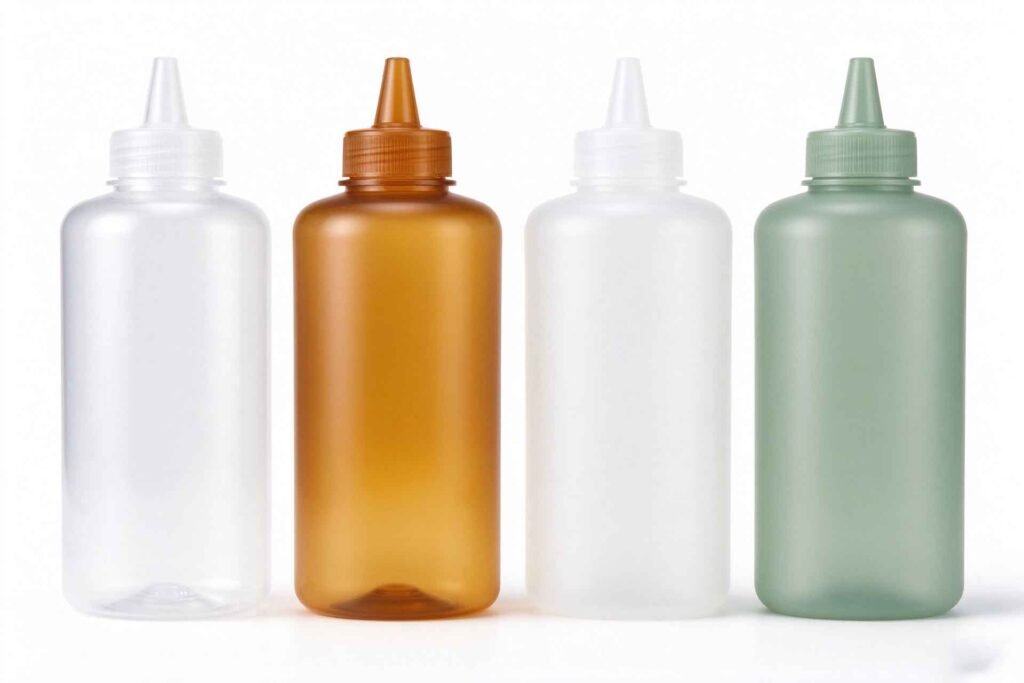
Packaging branding usually runs through bottle colour, cap colour, screen printing, labels or both. Matte, frosted, natural, amber or white finishes each give a different shelf impression. Solid colour is mixed into the resin during moulding, so it stays consistent across the whole wall, while spray coating can create special effects but may scratch under heavy friction.
One-colour silk printing is a low-cost option for a simple logo. Detailed artwork, ingredient lists or multi-colour graphics are often better handled by adhesive labels, which also make it easier to update text when regulations change. Confirm the print area, ink adhesion and whether the surface needs treatment before printing.
7. MOQ, Samples and Tooling
For standard moulds, the minimum order quantity is usually lower, and buyers can start with a trial batch before scaling up. Custom bottle shapes require a new mould, which adds tooling cost and lead time. If your priority is keeping unit cost low, look first for an existing mould that matches your capacity, neck and nozzle style.
Always request physical samples before mass production. Test the squeeze feel, cap seal, colour match and print quality with your real filling. Compare samples from more than one supplier if possible, and keep a signed sample as the benchmark for the bulk order. For export orders, agree the production lead time, sample lead time, packing method and shipping terms in writing.
FAQ
Q: Which plastic is best for sauce squeeze bottles, HDPE or PET?
A: HDPE is usually preferred for oily, thick or greasy condiments because it resists grease and chemicals well. PET suits clear, lighter products where shelf visibility matters, but check compatibility before filling high-fat or acidic sauces.
Q: How do I prevent sauce bottles from leaking during sea freight?
A: Choose a cap with a matching neck thread, add a suitable seal liner or induction seal if required, and test the bottle upright and inverted after filling. Good inner packing and divider trays also reduce vibration damage in containers.
Q: What MOQ should I expect for branded squeeze bottles?
A: Existing moulds typically have a lower MOQ for plain bottles; custom colours, printing or new tooling raise the MOQ. Confirm the MOQ for bottles, caps and printing separately with the supplier.
Q: Can I get EU food contact certificates for sauce bottles?
A: A reliable manufacturer should provide food contact documentation aligned with EU 10/2011 for both bottle and closure. Ask for the actual report before placing the order, especially for export to Europe.
Q: Is screen printing or sticker labels better for condiment bottles?
A: Screen printing suits a simple one-colour logo and gives a clean, durable look. Labels are more flexible for detailed graphics, ingredient information and future artwork changes. Many brands use printed logos on the front and labels on the back.
Get Your Wholesale Packaging Bottle Inquiry Solution
Tell us your requirement for capacity, color, logo printing. We will reply you within 24 working hours.