

Introduction
Acetaldehyde (AA) is one of the most well‑known defects in PET packaging. Many beverage brands, especially purified water and mineral water producers, are extremely sensitive to AA content. Even low‑level acetaldehyde residue can transfer an unwanted fruity or off‑flavor taste into bottled water.
The source of AA is not only the PET resin itself; the injection molding process for PET preforms is the major stage where acetaldehyde increases. If preform AA level is too high at the preform factory, the later blow‑molding process cannot fully eliminate the risk. In this guide, we break down where AA comes from, what risks it brings, and the practical control points every preform buyer must evaluate.
What Is Acetaldehyde (AA) And Why It Matters For PET Bottles
How acetaldehyde affects your beverage product
Drinking water products show the highest sensitivity to acetaldehyde odor. Even trace AA concentration can create noticeable off‑flavor and lead to consumer complaints. Sweet juice, carbonated drinks and sauce packaging have relatively higher tolerance for acetaldehyde residue. Poor AA control will damage your brand reputation and reduce repeat purchases from end customers.
Common misunderstanding: AA is only created during bottle blowing
A widespread misconception among packaging buyers is that acetaldehyde is mainly generated in the blow molding stage. In fact, the injection molding phase of PET preform production is the decisive source of AA. Once the preform leaves the factory with excessive acetaldehyde, no later blow‑molding adjustment can completely fix the taste risk.
Where Does Acetaldehyde In PET Preforms Come From?
Raw PET resin intrinsic AA level
Virgin PET resin carries a baseline acetaldehyde value out of polymerization. Different resin grades have very different starting AA indicators. Water‑grade PET resin is specially formulated with naturally lower baseline acetaldehyde compared to general‑purpose packaging PET resin.
Thermal degradation during preform injection molding (THE BIGGEST factor)
PET molecular chains break down under excessive heat during plasticization, generating new acetaldehyde molecules. Four key thermal triggers include overly high barrel temperature, long resin residence time inside the screw barrel, excessive shear heat, and insufficient drying of PET chips. Wet PET pellets dramatically accelerate polymer degradation and AA accumulation.
Preform post‑molding cooling & storage
Slow cooling after injection keeps preforms at high temperature for an extended period, continuing acetaldehyde formation. Long‑term storage of finished preforms in hot warehouse environments will also gradually raise AA values. Hot ocean shipping containers can create the same risk during international transportation.
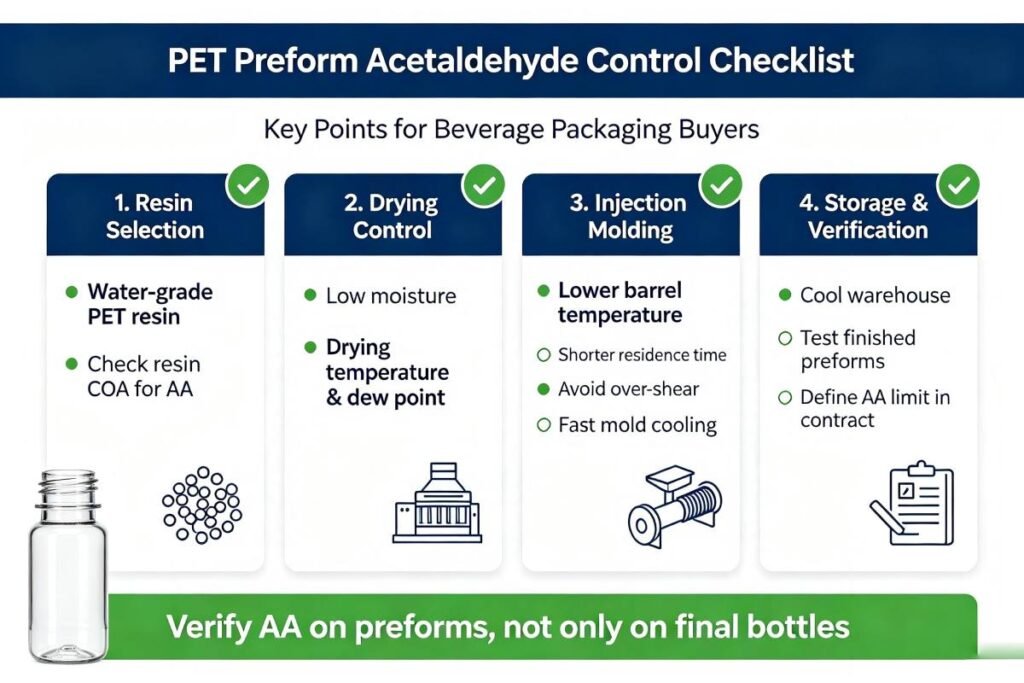
Core Control Points To Lower AA Level In PET Preforms
Point 1: Select the correct low‑AA PET resin grade
For drinking water bottle projects, always specify water‑grade PET resin as your raw material instead of universal PET grades. Ask your supplier for resin COA documents to verify the intrinsic acetaldehyde indicator before mass production starts.
Point 2: PET chip drying process control
PET resin must be fully crystallized and dried before injection. The moisture content must drop to an extremely low threshold. Drying temperature, dew point and drying duration all require stable, consistent monitoring. Poor drying is one of the most easily overlooked root causes of high AA.
Point 3: Injection molding parameter optimization (the most critical factory control)
Set the barrel temperature as low as possible while still guaranteeing qualified preform molding quality. Reduce resin residence time inside the injection screw, avoid over‑speed plasticization that creates extra shear heat, and optimize mold cooling design to rapidly remove heat once each cavity is filled.
Point 4: Post‑production rapid cooling & warehouse environment
High‑quality preform molds support fast heat removal immediately after injection. Finished PET preforms need to be stored in cool, dry warehouses. Avoid prolonged exposure to high ambient temperature before blow‑molding processing.
How Buyers Can Verify AA Level From Your PET Preform Supplier
Request finished PET preform acetaldehyde test reports, do not rely only on raw resin COA data. Clarify your end product type to define your acceptable AA specification, as limits differ greatly between water, juice and oil packaging. Confirm how frequently the factory runs batch‑by‑batch AA laboratory testing during mass production.
Common Mistakes Preform Buyers Make On Acetaldehyde Control
Mistake #1: Only test finished blow bottle AA, ignoring preform incoming AA value Checking only blown bottles leaves the root cause undetected. You need to audit AA quality at the preform incoming inspection stage.
Mistake #2: Accept general‑grade PET resin for mineral water packaging project General PET resin cannot meet the low baseline AA requirement for premium drinking water applications.
Mistake #3: No specification written for AA limit within purchase contract Without a clear written AA standard in your purchase agreement, you have limited grounds for quality claim when high‑AA preforms cause problems.
Mistake #4: Ignoring high temperature risk during ocean container shipping Sealed sea containers can reach very high temperatures on long overseas voyages, which may slowly increase acetaldehyde content inside stacked preform pallets.
Brief Summary
Acetaldehyde control is a full‑supply‑chain discipline covering resin selection, PET chip drying, injection molding parameter tuning, mold cooling, finished preform warehousing and international shipment. If your final product is bottled drinking water, low‑AA PET preform specification should rank among your top evaluation criteria when selecting a preform manufacturer.
FAQ
Q1: Can blow molding process completely eliminate high AA from incoming preforms?
A: No. Blow molding can only deliver limited adjustment on acetaldehyde. Low‑AA qualified preforms form the fundamental foundation for low‑taste‑risk finished bottles.
Q2: Which beverage type is most sensitive to acetaldehyde taste?
A: Still purified water and mineral water show the highest sensitivity to AA off‑flavor. Sweetened juice, carbonated beverages and sauce packaging tolerate much higher acetaldehyde levels.
Q3: Can we judge AA level only by visual appearance of PET preform?
A: Absolutely not. PET preforms with excessive acetaldehyde residue look completely normal visually. Laboratory testing is the only reliable method to quantify AA concentration.
Q4: Does rPET preform have higher AA risk than virgin PET?
A: Recycled PET material accumulates repeated thermal history from previous processing cycles. rPET preforms for drinking‑water applications demand stricter AA monitoring compared to virgin PET preforms.
Q5: What is a typical acceptable AA value for water‑grade PET preforms?
A: Acceptable AA limits depend on individual brand standards. Many premium water brands require preform acetaldehyde well below 8 ppm, while stricter high‑end brands set the target under 4 ppm. Always confirm your required specification with your preform supplier.
Get Your Wholesale Packaging Bottle Inquiry Solution
Tell us your requirement for capacity, color, logo printing. We will reply you within 24 working hours.