
Introduction
Blow molded plastic bottles have high-risk areas prone to pinholes and weak seals, which are the primary sources of leakage. Typical leak points include the bottle neck sealing surface, the pinch-off line at the bottle bottom, mold parting lines, thin-walled areas formed by uneven material stretching, and scratches or micro-cracks from demolding and handling. Minor defects at these locations may not be visible to the naked eye but will leak once filled with liquid or pressurized.
Water Bath Vacuum Leak Test
The water bath vacuum leak test is one of the most widely used offline testing methods for plastic bottles. Bottles are sealed, submerged fully in a water tank, and a vacuum is applied to the surrounding water chamber. If the bottle has leaks, air bubbles will steadily escape from the defective spot. Operators visually observe bubble formation to identify leaking units.
This method is low-cost, intuitive, and easy to deploy on production lines. It is suitable for most food, cosmetic and chemical packaging bottles. Its limitation is that it relies on human observation, so it works best for detecting relatively large leaks; ultra-fine micro-leaks may be missed.
Pressure Decay Testing
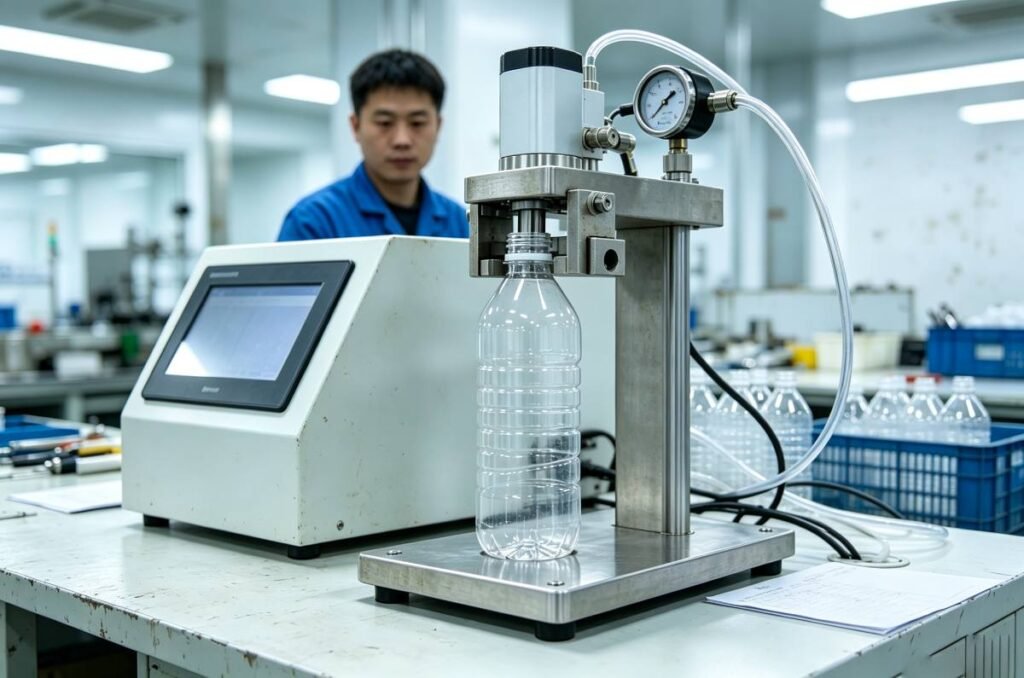
Pressure decay testing is an automated, quantitative leak detection method. The test fixture seals the bottle, injects compressed air to a preset test pressure, then isolates the air supply. The system monitors pressure changes over a fixed hold time. If pressure drops beyond the allowed threshold, the bottle is marked as leaking.
Unlike water bath testing, pressure decay does not require water, so bottles stay dry after inspection, avoiding secondary contamination. It delivers repeatable digital data and is ideal for high-volume production and strict specification requirements. It can catch tiny micro-leaks that bubble tests fail to pick up.
Statistical Sampling for Batch Release
Not every production scenario requires testing every single bottle. Many manufacturers follow statistical sampling plans for batch release, referencing standards such as AQL (Acceptable Quality Level). The buyer and supplier agree on the inspection level, sample size, and maximum allowable defective count before production.
Sampling is a balance between quality risk and production efficiency. It is commonly adopted when the molding process is stable and historical leak rates are extremely low. Important note: sampling approval only means the batch passes statistically; it does not rule out the existence of individual leaking bottles inside the batch.
How to Include Leak Tests in Your QC Agreement
Clear terms in the QC contract prevent disputes over leakage claims. Key clauses you should define:
1. Approved leak test method (water bath vacuum or pressure decay) plus test parameters: vacuum level, test pressure, hold time, acceptance criteria.
2. Whether 100% full inspection or AQL sampling is required, and the corresponding sampling standard.
3. Defect classification: distinguish bottle body leaks from cap assembly leaks.
4. Batch rejection rules: what happens if the sample fails, including re-inspection, sorting, rework, or batch rejection.
5. Record retention: suppliers must save test logs, equipment calibration records and test reports for traceability.
FAQ
Is 100% leak testing standard?
No. 100% leak testing is not a universal industry standard. It depends on your product risk classification. High-risk applications such as liquid pharmaceuticals, agrochemicals, and leak-sensitive liquids often require full inspection. For low-risk, stable commodity packaging, statistical sampling is the common default. 100% testing raises production cycle time and unit cost, so it needs to be specified upfront in your quality agreement.
Can leak issues come from the cap instead of the bottle?
Yes, very often. Many “bottle leaks” actually originate from cap-related issues: poor liner compression, mismatched cap thread dimensions, damaged sealing gaskets, over-torque or under-torque during capping. It is critical to separate bottle-only leak testing from assembled bottle-cap leak testing. Test bare bottles first to confirm whether the defect is on the blow molded body, then test the finished capped assembly to verify the sealing performance of the complete packaging system.
Get Your Wholesale Packaging Bottle Inquiry Solution
Tell us your requirement for capacity, color, logo printing. We will reply you within 24 working hours.