

Introduction
For packaging buyers, especially for cosmetic caps, pharmaceutical CR caps, and daily chemical packaging, factory scale and price are not the most reliable judging standards. Many medium and small factories look large in appearance but outsource all molds, leading to unstable quality, delayed delivery and inconsistent batch tolerance.
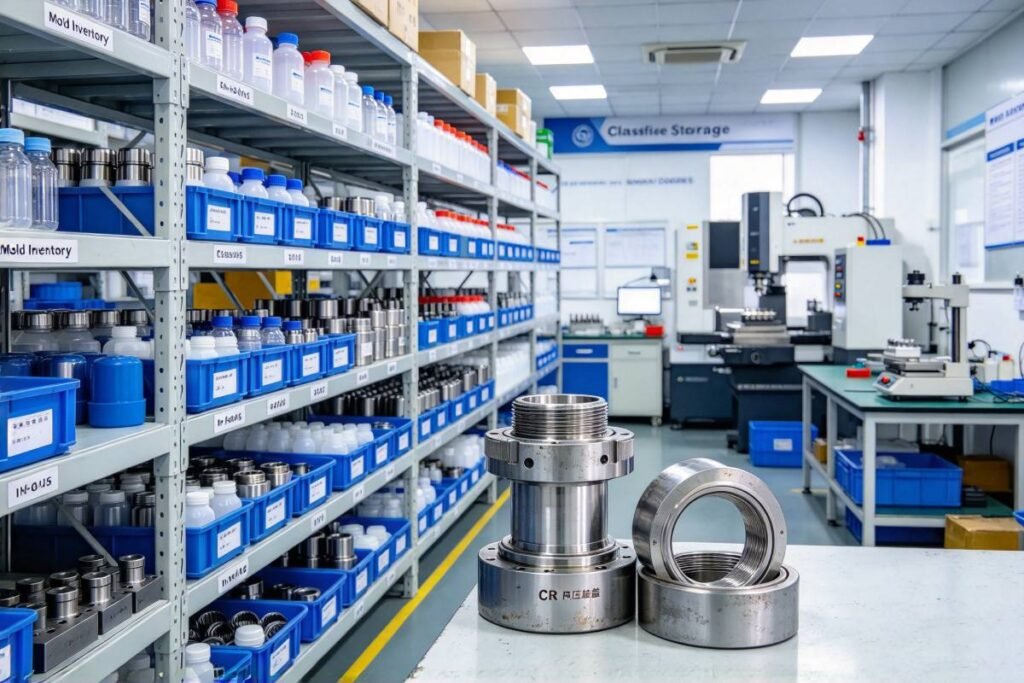
The most authentic hard indicator to identify a reliable packaging supplier is mold inventory and complete mold management system. Mold stock reflects the factory’s accumulation of process, technical strength, risk resistance and customization capability.
This article shares how professional overseas buyers audit packaging factories through mold inventory, and why mold reserve is the core advantage of high-quality packaging manufacturers.
Why Mold Inventory Equals Real Factory Strength
Many buyers misunderstand: factory strength depends on the number of injection machines or workshop area. In fact, injection molding equipment is only production capacity, while molds determine product precision, qualification rate, delivery speed and iteration capability.
All mature packaging factories have one thing in common: they have large self-owned mold inventory instead of temporary open molds for orders.
First, sufficient mold inventory means rich product accumulation. A large number of stock molds represent verified mature structures, stable mold opening data, and polished production processes, which can avoid new mold risks such as shrinkage, deformation, thread mismatch and locking failure.
Second, independent mold resources reflect independent R&D and technical capabilities. Factories that outsource all molds cannot control tolerance, friction matching and structural stability. While manufacturers with in-house mold design, mold making and mold repair can adjust structures in real time according to customer testing feedback.
Third, mold inventory represents delivery stability. Stock molds support direct sampling and mass production without waiting for new mold cycles, greatly shortening lead time and avoiding order delays caused by mold debugging failures.
4 Core Judging Standards: How Buyers Screen Factories Through Mold Inventory
1. Self-owned Mold Quantity & Rich Product Coverage
Reliable packaging factories have complete mold reserves covering mainstream sizes, conventional bottle mouths, and classic cap structures, including flat caps, flip caps, press-turn CR caps, threaded caps and special-shaped packaging caps.
Adequate stock molds mean most conventional customer samples can be provided within 24 hours without re-opening molds.
On the contrary, factories with scarce molds can only open molds according to single orders, which has long cycle, high cost and unstable first-pass yield.
2. Complete Mold Classification & Professional Warehouse Management
Professional mold management is more important than quantity. Many factories pile molds randomly in the corner without labels, anti-rust treatment or maintenance records. Such molds will cause dimensional deviation, burrs and poor friction fit after re-production.
Qualified supplier mold management includes: independent mold warehouse, classified storage by size/structure, complete mold number labeling, anti-rust protection, regular maintenance records, production shot count tracking and inspection logs.
This set of management directly determines the batch consistency of caps and packaging parts, especially critical for CR caps and high-precision cosmetic packaging that need friction testing and safety certification.
3. In-house Mold Development & Modification Capability
High-strength factories do not only stock existing molds, but have independent mold development teams and processing equipment (CNC, EDM, precision testing instruments).
This core advantage solves two major pain points for buyers:
For standard products: optimize mold gaps and tooth structures according to friction test data to ensure stable test passing rate;
For customized products: quickly modify mold details such as thread depth, locking tooth height and surface texture according to customer drawings and certification requirements.
Factories relying on external mold making cannot support rapid iteration and test problem fixing, resulting in repeated sample delays and test failures.
4. Mold Update Iteration & Market Adaptability
Excellent packaging factories will continuously update mold inventory according to market certification updates and customer feedback, such as optimizing CR cap anti-slip structure, upgrading wear-resistant tooth molds, and iterating high-airtight packaging molds.
Static mold inventory only represents past capability; continuous mold iteration represents long-term stable service capability, which can adapt to ISO 8317, ASTM D3475 and other international standard upgrades.
What Risks Can Be Avoided By Choosing A Factory With Strong Mold Reserves?
1. Avoid high new mold cost and long lead time
Mass stock molds support direct mass production, saving mold opening fees and shortening delivery cycle.
2. Avoid unstable batch quality
Mature molds after repeated production and maintenance have stable friction coefficient, uniform tooth position and consistent thread tolerance, effectively preventing slipping, jamming and poor sealing.
3. Avoid test failure and certification risks
Iterated optimized molds have sufficient wear margin and structural safety margin, with extremely high passing rate of friction test, child resistance test and aging test.
Final Takeaway
In the packaging industry, machine quantity determines production speed, while mold inventory and mold management determine product quality and enterprise strength.
For overseas buyers, mold reserve is the most intuitive and credible hard indicator to judge whether a supplier is stable, professional and capable of long-term cooperation.
A factory with complete self-owned mold inventory, standardized mold maintenance and independent R&D iteration can always provide stable quality, fast delivery and test-qualified packaging solutions.
FAQ
Q: Is more mold quantity equal to stronger factory strength?
A: Not exactly. Quantity is the foundation. Standardized mold management, independent modification capability and continuous technical iteration are the core strength. Randomly stacked old molds without maintenance cannot guarantee quality.
Q: Why do CR cap and certified packaging need higher mold management standards?
A: Child-resistant caps and certified packaging rely on precise tooth position, gap and friction structure. Slight mold aging and deviation will directly cause friction test failure, accidental opening or jamming problems.
Q: Can stock molds support personalized customization?
A: Yes. Mature factories can realize micro-adjustment based on stock molds, including surface texture, color matching and local structure optimization, which is faster and lower-cost than full new mold development.
Get Your Wholesale Packaging Bottle Inquiry Solution
Tell us your requirement for capacity, color, logo printing. We will reply you within 24 working hours.