

Introduction
Unknown peaks often appear in GC-MS or LC-MS migration testing for food contact plastic packaging. Many exporters panic immediately, assuming the batch is non-compliant. In reality, an unknown peak is a signal that needs systematic investigation, not an automatic failure.
This article walks you through the standard response workflow, root cause tracing, TTC risk evaluation and how to prepare documents for EU buyers and market surveillance authorities.
First Response to an Unknown Peak
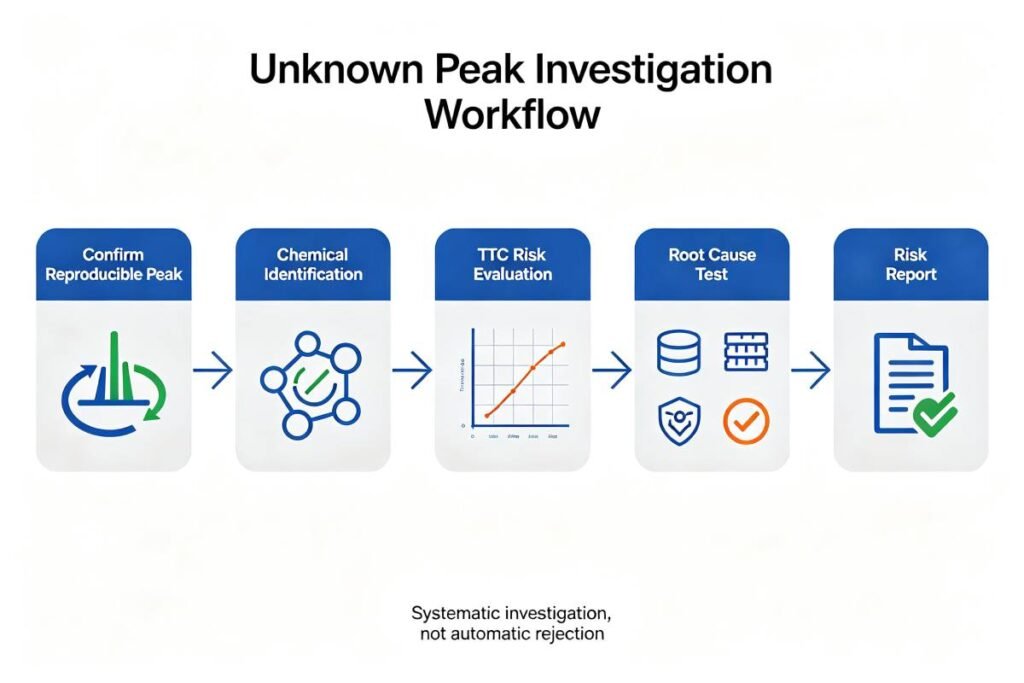
When your lab report flags an unknown peak, the first step is to lock down the sample and test records. Confirm testing conditions match the real food contact scenario: food simulant, temperature, contact duration and surface volume ratio. Request the raw chromatogram, mass spectrum and retention time data from the testing laboratory.
Do not rush to declare failure or scrap the batch. Check for common test artifacts first: contamination from lab consumables, solvent impurities, or background noise. Repeat migration extraction and instrumental analysis to confirm whether the peak is reproducible. A non-reproducible peak is usually an instrument or testing error rather than a packaging hazard.
Identification and TTC Evaluation
If the peak appears consistently in repeated tests, the next stage is substance identification. The lab will match mass spectra against chemical libraries. If exact identification is not possible, the TTC (Threshold of Toxicological Concern) approach is widely accepted under EU food contact guidance for risk screening.
TTC sets safe exposure thresholds for unidentified substances. The measured migration value is compared against the TTC threshold. If migration is below the applicable TTC limit, the substance is considered low-risk. TTC is a screening tool, not a full safety assessment, and regulators may still require further investigation for high-migration unknown peaks.
Root Cause: Resin, Processing, Printing or Seals
Unknown peaks come from four main sources. Raw resin: residual monomers, oligomers, catalyst residues or impurities from plastic pellets. Processing: thermal degradation products generated during blow molding, extrusion or hot filling at high temperatures.
Printing and coatings: ink solvents, photoinitiators and varnish additives can migrate into simulants. Seals and gaskets: adhesive or rubber additives from caps and sealing layers are another frequent source. Isolation testing helps separate these sources: test printed vs unprinted samples, sealed vs unsealed samples, different resin batches.
Documentation for Regulators and Buyers
You need a complete investigation file for buyers or market surveillance inspection. The package should include original test reports, repeat test results, chromatogram data, TTC calculation sheets, root cause analysis, corrective actions and updated batch records.
Explain clearly whether the peak is an artifact, a low-risk oligomer or a migrant requiring control. If corrective actions are taken, record changes in raw material, processing temperature, ink type or sealing formulation. This structured proof shows due diligence and greatly reduces the chance of detention or recall during EU inspection.
FAQ
Does an unknown peak automatically mean non compliant?
No. An unknown peak is only an analytical observation. Compliance depends on migration level and toxicological risk. Many oligomers from PET or PP appear as unknown peaks and are low-risk below TTC. Regulators require risk assessment, not automatic rejection just because the substance cannot be identified.
Can virgin resin produce unknown chromatogram peaks?
Yes. Even pure virgin plastic resin contains low levels of oligomers, residual catalysts and processing by-products. These compounds may show up as unknown peaks in sensitive GC-MS / LC-MS testing. This is normal, as long as migration concentration stays below relevant risk thresholds and no prohibited substances are present.
Get Your Wholesale Packaging Bottle Inquiry Solution
Tell us your requirement for capacity, color, logo printing. We will reply you within 24 working hours.