
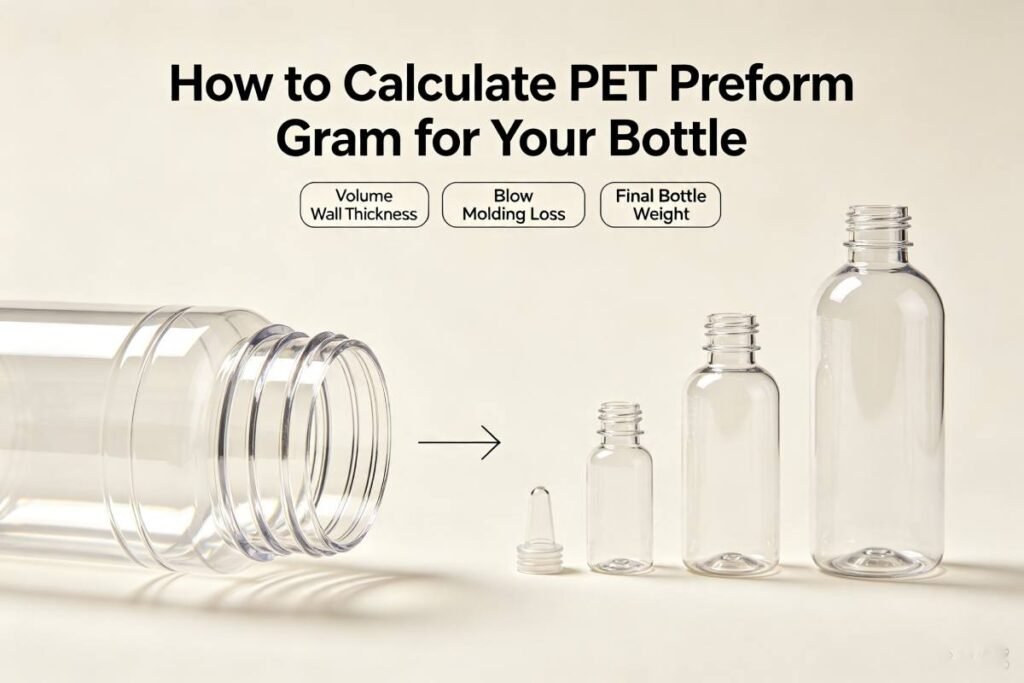
Why preform weight matters before blow‑molding
Every finished PET bottle starts from a PET preform. Many new buyers make one common mistake: selecting a preform only by the bottle’s volume in ml, not by its required wall thickness, shape and application.
If your preform is too light: the blown bottle will have thin, weak walls, easy to dent, leak or fail drop tests.
If your preform is too heavy: you waste raw PET resin, raise your unit cost and reduce your profit margin.
Basic formula: the core calculation rule
Here is the fundamental formula we use in daily packaging projects:
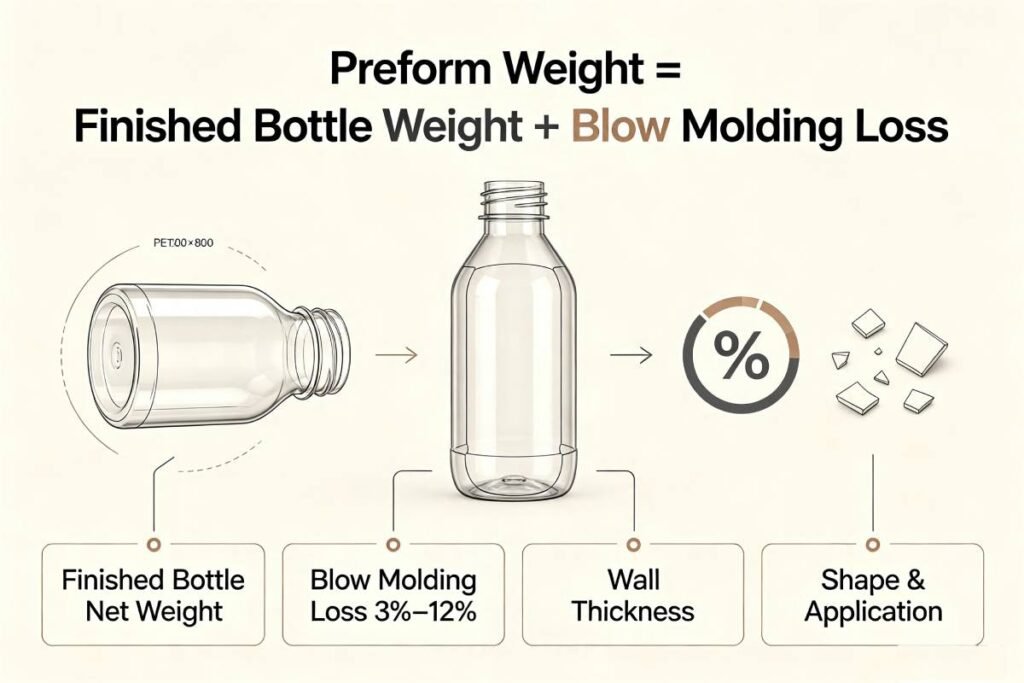
Preform weight (g) ≈ Finished bottle net weight + blow‑molding loss
- Finished bottle net weight: The actual weight of the empty blown bottle, without cap.
- Blow‑molding loss: Small PET waste from trimming, neck scraps, occasional defective parts. Normally 3%‑8% for standard automatic blow‑machines. For small‑batch manual blowing, allow 8%‑12%.
Example:
If your target empty 500 ml bottle needs to weigh 24g after blowing, with 5% production loss:
Required preform weight = 24 × 1.05 = 25.2 g. So a standard 25‑g or 26‑g preform will work.
Volume (ml) is NOT weight — the most common misunderstanding
A 500 ml bottle only tells you how much liquid it can hold. It does NOT tell you how heavy the plastic shell must be.
We can make two completely different 500 ml PET bottles:
- Light‑weight disposable water bottle: empty bottle ~18‑22g → preform ~19‑24g
- Thick‑wall reusable juice / sauce bottle: empty bottle ~30‑36g → preform ~32‑39g
Rule to remember: ml is capacity, gram is plastic material. Never pick preform gram only by bottle volume.
Key factors that decide your required preform gram
When we help customers reverse‑calculate preform weight from their target bottle, we check 5 main factors one by one:
1. Required wall thickness
Thicker walls = more PET material = heavier preform.
- Water bottles: 0.20‑0.28 mm (light weight)
- General food & sauce bottles: 0.30‑0.45 mm (most popular for our clients)
- Heavy‑duty oil / squeeze bottles: above 0.45 mm, for better anti‑ESCR performance against grease
2. Bottle shape
Complicated shapes (deep curves, concave panels, square bodies) need slightly heavier preforms. Sharp corners stretch PET unevenly during blowing; extra material avoids ultra‑thin weak spots on corners.
Round bottles are the most material‑efficient shape.
3. Contents inside the bottle
This is extremely important for food and oil packaging, including animal grease as we discussed with our client Jamie.
- Water, drinks: standard light‑to‑medium wall is okay
- Thick sauce, edible oil, animal fat: better use a heavier preform for thicker bottle walls. Thicker PET slows ESCR (Environmental Stress Cracking Resistance) risk in long‑term hot sea‑container transport.
- Dry powder: can use lighter walls, as no chemical stress from liquid.
4. Expected logistics & handling
Bottles for export will be stacked in pallets and containers, experience high temperature and rough handling.
Export‑oriented bottles usually need 10‑15% more material weight than local domestic lightweight versions.
5. Blow‑molding machine type
High‑speed 2‑stage automatic blowers stretch PET more evenly. Semi‑automatic blowers need extra material allowance.
Share your blow machine model with your preform supplier, and they can fine‑tune the recommended preform weight.
Practical reference table (for quick estimation only)
This is a general reference for round food‑grade bottles for sauce & oil. For custom square or special‑shape bottles, always ask your supplier for professional calculation.
- 250 ml bottle → preform: 18‑24 g
- 500 ml bottle → preform: 25‑34 g
- 750 ml bottle → preform:33‑42 g
- 1000 ml (1L) bottle → preform:40‑52 g
- 1750 ml (59oz) bottle → preform:65‑80 g
Important note: The range is wide. The final gram depends on all the 5 factors listed above.
Common pitfalls to avoid when selecting preform weight
- Copying a competitor’s bottle volume only: Your competitor’s bottle may use thinner walls for domestic sales, which may not work for your export requirements.
- Cutting weight too aggressively to save resin cost: Too‑light preforms lead to high reject rates during blowing and hidden ESCR cracking risk later.
- Ignoring neck finish size: Same volume bottle with different necks (28mm,38mm,45mm,82mm) will have different preform weights. Wider necks mean more plastic on the preform thread section.
How Brotherpack can help you calculate preform weight
You don’t need to do all complex math alone. When you send us your project information, we can recommend the correct preform gram for you.
Just provide:
- Target bottle volume (ml / oz)
- Bottle drawing, photo or sample
- Product to fill inside (water, sauce, animal grease, powder etc.)
- Target empty bottle weight (if you already know it)
- Neck diameter (e.g. 28 mm, 38 mm, 82 mm)
- End market: domestic or sea‑export
With 5000+ existing preform and bottle molds, we can quickly match the best solution instead of starting new mold development from scratch.
FAQ
Q1: Can one preform make bottles of different volumes?
Within a small range yes. A 30‑g preform can be blown into a 450 ml or a 550 ml bottle, but wall thickness will change. Large volume jumps need heavier preforms.
Q2: If my blown bottle is thinner than planned, should I use a heavier preform?
Yes, after you confirm your blow‑machine parameters are correctly set. If machine settings are fine, upgrade to a higher‑gram preform.
Q3: Does resin material grade affect preform weight calculation?
Standard PET resin density is nearly fixed. Food‑grade, high‑intrinsic‑viscosity PET improves strength, but it cannot compensate for insufficient preform gram weight.
Q4: Is heavier always better for oil and animal‑fat bottles?
Not “as heavy as possible”, but “heavy enough”. Over‑heavy is a waste of cost. We calculate a balanced weight for wall strength and ESCR resistance for high‑fat contents.
Get Your Wholesale Packaging Bottle Inquiry Solution
Tell us your requirement for capacity, color, logo printing. We will reply you within 24 working hours.