

Introduction
The global PET preform industry is entering a stable but structurally transformative phase from 2026 to 2031. As the core semi-finished material for all blow-molded PET bottles, PET preforms dominate food, beverage, personal care, and cosmetic packaging worldwide.
For packaging importers, brand owners, and bulk buyers, understanding PET preform market trends is critical for sourcing planning, cost control, recycled material compliance, and supply chain stability.
Based on the latest 2026 authoritative industry forecast data, this article analyzes the full PET preform market overview, growth drivers, challenges, material segmentation, regional demand changes, and future industry opportunities.
Global PET Preform Market Size & Growth Forecast 2026–2031
The global PET preform market maintains steady low-single-digit growth with strong industry resilience.
Official industry statistics show:
2025 Global PET Preform Market Value: USD 23.81 Billion
2026 Estimated Market Size: USD 24.33 Billion
2031 Forecast Market Size: USD 27.08 Billion
Compound Annual Growth Rate (2026–2031): 2.17%
Unlike volatile emerging industries, the PET preform market is a rigid-demand track with stable base volume. The overall market concentration is low, meaning no single enterprise monopolizes the global supply. Small and medium professional preform manufacturers still have huge market space through high-precision molds, stable quality, and EU food-contact compliance capabilities.
Core Growth Drivers Boosting PET Preform Demand
1. Continuous Expansion of Global Bottled & Packaged Food Demand
Bottled water, carbonated drinks, fruit juice, dairy beverages, and condiment packaging are still the largest consumption scenarios for PET preforms.
Emerging markets in Southeast Asia, the Middle East, Africa, and South America maintain strong growth in packaged food penetration. India, Indonesia, and Vietnam show double-digit annual growth in bottled water consumption, steadily supporting basic PET preform market volume.
Even in mature European and American markets, functional beverages, low-sugar health drinks, and portable small-capacity packaging continue to generate new preform demand.
2. EU Sustainability Rules Reshape the Industry Structure
Global recycled content policies are the most important structural driver of the PET preform industry from 2026 to 2031.
The EU PPWR regulation clearly stipulates:
30% recycled PET content for single-use plastic bottles by 2030
65% recycled PET content by 2040
This forces global brand owners and importers to gradually replace virgin PET preforms with food-grade rPET blended preforms.
At the same time, the EU tethered cap regulation (effective July 2024) has triggered large-scale preform neck finish upgrading and mold modification. Nearly 15%–20% of European market preform molds have been iterated, bringing long-term customized preform replacement demand.
3. Ultra-Lightweight Preform Technology Popularization
To reduce packaging costs and meet global plastic reduction policies, ultra-lightweight PET preforms have become a mainstream trend in high-volume filling factories.
Low-viscosity resin matching + precision injection molding technology can effectively reduce single preform weight while ensuring bottle strength and barrier performance. This lightweight upgrade continues to penetrate beverage, sauce, and daily chemical packaging markets, forming incremental demand for new specification preforms.
Main Market Challenges Restricting Profit Margins
1. Volatile PET Raw Material Prices
PET preform costs are highly dependent on PTA and MEG crude oil downstream raw materials. Frequent international energy price fluctuations lead to unstable resin costs, bringing inventory risks and profit pressure to preform manufacturers and bulk purchasers.
Vertically integrated large factories have hedging advantages, while professional customized preform factories rely on stable long-term resin procurement to control costs.
2. Food-Grade rPET Material Supply Shortage
Although recycled content policies are strictly implemented globally, qualified food-grade rPET flakes are in short supply worldwide.
Food-safe recycled PET is 20%–30% more expensive than virgin PET resin, and the output cannot fully meet market demand. This makes pure rPET preforms difficult for large-scale popularization before 2031, and virgin-rPET blended preforms will remain the mainstream solution.
3. Regional Plastic Tax & EPR Cost Pressure
European plastic packaging taxes and EPR (Extended Producer Responsibility) fees continue to rise. Southeast Asian countries are also gradually launching similar environmental tax policies.
Different regional compliance standards increase the administrative cost and delivery threshold for export-oriented preform manufacturers.
PET Preform Market Segmentation: Virgin PET vs rPET
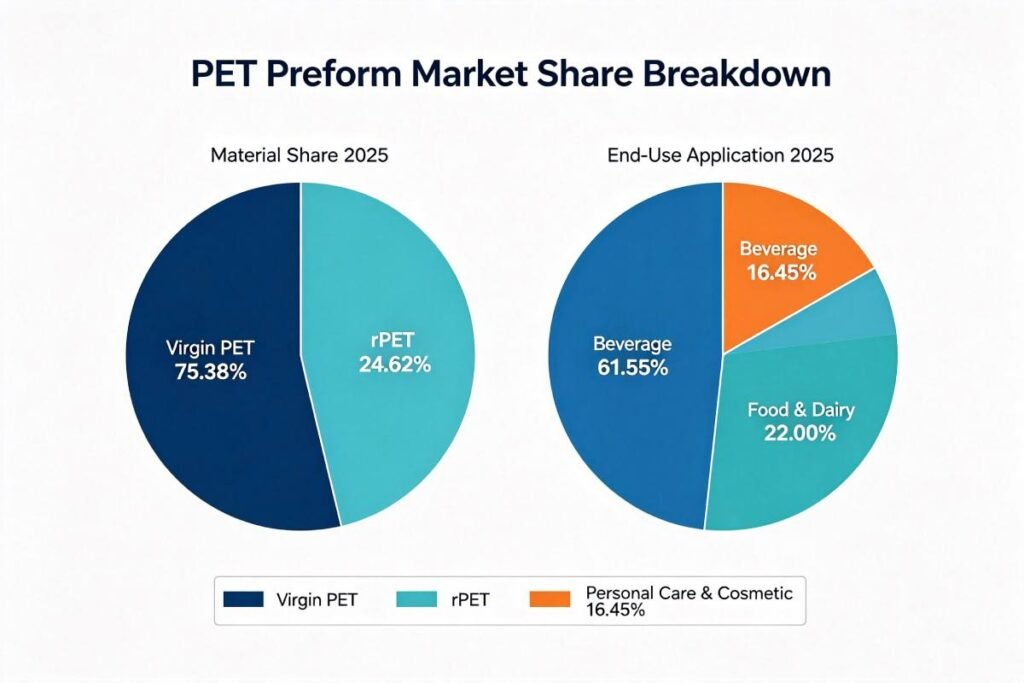
By material type, the PET preform market is divided into virgin PET and recycled PET (rPET):
Virgin PET Preform: Occupies 75.38% of the 2025 market share, absolute mainstream. It has stable viscosity, no impurity risk, and is suitable for carbonated drinks, high-barrier food, and long-shelf-life packaging.
rPET Preform: The fastest-growing segment with a 3.18% CAGR (2026–2031). Driven by EU compliance requirements, it is the core direction of future industry iteration.
Industry practical conclusion:
Before 2031, virgin PET preforms will still dominate the market. rPET will grow rapidly in proportion but cannot replace virgin PET in food-grade high-standard scenarios due to raw material supply and technical limitations.
End-Use Application Market Share Analysis
1. Beverage Packaging (Largest Market, 61.55% Share)
Bottled water and carbonated soft drinks are the largest downstream applications of PET preforms, supporting the basic volume of the entire industry. Standard preforms with stable specifications and mass production are the main demand.
2. Food & Dairy Packaging (Fastest Growing Segment)
With the popularization of aseptic filling technology, more dairy drinks, yogurt drinks, sauces, and condiments are replacing glass and cartons with PET bottles.
Food-grade preforms require stricter safety standards, higher mold precision, and stable food-contact compliance, bringing higher-margin customized order opportunities for professional manufacturers.
3. Personal Care & Cosmetic Packaging
Cosmetic bottles, essential oil bottles, and daily chemical packaging require transparent, high-gloss, and high-appearance preforms. This segment has high customization requirements for colors, weights, and mouth diameters, suitable for small-batch and multi-specification customized production.
Regional Market Trend Analysis (2026–2031)
Asia-Pacific (Largest & Fastest-Growing Region)
APAC accounts for 46.20% of the global PET preform market share, with a 2.78% CAGR from 2026 to 2031, ranking first in global growth.
India, Vietnam, and Indonesia have soaring demand for civilian bottled packaging. China’s first-tier market is saturated, while second and third-tier cities and export processing capacity continue to release growth potential.
European Market
European market volume growth is stable and slow, but compliance thresholds are the highest. Tethered cap preform transformation, rPET mixing rate certification, and food contact dossier compliance are essential entry barriers. European buyers pay more attention to factory qualification and complete compliance documents than low prices.
North American Market
Driven by functional beverages and e-commerce portable packaging demand, the North American market maintains steady growth. California’s upcoming plastic policy will drive a new round of preform specification upgrades.
Middle East, Africa & South America
Benefiting from population growth and improved packaged food penetration, these regions maintain rigid demand growth. Local manufacturing capacity is insufficient, and long-term reliance on imported PET preforms and finished bottles.
Future Industry Opportunities for Preform Manufacturers & Buyers
1. Compliance differentiated competition: Factories that can provide complete EU food contact documents, NIAS risk assessment, and rPET component certification will have lasting competitive advantages in European and American markets.
2. Customized food-grade preform track: Sauce, honey, edible oil, and dairy packaging have high safety thresholds and low industry competition, which is a high-quality profit segment.
3. Stable mixed virgin-rPET solution: Before large-scale popularization of pure rPET preforms, stable proportion blended preforms are the best balance point for buyers to meet policies and control costs.
4. High-precision multi-cavity mold production: Ultra-lightweight preforms and special-shaped bottle preforms have high technical barriers, which can effectively avoid low-price homogeneous competition.
FAQ – PET Preform Market & Sourcing Questions
Q1: Will rPET preforms completely replace virgin PET preforms before 2031?
A: No. Restricted by food-grade recycled raw material supply, cost premium, and technical stability, virgin PET preforms will still be the mainstream before 2031. Most European brands adopt virgin-rPET blended solutions to meet recycling policies.
Q2: What is the biggest trend for PET preform export from 2026 to 2031?
A: The core trend is compliance iteration + lightweight upgrading. Buyers no longer only focus on unit price, but pay more attention to food contact safety documents, recycled component traceability, and stable batch consistency.
Q3: Why do European customers update preform molds frequently?
A: Mainly due to the EU tethered cap regulation and recycled content policy iteration. Old preform neck specifications cannot match the new anti-drop cap structure, so mold upgrading is mandatory for EU market sales.
Get Your Wholesale Packaging Bottle Inquiry Solution
Tell us your requirement for capacity, color, logo printing. We will reply you within 24 working hours.