
Introduction
Even with a qualified mould and approved sample, plastic food jar mass production can bring unexpected defects. For supplement brands and Australian importers, hidden defects often lead to induction sealing failure, leakage, customer complaints, and customs hold-ups.
Many problems are hard to spot at first glance. Some only show up after capping, induction sealing or long sea freight transport.
This article lists the most frequent defects found in HDPE food jars, explains their root causes, and provides a ready-to-use inspection checklist for your QC team before bulk shipment.
You can download our available mold list as below to check in-stock molds and save your tooling cost.
Common Visual & Dimensional Defects
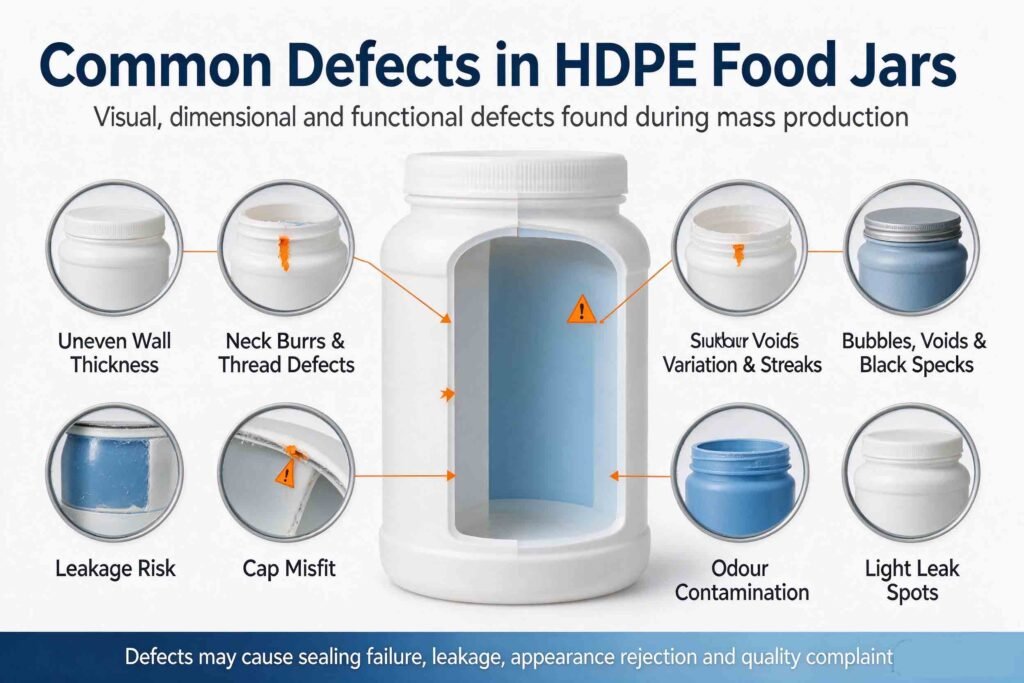
1. Uneven Wall Thickness
This is one of the most frequent blow moulding defects. Some jar sides are thin while others are thick. Thin areas can easily deform under stacking pressure or high humidity, and may cause inconsistent sealing results.
Causes: unstable mould temperature, improper parison control, worn mould parts.
Risk: jar deformation during storage, leak risk, failed induction seal.
2. Neck Finish Damage & Thread Defects
Threads on the jar neck may have burrs, missing threads, scratches, or out-of-tolerance diameters. Even small burrs will stop the cap from screwing down smoothly, and break the contact surface needed for induction foil sealing.
Causes: mould wear, improper trimming, rough post-processing.
Risk: loose caps, poor seal, liner misalignment, leakage.
3. Sink Marks & Dents
Sink marks are shallow indentations on the jar surface, usually formed where material cools unevenly. Dents can also appear after stacking or packaging.
Causes: insufficient material injection, fast cooling, unstable blow pressure.
Risk: poor appearance, unstable stacking, rejected by retail buyers.
4. Bubbles, Voids & Black Specks
Tiny air bubbles inside the plastic wall, empty voids, or black specks scattered on the surface. Black specks usually come from contaminated recycled resin or overheated plastic inside the barrel.
Causes: wet raw material, contaminated resin, overheating, poor machine cleaning.
Risk: food contact compliance concerns, visual rejection, potential weak points on the jar wall.
5. Colour Variation & Streaks
Opaque white or coloured jars show inconsistent colour, streaks, or shade differences between batches or even within the same carton.
Causes: unstable masterbatch mixing, raw material switch, temperature fluctuation.
Risk: inconsistent shelf look, brand rejection, batch non-conformity.
Functional Defects (More Dangerous for Supplement Packaging)
6. Leakage & Poor Induction Seal Compatibility
The jar looks fine visually, but the neck surface is wavy or uneven. When you run induction sealing, the foil cannot fully bond, leading to partial seal or easy peel failure.
Causes: bad neck flatness, mould deflection, dimension out of spec.
Risk: moisture ingress, powder caking, tamper evidence failure.
7. Cap Misfit & Cross-Threading
Caps cannot tighten smoothly, or they cross-thread easily. Sometimes the cap feels tight but there is a hidden gap between cap and jar neck.
Causes: thread pitch error, neck diameter out of tolerance, cap-jar mismatch.
Risk: dust and moisture get inside, failed PS liner seal.
8. Odour Contamination
Some jars carry a strong plastic, burnt or solvent smell. This is often overlooked in quick visual checks.
Causes: overheating resin, poor machine purging, low-grade additives.
Risk: odour transfer into protein powder, herbal supplements, retail returns.
9. Light Leak Spots on Opaque Jars
For opaque HDPE jars, thin spots can create tiny light-transparent pinholes or weak areas. Light will pass through and degrade light-sensitive powder ingredients.
Causes: uneven blow moulding, local thin wall.
Risk: light degradation, potency loss for herbal and vitamin powders.
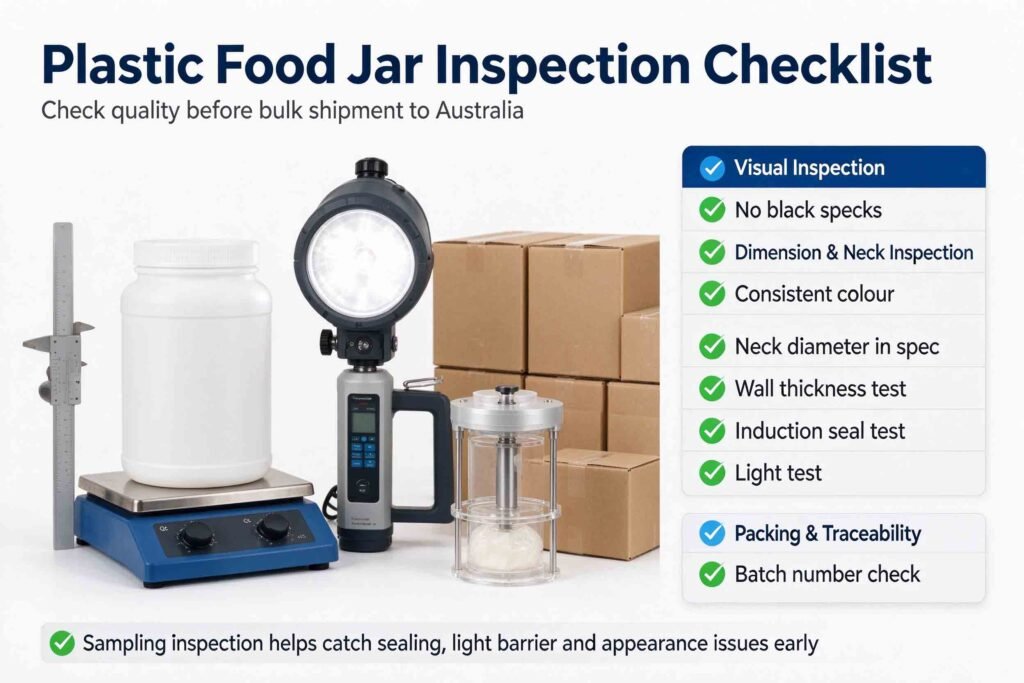
Mass Production Inspection Checklist for Plastic Food Jars
Visual Inspection
✅ No black specks, dirt, scratches, bubbles or cracks
✅ Consistent colour, no streaks or obvious shade difference
✅ No sink marks, dents or deformation
✅ Smooth surface, no sharp burrs especially on the neck
Dimension & Neck Inspection
✅ Neck diameter and thread pitch match drawing specification
✅ Neck sealing surface flat, no warp or wave
✅ Wall thickness checked at multiple positions (top, middle, bottom)
✅ Height and outer diameter within tolerance
Functional Testing
✅ Cap screws on smoothly without cross-threading
✅ Cap tightness test, no loose fit
✅ Induction sealing test: full, continuous foil bond
✅ Light test for opaque jars: zero light penetration
✅ Odour check: no strange plastic or burnt smell
Packing & Batch Traceability
✅ Batch number marked correctly
✅ Carton packaging protects jars from scratching during transit
✅ Defect rate recorded and controlled according to agreed AQL
Why These Defects Matter for Australian Importers
Australia’s Imported Food Inspection Scheme uses risk-based checks. Defective packaging can trigger inspection, cargo hold, and rejection. Even if the powder itself is compliant, bad jars or failed induction seals will create non-compliance issues.
Australian supplement retailers are very strict on sealing consistency, light barrier and appearance. A high defect rate will lead to chargebacks and cancelled repeat orders.
Frequently Asked Questions
Q1: Can minor sink marks be accepted?
It depends on your retail standard. If the sink mark does not affect stacking, sealing and appearance, some brands accept it. But for premium supplement lines, sink marks are usually classified as reject.
Q2: How do we check light leak spots on opaque HDPE jars?
QC can put jars in front of a strong light source. Any thin spot will show light penetration. This is a fast, low-cost test for light-sensitive powder packaging.
Q3: What is the most common reason for induction seal failure in mass production?
Uneven or wavy neck finish is the top cause. The foil liner cannot fully contact the sealing surface, creating gaps and partial seals.
Q4: Should we test every jar before shipment?
100% full inspection is expensive. Most importers use standard AQL sampling inspection for mass shipments, with extra functional tests taken from each production batch.
Get Your Wholesale Packaging Bottle Inquiry Solution
Tell us your requirement for capacity, color, logo printing. We will reply you within 24 working hours.