

Introduction
Most supplement and food brand importers face the same risky dilemma: low sample price, professional sales communication, and fast reply do **not** guarantee stable bulk quality.
Many new suppliers perform perfectly for trial samples but produce inconsistent jars, defective liners, unqualified migration performance, or delayed shipments during mass production.
For Australian, US, and EU food-grade HDPE packaging importers, validating a new supplier before placing bulk orders is the most critical step to avoid customs holds, retail rejection, customer complaints, and huge inventory losses.
This article shares a complete, practical validation checklist specifically for HDPE food jars and supplement packaging suppliers, covering compliance, sample testing, factory capability, quality control, and batch traceability.
You can download our available mold list as below to check in-stock molds and save your tooling cost.
1. Verify Market-Specific Food Contact Compliance Documents
Certification is the first filtering gate, and generic “food grade certificates” are useless for formal import clearance.
You must request documents matched exactly to your product structure, not factory-wide blanket certificates:
– Food contact migration test report for dry powder application
– Material safety declaration for HDPE jar, cap, and liner
– BPA-free statement and heavy metal test results
– EU 10/2011 or FDA 21 CFR compliance letter
– Batch traceability documents linking test reports to production batches
Australian importers especially need to confirm dry food simulant testing. Many failed shipments happen because suppliers provide liquid-food test reports that do not apply to powder supplements.
2. Conduct Full Functional Sample Validation
Never approve bulk production only by visual appearance. You need to simulate real export and storage conditions.
Complete sample validation items for supplement jars:
– Sealing performance: induction seal tightness, no leakage after torsion and compression
– Light barrier consistency: uniform opaque color, no light transmission spots
– Moisture resistance: no deformation or sweating under high-humidity simulation
– Dimension tolerance: neck finish, cap fitting, height and diameter consistency
– Drop and stack test: suitable for sea freight and pallet stacking
Only samples that pass full functional testing can represent bulk quality.
3. Audit Factory Production & Quality Control System
Sample quality can be manually polished, but bulk quality depends on stable factory systems.
Focus on these core factory capabilities:
– ISO 22000 / HACCP food safety management system
– Fixed raw material resin suppliers (no random recycled material mixing)
– In-line inspection process for each production shift
– Strict mould maintenance to avoid uneven wall thickness and defective neck finishes
– Independent QC team for pre-shipment full inspection
A factory without standardized QC will inevitably produce unstable batches, causing liner fitting failure and sealing problems in bulk shipments.
4. Confirm Stable Capacity & Lead Time Reliability
Many packaging factories accept large orders beyond their actual capacity, resulting in delayed delivery and rushed defective goods.
Before bulk placement, confirm:
– Daily stable output of your jar model
– Peak season capacity reservation policy
– Clear lead time agreement for mass production
– Emergency backup production plan
For Australian importers with seasonal retail demand, stable lead time is as important as quality.
5. Validate Batch Consistency & Traceability
Food packaging requires strict batch consistency. Color, wall thickness, liner compatibility, and resin formula must remain unchanged batch by batch.
Ask your new supplier to confirm:
– Fixed masterbatch and pigment formula for opaque jars
– No raw material replacement without prior notification
– Batch number recording and full production traceability
– Defect rate data of previous bulk orders
Uncontrolled batch changes will cause sealing failure, color difference, and migration test inconsistency.
6. Check After-Sales & Defect Handling Mechanism
A reliable supplier must have a clear quality compensation system.
Confirm in advance:
– Defect rate allowance in bulk shipment
– Free replacement policy for unqualified products
– Quick response for customer quality complaints
– Professional technical support for sealing and packaging matching
This protects you from huge losses caused by bulk defective goods.
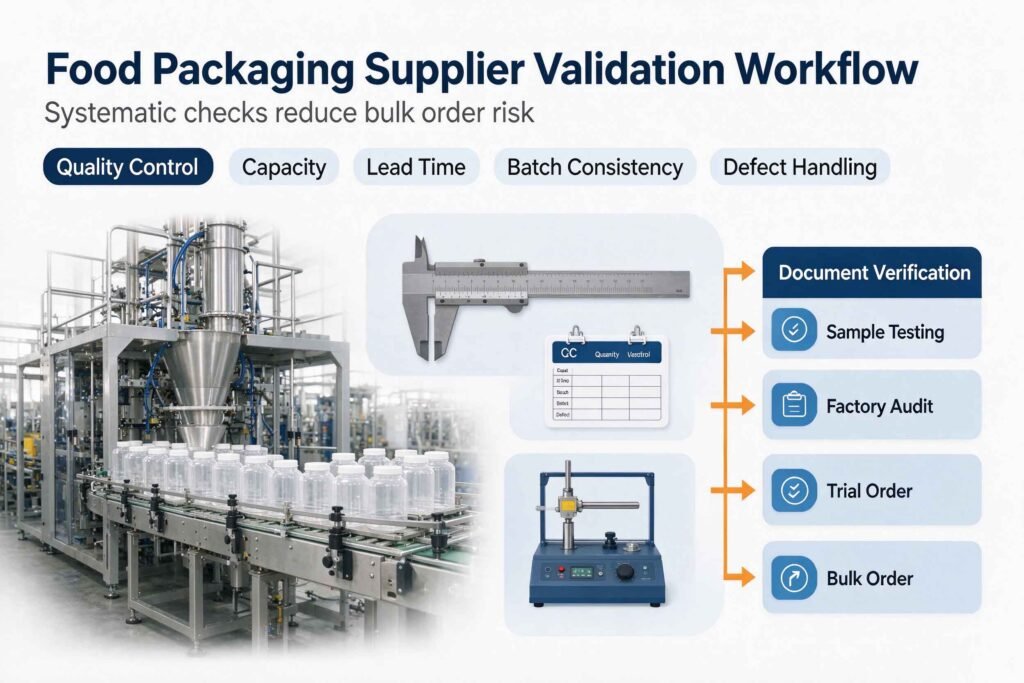
Standard Validation Workflow Before Placing Bulk Order
1. Document verification → screen compliant suppliers
2. Sample functional testing & fitting testing
3. Factory audit and capacity confirmation
4. Small trial order verification
5. Formal bulk order placement
Always follow “sample → trial batch → large bulk” rule for new packaging suppliers.
Frequently Asked Questions
Q1: Can I trust a supplier with only food grade certificates but no migration reports?
No. Food grade certificates only prove resin qualification. Migration test reports prove safe food contact performance under real shipping and storage conditions. Australian customs and retail buyers require migration data.
Q2: How many sample units are enough for validation?
We recommend 20–50 pieces for full fitting, sealing, stacking and humidity testing to simulate real bulk performance.
Q3: Why do new suppliers’ bulk quality differ from samples?
Samples are usually manually selected and inspected. Bulk production relies on machine stability, raw material consistency, and QC management. Only systematic factories maintain consistent bulk quality.
Q4: Is a trial order necessary before large bulk orders?
Yes. A small trial bulk helps you verify batch consistency, packaging, shipping protection, and overall supplier service before scaling to 100K+ large orders.
Get Your Wholesale Packaging Bottle Inquiry Solution
Tell us your requirement for capacity, color, logo printing. We will reply you within 24 working hours.