
Introduction
For brands sourcing plastic jars and bottles for cosmetics, personal care, food supplements or home care products, one of the earliest and most critical decisions is simple: buy ready stock packaging, or invest in fully custom blow moulded containers?
Both options have distinct trade-offs around lead time, minimum order quantity, per-unit cost and regulatory compliance. There is no universal “better” choice — only the right fit for your brand’s order volume, launch timeline, budget and product positioning.
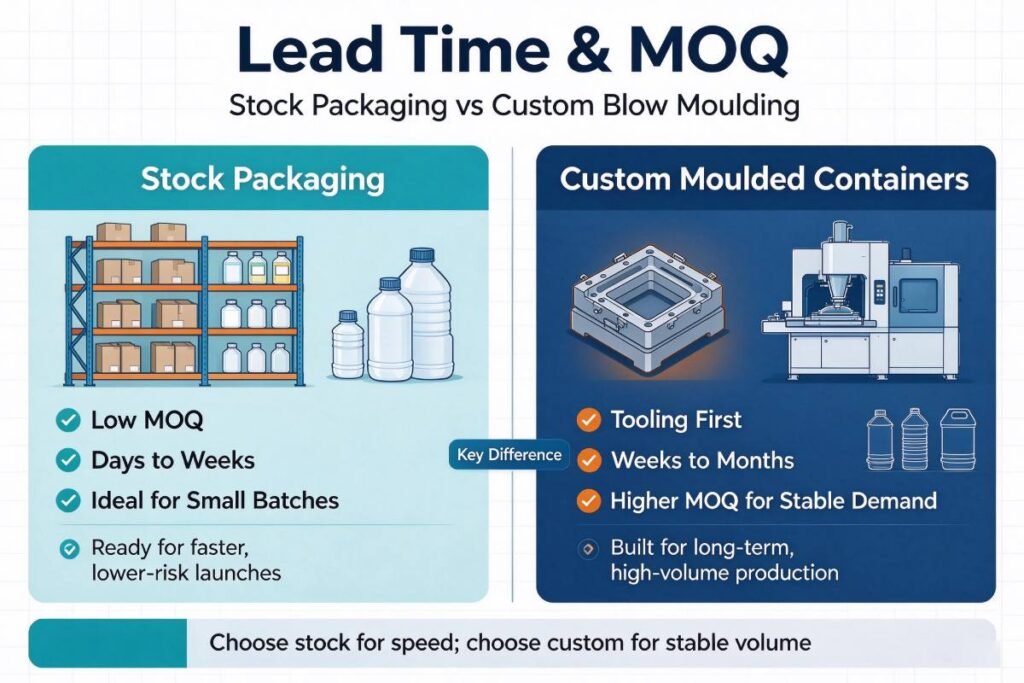
Lead Time and MOQ Differences
Stock packaging is manufactured in advance and warehoused, which is its biggest advantage for fast-moving or small-batch projects.
Stock bottles and jars typically have low MOQs, sometimes starting from a few thousand pieces. Lead times are short: if the item is in stock at your supplier’s warehouse, shipment can be arranged in days or a couple of weeks. This makes stock packaging ideal for new brand testing, limited-edition runs, pilot launches or urgent replenishment orders.
Fully custom blow moulded containers require new mould fabrication first. Tooling development alone can take several weeks, followed by sample approval, trial production and mass manufacturing. The total lead time is often multiple months.
Custom moulding also comes with substantially higher MOQs. The fixed cost of moulds needs to be amortized across production runs, so factories usually require much larger order volumes. This route is only practical when you have stable, long-term demand and can lock in packaging specifications for a long production cycle.
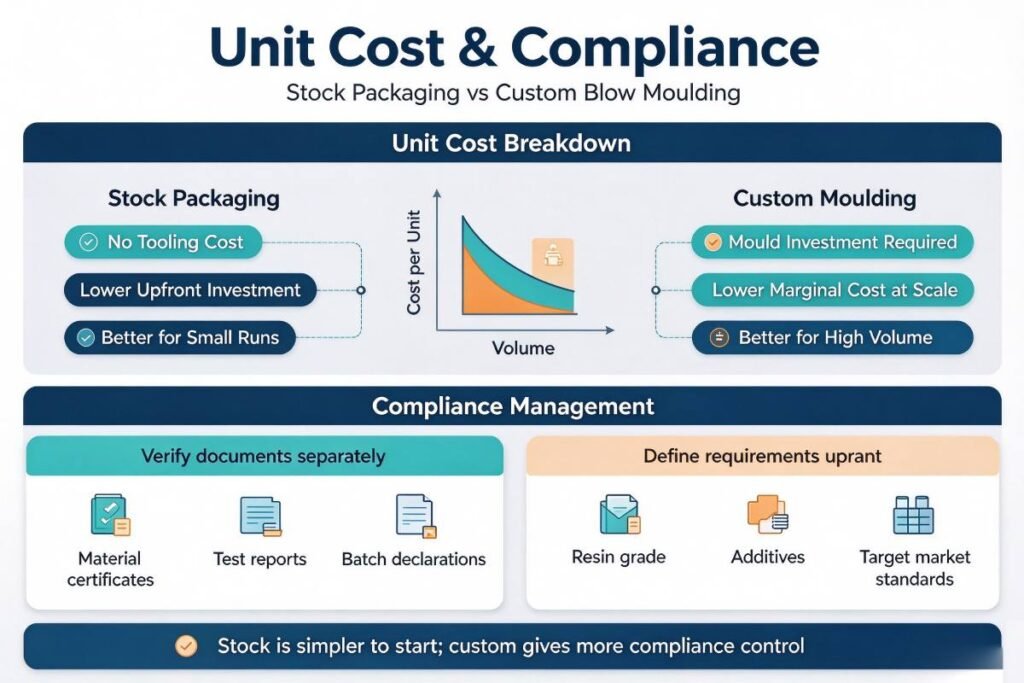
Unit Cost Breakdown
On the surface, stock packaging often looks like the cheaper option — but unit pricing needs to be analysed carefully.
Stock items have no upfront tooling charge. You only pay the per-piece price, plus freight. This low barrier to entry is perfect for brands that cannot absorb separate mould investment.
Custom blow moulding has a large one-time upfront cost for moulds. Once tooling is completed and approved, however, the marginal unit cost for plastic containers can drop considerably for high-volume production.
If your annual order volume is large enough, the per-piece saving over time will offset the initial mould expense. For mass-market brands with consistent SKUs, custom moulding can deliver better long-term unit economics.
One important caveat: custom moulding only reduces unit cost when volumes are high. For small or irregular orders, stock packaging will almost always be more cost-effective.
Compliance Management for Stock Items
A common misconception is that stock packaging automatically meets your target market compliance requirements. This is not guaranteed.
Stock bottles are produced to a general specification. The material, resin grade, additive content and test documentation may or may not fit food contact regulations, cosmetic GMP requirements, or regional standards such as FDA, EU REACH or GCC certification for Middle East markets.
When you select stock packaging, you must verify compliance documents separately: material certificates, test reports and batch declarations. Some stock lines can be certified, but this often adds extra lead time and testing cost.
Custom moulded containers give you greater control over compliance from the start. You specify the exact resin grade, colourants and additives during the mould design stage. The manufacturer can build the product to match your target market’s regulatory requirements from day one, which reduces compliance risk for regulated categories like food, ingestible supplements and sensitive skincare.
That said, custom design does not equal automatic compliance. You still need to define your compliance requirements clearly and confirm testing before mass production.
When Custom Moulding Makes Commercial Sense
Custom blow moulding is a strategic choice rather than a default upgrade. It usually makes commercial sense when one or more of these conditions apply:
1. You have a unique product formula that requires a specific neck size, wall thickness, shape or barrier property that stock bottles cannot match.
2. Brand differentiation is a core priority. A proprietary container shape cannot be copied easily from competitors and supports premium positioning.
3. Your forecasted order volume is high and stable, so the mould cost can be spread across thousands or millions of units.
4. You require consistent, long-term supply with fixed dimensions and no risk of the stock line being discontinued by the supplier.
5. You need specialized functional features: specific stacking geometry, anti-leak structure, custom weight distribution, or compatibility with unique caps, pumps and dispensers.
If your main goals are fast launch, low initial risk and flexible small orders, stock packaging remains the more practical route.
FAQ
Are stock bottles always cheaper?
No. Stock bottles have no mould cost and lower upfront investment, which makes them cheaper for small and medium runs. At very high annual volumes, custom moulded containers can achieve a lower unit price after the mould cost is recovered.
Can stock packaging be modified with custom necks?
In most standard blow mould stock lines, the neck finish is fixed as part of the mould. You cannot easily change the neck size or thread style of an existing stock bottle. Minor customisation such as labelling, silk screen printing or hot stamping is possible, but core structural changes like neck geometry require a new custom mould.
Get Your Wholesale Packaging Bottle Inquiry Solution
Tell us your requirement for capacity, color, logo printing. We will reply you within 24 working hours.