
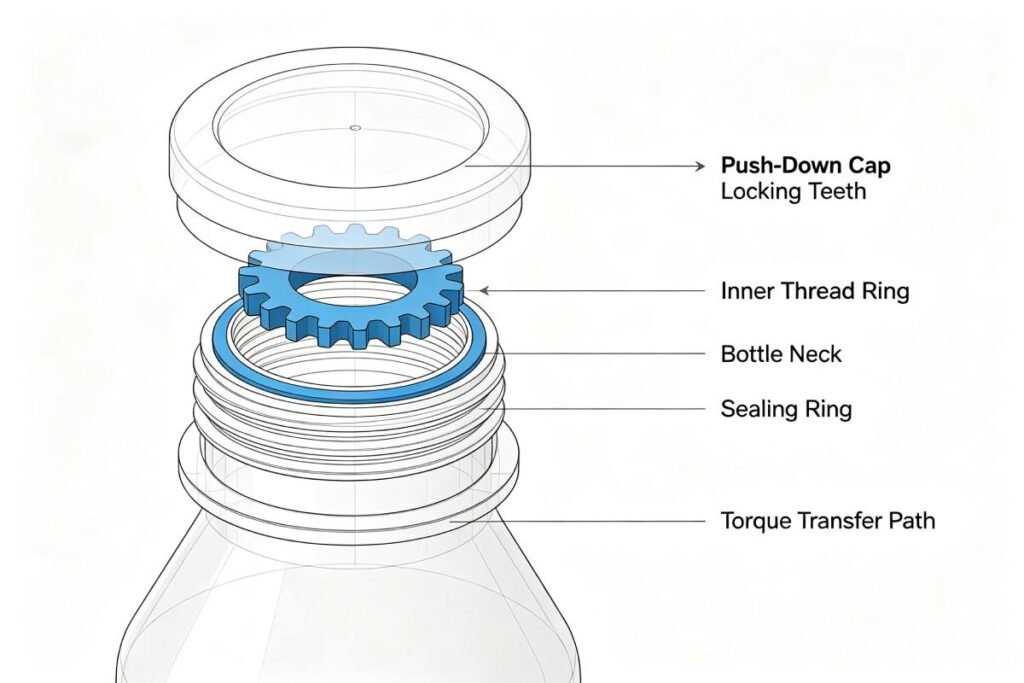

Introduction
Child-resistant caps are widely used for pharmaceuticals, essential oils, chemicals and high-risk consumer packaging. Many suppliers pass lab tests on new samples, yet fail friction and durability tests after mass production, storage and transportation.
This article breaks down typical failure modes and gives actionable design, material and production controls to keep your CR caps compliant.
What Does the CR Cap Friction Test Actually Check?
A lot of manufacturers misunderstand this test as a simple surface abrasion check. It is not only about scratches or appearance.
The friction and durability test simulates repeated pressing, twisting, temperature cycling and long-term storage.
There are two core judging standards. First, children should not be able to open the cap easily within the required time. Second, adults can open it smoothly with proper operation.
The real goal is to verify whether the locking mechanism remains reliable after continuous wear. If the balance between safety and operability is destroyed, the sample will be rejected.
Three Typical Failures: Slip, Accidental Opening and Jamming
1. Press and twist, but the cap slips and cannot unlock
This is the most frequent problem in mass production. The cap clicks down as required, but spins in place without releasing the lock.
The main cause is the rapid drop of friction coefficient on contact surfaces. New teeth and mating surfaces work well at first. After repeated friction, residual release agent, surface coating and minor plastic wear reduce grip.
Thermal expansion mismatch makes this worse. PP caps, PET necks and glass necks expand and shrink differently. When containers stay in high-temperature warehouses, closure torque decays and slipping becomes likely.
2. Locking teeth wear down, leading to accidental opening by children
This is the most dangerous failure. After friction cycling, the locking resistance falls below the safety threshold.
Some designers set a low initial torque deliberately to make opening easier for adults. They leave almost no allowance for wear. Once teeth deform or wear slightly, the cap becomes loosely engaged. It looks fully closed, but it is only a false lock.
Poor fatigue-resistant resin makes this worse. Under repeated pressing and twisting, small cracks, edge chipping and permanent deformation appear on locking teeth.
3. The cap gets stuck and cannot be opened
Opposite to slipping, some caps become too tight after friction. Even adults struggle to twist them open.
Fine plastic debris from friction may collect inside the gap between locking teeth. Burrs and accumulated dimensional tolerance also cause squeezing during rotation.
Gaskets and liners are another hidden source. When the liner softens, deforms or bulges under heat and pressure, it blocks the rotation path and creates jamming.
Practical Solutions to Prevent Friction Test Failure
Select proper resin and control surface treatment
Choose modified PP or modified PE instead of general-purpose plastic for critical locking parts.
Avoid thick glossy coating on mating surfaces. Minimize release agent residue on the mould. Both will accelerate the drop of friction coefficient.
Match materials according to neck types. Separate formulations for glass necks and plastic necks help stabilize torque across temperature changes.
Build wear allowance into the structure
Do not only tune samples to just pass the test when brand new. Reserve around 15%–20% wear margin for locking resistance.
Optimize the press-and-twist locking layout. Design small escape gaps so plastic debris can flow out instead of stacking inside. This greatly reduces the chance of jamming.
Control mould tolerance and consistent closure torque
Batch inconsistency is one of the biggest hidden risks. Keep tight dimensional control for locking teeth and mating parts. Remove flash and burrs before assembly.
Standardise capping torque on the production line. Keep batches stable, so you avoid some caps too loose and others overly tight.
Run pre-simulation ageing and durability tests
Testing only fresh samples is not enough. Add repeated opening cycles and temperature cycling before formal submission.
After ageing and friction cycling, recheck torque, locking force and opening performance. Then run the full child-resistant test following ISO 8317 or ASTM D3475.
Final Takeaway
CR compliance is not a one-time pass for new samples. It requires stable performance after wear, temperature change and long storage.
Most failures come from insufficient wear margin, unsuitable surface treatment, unstable production torque and incomplete pre-testing.
If you combine suitable materials, well-designed locking geometry, strict process control and simulated ageing tests, you can greatly reduce rejection rates and avoid costly mass production rework.
FAQ
Q: Is the friction test the same as abrasion test?
A: No. Abrasion mainly checks surface scratch resistance. The CR friction test focuses on whether the safety locking function remains effective after repeated use and environmental exposure.
Q: Can we fix slipping just by increasing initial torque?
A: Not reliably. Higher torque may make it safer at first, but it raises the risk of jamming and makes opening difficult for adults. Material and friction coefficient control is more important.
Q: Which standards apply for CR caps?
A: ISO 8317 is widely accepted in Europe. ASTM D3475 is commonly used for the US market. Customers may also require extra ageing and migration tests for food, pharmaceutical or essential oil packaging.
Get Your Wholesale Packaging Bottle Inquiry Solution
Tell us your requirement for capacity, color, logo printing. We will reply you within 24 working hours.