

Introduction
Many food and beverage brands spend 90% of their packaging budget on the bottle — shape, clarity, feel — and treat the cap as an afterthought. But the cap is the true gatekeeper of your product. A leaking drink, a caked powder, a moldy jam, or a bloated hot-fill juice bottle is usually a cap problem, not a bottle problem.
In this guide, we break down everything you need to know about food grade plastic caps: what “food grade” really means, which cap type fits which product, how filling temperature dictates your cap material, and the barrier functions (leak-proof, moisture barrier, light barrier, tamper-evident) that protect your shelf life.
What Does “Food Grade” Really Mean for Plastic Caps?
Not every plastic cap is safe for food contact. A food grade plastic cap must meet three hard requirements:
- Food-contact compliant resin — the cap material must comply with FDA 21 CFR (US), EU 10/2011 (Europe), and LFGB (Germany).
- No migration — within the shelf life, the cap must not release plasticizers, heavy metals, or off-flavors into the food.
- Clean manufacturing — injection molding and capping must happen in a dust- and oil-controlled environment, and caps must be packaged and sealed to stay clean.
The two most common resins for food grade caps are:
- PP (Polypropylene) — heat resistant up to ~120°C, rigid, easy to mold flip-top, CRC and tamper-evident structures. Preferred for hot-fill and high-heat processes.
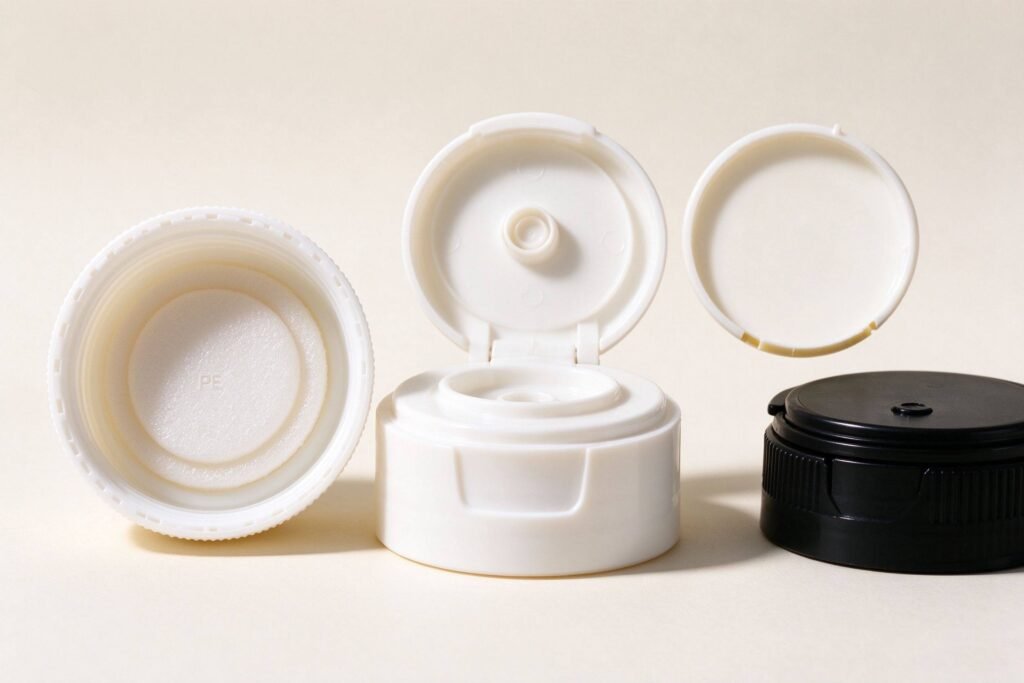
- PE / HDPE (High-Density Polyethylene) — flexible, elastic, excellent sealing contact. Used for beverage caps, milk caps, and snap-on lids.
- LDPE (Low-Density Polyethylene) — soft and springy, commonly used as inner liners, gaskets, and dropper bulb tops.
Common mistake: a food-safe bottle does not automatically mean a food-safe cap. Cheap caps made from recycled resin may look identical, but they smell of plastic and will taint the product. Always ask the cap supplier for the food-contact declaration separately.
Food Grade Plastic Caps by Application
1. Beverages (Water, Tea, Juice, Carbonated Drinks)
- Still water — standard tamper-evident screw cap; the breakaway ring proves the bottle has not been opened.
- Carbonated drinks — screw cap with a sealing liner that can hold internal CO₂ pressure, otherwise you get leaks and bursts.
- Hot-fill tea / juice (85–92°C) — must use a heat-resistant PP cap paired with heat-set PET bottles.
- Sports & kids’ drinks — sports sip cap (sports cap / sip cap) for one-handed, splash-free drinking.
2. Sauces, Honey, Jam, Ketchup
The key requirements are leak-proof and easy to squeeze or pour:
- Honey and thick sauces go on squeeze bottles with flip-top or pointed nozzle caps.
- Wide-mouth jam jars use a tamper-evident screw cap plus induction liner, giving the classic “pop” opening sound.
- Salad dressing and ketchup use inverted squeeze bottles with a pointed nozzle screw cap.
3. Powdered Foods (Milk Powder, Protein Powder, Seasoning)
Key requirements: moisture-proof, anti-caking, easy dosing.
- An aluminum foil induction liner is a must — once the cap is screwed on, induction sealing makes the jar airtight until first opening.
- Add an inner dust lid (flapper lid) so powder is sealed again immediately after use.
- Premium milk powder jars use a scoop cap with the measuring scoop clipped inside the lid.
4. Edible Oil, Olive Oil, Liquid Condiments
- Anti-drip pourer spout stops oil from running down the bottle neck.
- Premium olive oil bottles pair a flip-top aluminum lid with a tamper-evident ring.
- Bulk cooking oil jerrycans use a flip-top with an integrated handle.
5. Supplements & Nutraceuticals (Gummies, Tablets, Powders)
- Tablets and gummies require a child-resistant cap (CRC) — press-down-and-turn to open.
- Always pair with a tamper-evident ring so consumers can confirm the bottle is factory-sealed.
6. Ready-to-Eat & Foodservice Sauce Cups
10–30g takeaway sauce cups use heat-seal aluminum foil + PP screw cap to survive delivery without leaking.
Match the Cap to Your Filling Temperature
The cap must withstand at least the filling temperature. If it does not, the cap deforms, the seal fails, and you get leaking or bloated bottles — one of the most overlooked reasons for product returns.
| Filling process | Temperature | Recommended cap | Matching bottle |
|---|---|---|---|
| Cold fill (carbonated, water) | ≤ 4°C or ambient | PE / PP cap | Standard PET |
| Ambient fill (juice, tea) | RT – 40°C | PE / PP cap | Standard PET |
| Hot fill | 85 – 92°C | Heat-resistant PP cap | Heat-set PET |
| Pasteurization / retort | 100 – 120°C | PP heat-resistant cap | PP bottle / glass |
A quick warning: a standard PET cap softens at 85°C hot-fill, the sealing gasket loses pressure, and the whole bottle leaks. Hot-fill lines must upgrade both bottle and cap to the heat-resistant package.
Protecting Food Safety & Shelf Life: 6 Barrier Functions
1. Leak-Proof
Liquid products must pass drop tests and inversion tests. Relying on threads alone is not enough — there must be a silicone or PE sealing liner inside the cap.
2. Moisture Barrier
Powders and dry goods (milk powder, coffee, nuts) are ruined by humidity. Use an aluminum foil induction liner and choose HDPE / PP resins with low WVTR (water vapor transmission rate).
3. Light Protection
Olive oil, fish oil, tea, and vitamins oxidize under light. Pair amber or dark green bottles with dark caps (black / brown) or aluminum foil liners — never let UV light sneak in through a clear cap.
4. Oxygen Barrier
Juice, beer, and coffee powder go stale on oxygen. Premium packages add an EVOH barrier layer or aluminum foil composite liner inside the cap.
5. Tamper-Evident
Food is personal. Consumers expect proof that nobody opened the package before them. A tamper-evident ring + induction liner is the industry standard.
6. Compliance Certifications (What Overseas Buyers Will Ask For)
- FDA 21 CFR declaration (US market)
- EU 10/2011 food contact compliance (Europe)
- LFGB (German market, non-negotiable)
- BPA-Free / Phthalate-Free statements
Common Food Grade Cap Types at a Glance
| Cap type | Typical products | Core benefit |
|---|---|---|
| Tamper-evident screw cap | Water, beverages, sauces | Visible proof of first opening |
| Flip-top cap | Squeeze sauces, honey, condiments | One-handed open and close |
| Sports / sip cap | Sports drinks, kids’ water | Splash-free, on-the-go |
| Nozzle / dropper cap | Flavor extracts, salad dressing | Precise dosing |
| Shaker cap | Spices, seasoning, protein powder | Even powder pour |
| Child-resistant cap (CRC) | Supplements, medicated food | Prevents accidental child opening |
| Scoop / measuring cap | Milk powder, protein powder | Built-in dose control |
| Pourer spout cap | Edible oil, olive oil | Anti-drip pouring |
| Induction liner | Powders, sauces, liquids | Moisture / oxygen / tamper barrier |
5 Quick Tips for Buyers & Brand Owners
- Choose bottle and cap together — thread finish, heat resistance, and sealing method must match.
- Start from filling temperature — never put a standard PE cap on a hot-fill line.
- Powdered products must have an induction liner — it is the baseline of shelf life.
- Ask for certifications before sampling — FDA, EU 10/2011, LFGB. Missing one can hold up customs.
- Test real samples — water inversion for 24 hours, drop test, oven heat test. It beats any PPT.
Frequently Asked Questions
What is the difference between food grade and regular plastic caps?
Food grade caps are made from virgin resins approved under FDA 21 CFR and EU 10/2011, produced in a clean environment, and come with a food-contact declaration. Regular caps often use recycled or industrial-grade resin and are not safe for direct food contact.
Which plastic is best for hot-fill beverages?
For 85–92°C hot-fill tea and juice, use a polypropylene (PP) cap paired with a heat-set PET bottle. Standard PE or PET caps will deform and leak.
Do powder supplements really need an induction liner?
Yes. Without an aluminum foil induction liner, humidity and oxygen will cause caking, flavor loss, and a much shorter shelf life. It is the single most cost-effective seal for powder jars.
Are black plastic caps safe for food?
Yes, as long as the resin itself is food grade. Black caps are often preferred for light-sensitive products like olive oil, fish oil, and vitamins because they block UV light.
What certifications should I ask for when importing food caps?
Request the FDA 21 CFR declaration for the US, EU 10/2011 for Europe, LFGB for Germany, and a BPA-Free / Phthalate-Free statement. Your supplier should provide these on their letterhead.
Final Thoughts
A cap is only a few grams of plastic, but it decides how long your product stays fresh on the shelf, whether it reaches the consumer intact, and whether your brand gets a complaint about leaks or spoilage. Choosing the right food grade cap is the cheapest and most important insurance you can buy for your product.
Get Your Wholesale Packaging Bottle Inquiry Solution
Tell us your requirement for capacity, color, logo printing. We will reply you within 24 working hours.