
Introduction
When sourcing squeeze bottles for condiments, sauces, edible oils, and animal grease, brand owners and food manufacturers always face one core question: PET or HDPE?
These two are the most common food-grade plastic materials for squeeze packaging, but their physical properties, chemical resistance, shelf-life performance, and retail presentation differ drastically. Many clients simply choose based on appearance or sample testing, ignoring long-term hidden risks like environmental stress cracking (ESCR) during ocean shipping and long-term storage.
In this complete guide, we break down every key difference between PET and HDPE squeeze bottles with real application cases, helping you make a risk-free, cost-effective, and market-oriented material selection.
Visual Appearance & Retail Marketing Performance
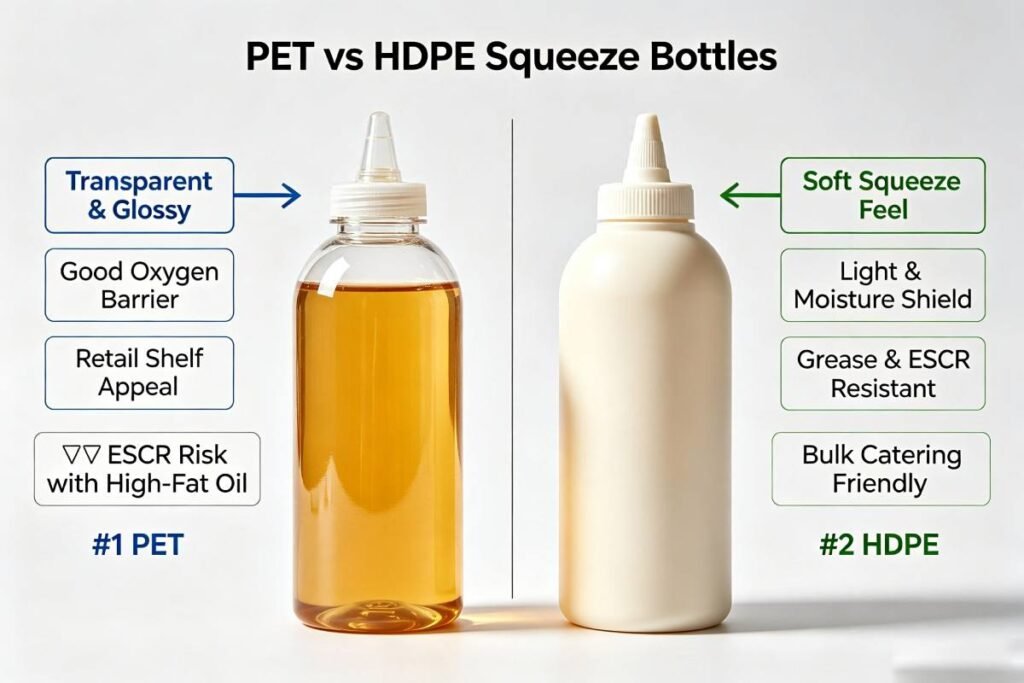
PET is famous for its high transparency and glossy finish. It fully displays the color, texture, and particle details of internal products such as golden edible oil, colored sauces, and fruit condiments.
The premium crystal‑clear look greatly enhances retail shelf appeal, boosts product grade, and attracts end consumers’ purchase intention. It is the top choice for retail‑oriented consumer packaging.
HDPE is naturally opaque or milky white with a matte surface. It cannot achieve full transparency, so customers cannot see the state of the internal sauce or grease.
Its low‑key, industrial‑style appearance is less competitive in retail supermarkets, making it more suitable for catering bulk packaging, industrial wholesale, and economical private‑label products.
Core Takeaway: Choose PET for retail sales; choose HDPE for bulk catering and industrial packaging.
Squeeze Handfeel & Structural Durability
A common market misconception: Only HDPE can be used for squeeze bottles. This is not true. Both materials can be made into squeeze bottles, but with totally different handfeel.
PET Squeeze Bottle
‑ Hard and elastic texture with fast rebound performance
‑ Designed with precise wall thickness for controllable squeezing
‑ Will not permanently collapse after extrusion
‑ Firm structure, stable shape after long‑term use
HDPE Squeeze Bottle
‑ Inherently soft and flexible, super easy to squeeze
‑ Excellent buffer performance
‑ Disadvantage: Thin‑walled HDPE bottles are prone to permanent deformation and poor rebound after repeated squeezing or extrusion
Core Takeaway: PET offers precise, stable squeeze experience for daily retail use; HDPE provides ultra‑soft squeeze for frequent bulk catering use.
Barrier Performance (Oxygen & Moisture Resistance)
Barrier property directly determines the shelf life of food contents, especially for oxidation‑sensitive sauces and oils.
PET Advantage
PET has excellent oxygen barrier performance. It effectively blocks external oxygen penetration, slowing down the oxidation, discoloration, and deterioration of colored sauces, tomato sauces, and fruit‑based condiments.
PET Disadvantage
PET cannot block ultraviolet light. Products sensitive to light oxidation will still degrade under long‑term light exposure.
HDPE Advantage
HDPE features superior water vapor barrier and natural light‑shielding properties. It perfectly protects light‑sensitive formulas, spice‑containing sauces, and essential oil‑based products.
HDPE Disadvantage
HDPE has mediocre oxygen barrier capacity. Long‑term storage will lead to slow oxidation of water‑based sauces, limiting the long shelf‑life effect.
Core Takeaway: PET = anti‑oxidation for colored retail sauces; HDPE = moisture & light protection for spiced, oily formulas.
Chemical Compatibility & ESCR Risk (Critical Real Case)
This is the most practical and overlooked difference for oil and grease packaging, verified by our real client case.
Key Definition: ESCR (Environmental Stress Cracking)
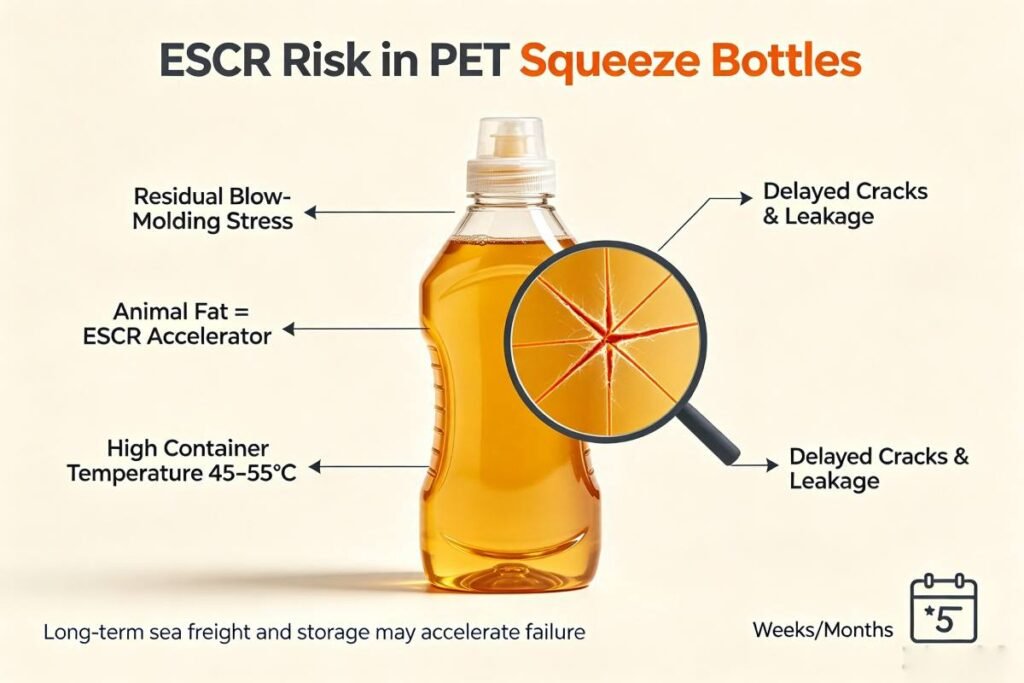
Blow‑molded plastic bottles inevitably retain tiny invisible residual tensile stress during production. Specific chemical contents will penetrate these micro‑stress points and expand cracks gradually, which is defined as Environmental Stress Cracking. This failure is delayed and latent, not visible in short‑term sample tests.
Real Client Case: Jamie’s Animal Grease Packaging
Client Jamie customized PET squeeze bottles for animal grease, with a filling temperature of 40°C.
We confirm: 40°C filling temperature is completely safe for PET, no thermal deformation risk.
However, the hidden risk does not come from temperature, but from the animal grease itself:
Animal fat contains high saturated fatty acids, which are typical ESCR accelerators. Combined with high temperature inside ocean containers (45°C–55°C during shipping), the residual blow molding stress of PET will be continuously stimulated. After 2–8 weeks of transportation and warehousing, the bottle wall will slowly produce fine cracks and cause leakage.
Material Compatibility Comparison
PET
‑ Suitable for: Water‑based sauces, vinegar sauces, cold‑filled colored condiments
‑ Risky for: High‑fat animal grease, strong essential oil, high‑concentration spicy resin, long‑term high‑temperature shipping
HDPE
‑ Excellent chemical resistance to weak acid, weak alkali, high salt, and various grease formulas
‑ Almost no residual tensile stress, zero ESCR risk for oily and spicy products
‑ The safest choice for animal grease, chili oil, and essential oil packaging
Core Takeaway: PET can hold grease for short‑term distribution, but HDPE is the stable, risk‑free solution for long‑term animal grease packaging and sea freight.
Temperature Resistance & Filling Requirements
PET Squeeze Bottle
‑ Suitable only for cold filling (≤60°C‑70°C)
‑ High‑temperature filling will cause bottle shrinkage, deformation, and structural instability
HDPE Squeeze Bottle
‑ Higher temperature tolerance than PET
‑ Supports short‑time medium‑temperature filling
‑ More adaptable to diverse food production lines
Drop Resistance & Logistics Performance
‑ PET: Hard texture, easy to crack when severely impacted; suitable for standard gentle logistics
‑ HDPE: Flexible and shock‑absorbent, deforms instead of cracking; perfect for rough transportation, cross‑border sea freight, and repeated catering turnover
Cost & Supply Reality (Why Clients Choose PET Over HDPE)
Many customers wonder: Why do some brands choose risky PET for grease instead of safer HDPE? The reason is comprehensive commercial factors, not raw material price:
- Visual sales demand: Refined animal grease has a premium golden transparent appearance. HDPE’s opaque design kills retail sales appeal, while PET’s transparency improves product premium and conversion rate.
- Finished bottle cost balance: Although HDPE raw material is slightly cheaper, HDPE squeeze bottles require thicker walls to ensure squeeze performance, increasing total material weight. The final finished price is not lower than PET.
- Mold & supply maturity: PET bottle embryo production is highly standardized with low MOQ and fast delivery; customized HDPE extrusion blow molding has higher mold costs and higher starting order quantity.
- Global recycling preference: PET (#1 recycling code) has a more complete global recycling system and meets EU and Western market ESG packaging requirements.
- Latent risk misunderstanding: ESCR cracking is delayed and does not appear in short‑term sample tests. Most clients only verify appearance and initial stability, ignoring long‑term shipping and storage risks.
Final Selection Guide: PET VS HDPE
Choose PET Squeeze Bottles If:
- For supermarket retail sales
- Need transparent display of sauce/oil color and texture
- Cold filling production process
- Mainly pack water‑based, colored condiments
- Pursue high‑end shelf appearance and brand premium
Choose HDPE Squeeze Bottles If:
- For catering bulk packaging or industrial wholesale
- Pack animal grease, chili oil, essential oil, and high‑fat formulas
- Products sensitive to light and moisture
- Long‑term cross‑border sea freight and overseas warehousing
- Require zero cracking risk and ultra‑stable long‑term storage
FAQ
1. Can PET squeeze bottles be used for squeezing?
Yes. This is a widespread misunderstanding. PET squeeze bottles are professionally designed with optimized wall thickness to achieve stable extrusion and fast rebound, ideal for retail daily use.
2. Is 40°C grease filling safe for PET bottles?
Absolutely safe. PET will not deform or be damaged at 40°C. The potential risk is ESCR cracking caused by long‑term contact with animal grease plus high‑temperature sea freight, not filling temperature.
3. Why do animal grease PET bottles crack after sea shipping?
It is caused by ESCR (Environmental Stress Cracking). High saturated fatty acids in animal grease stimulate residual blow molding stress of PET, and high container temperature accelerates crack growth, resulting in delayed leakage failure.
4. Which material is better for long shelf‑life oil packaging?
HDPE is the best choice for long‑term storage of animal grease and oily sauces. It avoids ESCR risks and provides better light and moisture barrier protection.
5. Is HDPE cheaper than PET for squeeze bottles?
Not necessarily. HDPE raw material is slightly cheaper, but thicker wall requirements increase finished bottle weight and cost. Standard PET squeeze bottles are more cost‑effective for retail orders.
6. Are these two bottles FDA food‑grade compliant?
Both our PET and HDPE squeeze bottles pass FDA and EU 10/2011 food contact standards, safe for packing sauces, edible oil, and food‑grade grease.
Get Your Wholesale Packaging Bottle Inquiry Solution
Tell us your requirement for capacity, color, logo printing. We will reply you within 24 working hours.