
Introduction
Leaking plastic bottle caps are a frequent headache for packaging buyers and manufacturers. Even a tiny cap defect can trigger liquid leakage, resulting in product spoilage, customer complaints and extra rework costs. In this session, we mainly focus on key injection molding defects behind bottle‑cap leakage. We will walk through typical molding failures, analyze their root causes from production processes, and share actionable quality‑control advice to help you avoid packaging‑leak troubles in real‑world orders.
Why the Cap Matters
- Let’s start with the basics. A plastic bottle cap looks simple, but it has a very important job. It has to fit the bottle finish correctly, seal tightly, and stay closed during transport and use.
- When a cap fails to seal properly, liquid can escape. That’s what we call leakage. Leakage can happen slowly, through microscopic gaps in the seal, or it can happen more obviously if the cap is damaged, crooked, or the wrong size.
- In many cases, the root cause is related to how the cap was made. That’s why injection molding quality is so important for cap performance.
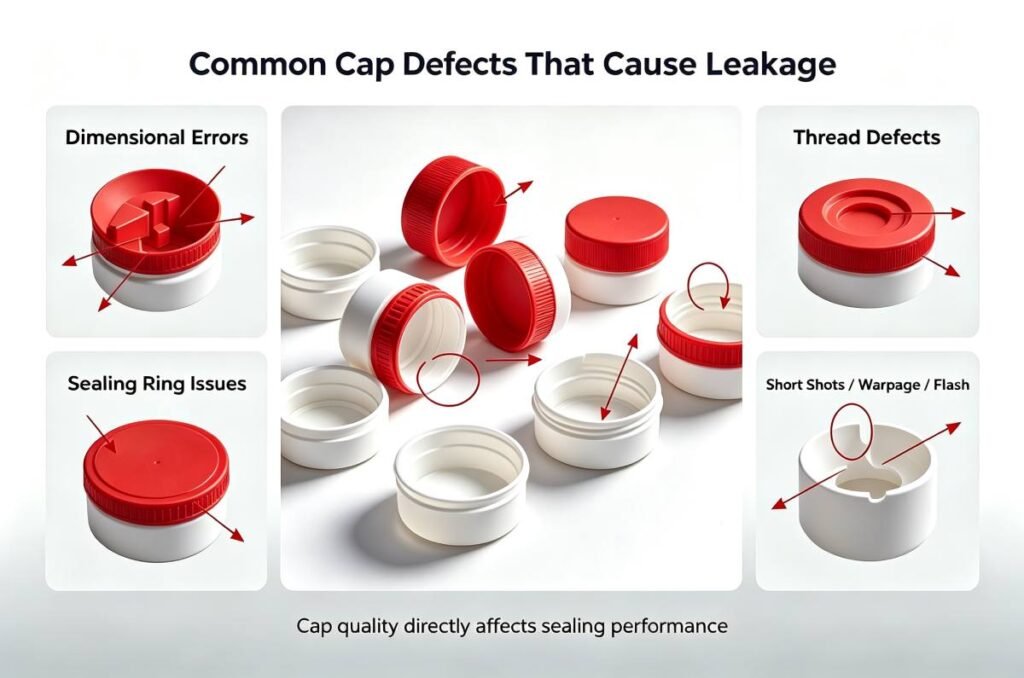
Common Cap Defects That Cause Leakage
There are several defects that can make a bottle cap leak. Let’s go through some of the most common ones.
Defect Number One: Dimensional Errors
Dimensional errors are one of the most common reasons for leakage. If the cap’s inner diameter is too large, it may not fit tightly on the bottle. If it’s too small, it might be hard to screw on, but it could also create too much stress and crack later.
The thread size is especially important. The cap and the bottle finish must match very closely. Even a small difference in diameter, pitch, or thread shape can prevent the cap from sealing properly.
Defect Number Two: Poor Thread Quality
Threads are what hold the cap onto the bottle. If the threads are incomplete, deformed, scratched, or uneven, the cap may not lock into place correctly.
For example, if part of the thread is missing or flattened, the cap might stop turning before it reaches the fully closed position. That leaves a small gap between the cap and the bottle, which can allow liquid to leak out.
Defect Number Three: Sealing Ring Defects
Many bottle caps have a sealing ring or inner sealing feature. This part is designed to press against the bottle and create a tight seal.
If the sealing ring is damaged, too thin, too short, or not formed properly, it may not make enough contact with the bottle. When that happens, pressure changes inside the bottle can push liquid through the gap.
Defect Number Four: Short Shots or Incomplete Molding
A short shot happens when the molten plastic doesn’t completely fill the mold cavity. When that occurs, the cap may be incomplete, especially in critical areas like the sealing ring or thread region.
Caps with short shots often look obviously defective, but sometimes the defect is subtle. Even a small unfilled section can compromise the seal and lead to leakage.
Defect Number Five: Warpage or Deformation
Plastic caps can also become warped or deformed if cooling is not controlled properly. If the cap cools too quickly or unevenly, it may twist, bend, or change shape after ejection.
A warped cap may sit crooked on the bottle. Even if it looks fine at room temperature, temperature changes during shipping or storage can make the deformation worse, causing the seal to fail.
Defect Number Six: Burrs and Flash
Burrs and flash are extra plastic that can appear on the edge of the cap, especially around the thread or sealing area.
These small plastic edges might not seem like a big problem, but they can prevent the cap from seating correctly. The result is often a loose fit or an incomplete seal.
Why Do These Defects Happen?
Now that we know the defects, let’s talk about what causes them.
First, material issues. If the plastic resin is too wet, or if the wrong material is used, it can affect molding stability. Moisture in the material can cause bubbles, surface defects, and inconsistent part quality.
Second, temperature control. If the barrel temperature is too high, the plastic may degrade. If it’s too low, the material may not flow properly. Both problems can lead to incomplete filling, poor surface quality, and weak sealing features.
Third, injection pressure and speed. Too little pressure may cause short shots. Too much pressure can overstress the mold, cause flash, or even create internal stress in the cap.
Fourth, cooling time. Insufficient cooling is a very common issue. If the cap is ejected too early, it may not be solid enough. That can lead to deformation, shrinkage, and loss of dimensional accuracy.
Fifth, mold quality. A worn mold, damaged insert, or poor venting can create consistent problems across production batches. If the mold is not maintained, defects will keep appearing even if the machine settings are correct.
How to Reduce Leakage-Related Defects
Now that we know the defects, let’s talk about what causes them.
First, material issues. If the plastic resin is too wet, or if the wrong material is used, it can affect molding stability. Moisture in the material can cause bubbles, surface defects, and inconsistent part quality.
Second, temperature control. If the barrel temperature is too high, the plastic may degrade. If it’s too low, the material may not flow properly. Both problems can lead to incomplete filling, poor surface quality, and weak sealing features.
Third, injection pressure and speed. Too little pressure may cause short shots. Too much pressure can overstress the mold, cause flash, or even create internal stress in the cap.
Fourth, cooling time. Insufficient cooling is a very common issue. If the cap is ejected too early, it may not be solid enough. That can lead to deformation, shrinkage, and loss of dimensional accuracy.
Fifth, mold quality. A worn mold, damaged insert, or poor venting can create consistent problems across production batches. If the mold is not maintained, defects will keep appearing even if the machine settings are correct.
How to Reduce Leakage-Related Defects
So, what can manufacturers do to prevent cap leaks? Let’s go through some practical steps.
First, control the material. Make sure the resin is dry, clean, and suitable for the application. Use the correct grade of PP, HDPE, or other specified material, and avoid contamination.
Second, monitor molding parameters. Keep an eye on temperature, injection pressure, holding pressure, cooling time, and cycle time. Small changes in these parameters can have a big effect on cap quality.
Third, check dimensions regularly. Measure the inner diameter, thread profile, sealing ring height, and overall cap dimensions. Use sample parts to verify that they match the bottle finish.
Fourth, inspect visual defects. Look for short shots, warpage, burrs, flash, sink marks, and damage to the sealing ring. Visual inspection is often the first line of defense against leakage issues.
Fifth, do sealability testing. Where possible, perform leak tests, torque tests, or simulation tests that mimic real shipping conditions. This is especially important for caps used in food, beverage, pharmaceutical, and cosmetic packaging.
Sixth, maintain the mold. Regular cleaning, inspection, and maintenance of the cap mold are essential. A well-maintained mold helps keep dimensions stable and reduces repeated defects.
The Business Impact of Cap Leaks
Before we finish, let’s talk about why this matters beyond the production floor.
A leaking cap can cause product loss, packaging damage, and customer complaints. For brands and manufacturers, that means returns, rejections, and extra costs. It can also damage customer trust.
For suppliers, especially those selling caps internationally, leakage issues can lead to lost orders and higher rework costs. That’s why cap quality control isn’t just a technical detail—it’s a commercial issue.
A small plastic cap might be cheap, but a bad batch of caps can be very expensive.
Conclusion
So, why do bottle caps leak? More often than not, it’s because of defects that happened during injection molding. Dimensional errors, poor thread quality, sealing ring problems, short shots, warpage, burrs, and flash can all break the seal.
The good news is that most of these issues are preventable. By controlling the material, monitoring molding parameters, checking dimensions, inspecting visual quality, testing sealability, and maintaining the mold, manufacturers can significantly reduce leakage problems.
That’s all for today’s episode. Thanks for listening. If you work in plastic injection molding, packaging, or quality control, we hope this episode helped you think more carefully about one of the smallest but most important parts in the whole packaging system: the humble bottle cap.
FAQ
Q1: Why do plastic bottle caps leak?
A: Bottle cap leakage is mostly caused by injection molding defects, including dimensional errors, poor thread quality, damaged sealing rings, short shots, warpage, flash and burrs. These defects break the sealing performance between cap and bottle finish.
Q2: What are the main defects leading to cap leakage?
A: Common defects are dimensional deviation, deformed or incomplete threads, damaged sealing ring, short‑shot molding, warpage deformation, and flash/burrs on cap surface.
Q3: How do molding parameters cause cap leakage defects?
A: Wrong barrel temperature, insufficient injection pressure, improper holding pressure and insufficient cooling time will lead to unstable cap dimensions, deformation and incomplete forming of sealing structures.
Q4: Can material quality affect cap sealing performance?
A: Yes. Wet resin, improper material grade or material contamination can bring bubbles, internal stress and surface flaws, which will result in poor sealing and leakage risk.
Q5: What testing methods can detect leakage‑related cap defects?
A: Manufacturers can use dimensional measurement, visual inspection, torque test and leak‑proof test to verify cap quality, especially for food‑grade HDPE powder jar caps.
Q6: How to reduce cap leakage in mass production?
A: Control raw material drying, stabilize injection molding parameters, inspect dimensions and appearance regularly, conduct sealability tests, and maintain cap molds properly.
Q7: Does mold wear cause repeated cap leakage problems?
A: Yes. Worn mold inserts, poor venting and mold damage will produce consistent defects in batch production, which will cause frequent leakage of finished caps.
Get Your Wholesale Packaging Bottle Inquiry Solution
Tell us your requirement for capacity, color, logo printing. We will reply you within 24 working hours.