
Introduction
Many food brands focus their packaging selection only on shelf appeal, material safety, and cost. Yet one overlooked factor can create massive production headaches: whether your plastic sauce bottles are fully compatible with your automated filling, capping, labelling and cartoning line.
Even an attractive, food-safe sauce bottle can trigger constant line jams, inconsistent fill volumes, cap misalignment, leaking finished goods and high scrap rates if the bottle geometry, weight, neck finish or base profile does not match your filling equipment. These production disruptions slow down output, raise waste cost and delay product launch schedules.
Brotherpack’s packaging engineering team has compiled this practical guide to help brand owners, co-packers and procurement teams evaluate sauce bottle compatibility before committing to stock or custom bottle molds. We will break down the core equipment interfaces, sauce property impacts, bottle design rules and validation steps required for stable high-speed bottling.
Why Sauce Bottles Are Much Harder to Match to Filling Lines Than Regular Liquid Containers
Sauces are a complex category of fill product. They range from low-viscosity hot sauce, thin salad dressings, up to thick ketchup, mustard, BBQ sauce, pasta sauce and chunky sauces with suspended solid particles.
Unlike plain water or thin syrups, sauces change viscosity when heated or cooled. Particles can clog filling nozzles. Thick products require piston filling rather than gravity filling. All these properties interact directly with your bottle shape and dimensions.
A bottle that works perfectly for thin dressing may fail completely when used for chunky pasta sauce on the same filling machine. That’s why sauce packaging compatibility assessment must combine product formula, bottle geometry, cap assembly and filling machine specs together.
6 Core Compatibility Checks for Sauce Bottles and Filling Lines
Thread matching is critical.If the bottle neck thread and cap inner thread are not produced with the same mold standard, they will not fit perfectly.
Scratches, burrs, flash or deformation on threads from injection molding will create gaps.
Even a tiny gap allows liquid to leak out under pressure or vibration in transit.
1. Match Bottle Dimensions to Conveyor, Star Wheel and Bottle Locating Mechanisms
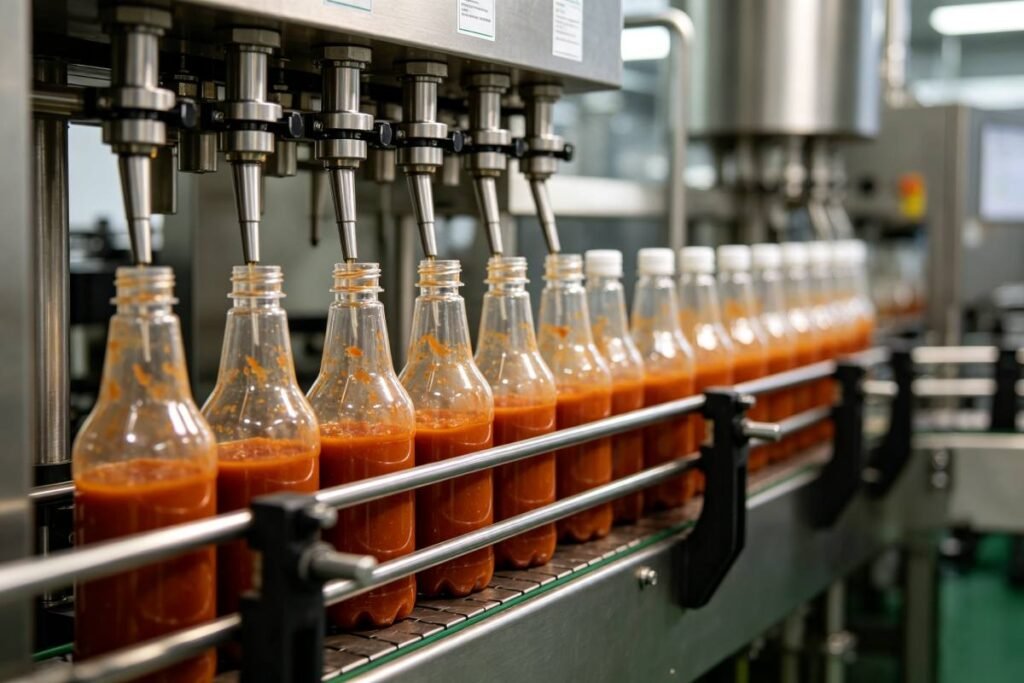
Automated filling lines use guide rails, star wheels, timing screws and bottom locating cups to position bottles accurately under filling nozzles.
- Bottle overall height, maximum body diameter, base shape and base diameter must fit the existing guides.
- Square, rectangular or contoured custom bottles often require star wheel modification, which adds extra cost.
- Uneven bottle bases, sharp bottom edges or unstable bottle weight distribution will cause tipping and jams during high-speed operation.
When selecting sauce bottles, provide your packaging supplier with your conveyor width, star wheel pocket size and bottle base locating specifications. Brotherpack can recommend stock bottle shapes that fit your existing line or adjust custom bottle geometry to match your equipment without costly machine rework.
2. Confirm Neck Finish and Cap Compatibility with Capping Heads
Neck thread size, neck height, sealing land and cap type directly control capping performance.
- Screw caps, flip-top caps and silicone valve caps all require different capping torque ranges.
- If the bottle neck dimension varies batch to batch, caps will be over-tightened, cross-threaded or loosely sealed, leading to leakage.
- For hot-filled sauce products, thermal expansion of the bottle neck after filling must be accounted for in neck finish design.
If you already selected caps, share cap samples or dimension drawings with us. Our engineers will verify the neck and cap interface, and test torque ranges to prevent leaking after bottling.
3. Align Bottle Shape & Opening Size With Filling Nozzle and Sauce Viscosity
Your sauce viscosity and particle size determine what filling nozzle type you need, and this restricts the minimum neck opening size of your bottle.
- Low viscosity sauces (hot sauce, vinegar dressing): Smaller neck openings work well with gravity filling nozzles.
- Thick, heavy sauces (ketchup, BBQ sauce): Require larger bottle openings and piston filling nozzles to avoid clogging.
- Chunky sauces with herbs, vegetable particles: Need extra wide mouths so solid chunks can flow smoothly into bottles without bridging or blockage.
Narrow necks paired with chunky sauce will lead to slow filling, air entrapment and inconsistent fill amounts. We will match your sauce formula to the proper bottle opening diameter during the design phase.
4. Check Bottle Material & Wall Thickness for Hot-Fill or Ambient Filling Conditions
Sauce filling temperatures create different mechanical stress on plastic bottles.
- Ambient cold filling: LDPE, PET, PP bottles are all viable options. Wall thickness requirements are relatively relaxed.
- Hot fill (80~95°C): Requires PP or specially designed PET bottles. Thin bottle walls will deform, shrink or cave in as sauce cools and creates vacuum inside.
Wall thickness distribution also affects bottle stability on the line. Overly flexible bottle bodies can get squeezed by guide rails during transport. Our team will select suitable resin grades and optimize wall thickness profiles to resist vacuum deformation for hot-filled sauce applications.
5. Validate Label Panel Flatness for Inline Labelling Equipment
Many sauce brands run pressure-sensitive labels or shrink sleeves right after filling. Curved, concave or uneven bottle surfaces will cause label wrinkling, bubbling and misalignment on automatic labellers.
- For wrap-around labels: A flat, uninterrupted label panel area is required.
- Shrink sleeves work better on rounded profiles, but bottle shoulders must be designed to prevent sleeve curling during application.
Custom bottle designs often look great in renderings but lack stable flat zones for labelling. We reserve dedicated label areas in bottle geometry early in the design process to match your labelling machine specs.
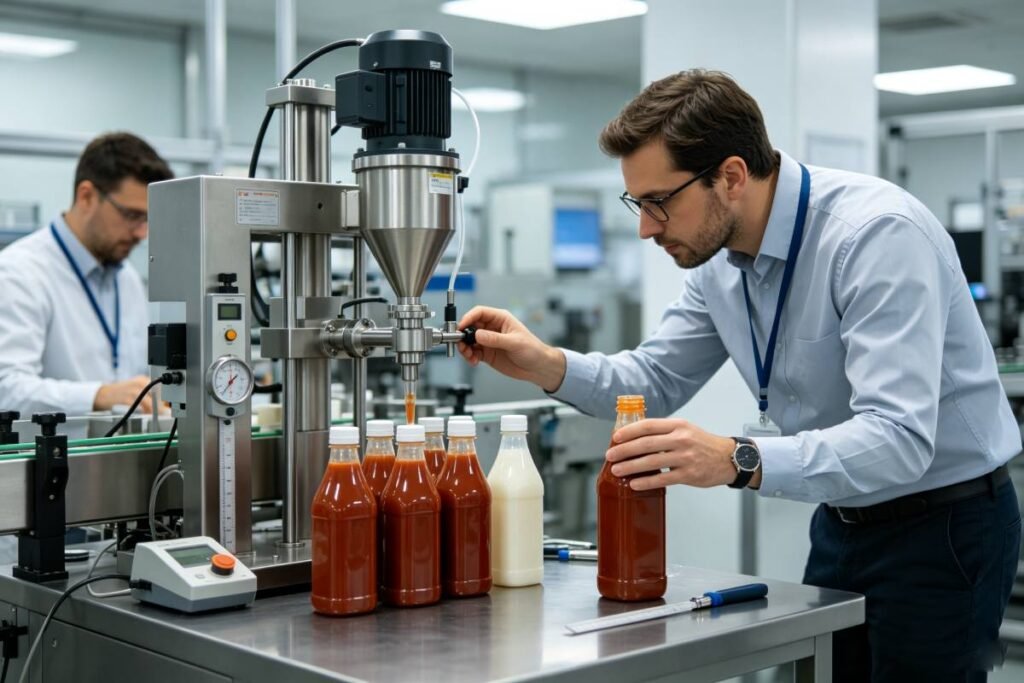
6. Test Bottles With Your Actual Sauce on the Full Line (Critical Final Step)
CAD drawings and empty bottle dimensional checks are not enough. Real-world validation is essential.
- Empty bottle tests can verify mechanical fit on the conveyor, but cannot simulate the weight, thermal stress and vacuum effect of filled sauce.
- Always run trial production using your real sauce recipe, not just water. Water testing cannot replicate particle clogging, viscosity changes or vacuum shrinkage.
- Track failure metrics: jam frequency, fill deviation, cap leakage rate and label defects. If issues occur, adjust bottle geometry or material before mass production.
This final line test helps you catch hidden compatibility risks before large orders, avoiding expensive downtime and product waste.
When to Choose Stock Bottles vs Custom Sauce Bottle Molds
Stock sauce bottles are ideal when your filling line has standard specifications, your sauce formula is conventional, and you want lower MOQ and faster lead times.
Custom bottle molds are recommended if you need unique branding shapes, special neck finishes for valve caps, optimized wall thickness for high-temperature hot fill, or specific base geometry to perfectly fit your existing star wheel and conveyor system.
Brotherpack offers both in-stock sauce bottles and fully custom mold development. Our engineering team will assess your filling line parameters and sauce formula to recommend the most cost-effective packaging solution.
Frequently Asked Questions About Sauce Bottle & Filling Line Compatibility
Q: What is the most common cause of bottle jams on sauce filling lines?
A: The most frequent issue is mismatched bottle base shape or overall dimensions that do not fit star wheels and guide rails. Uneven bottle weight distribution and unstable base design also lead to tipping during high-speed transport.
Q: Can PET plastic bottles be used for hot-filled sauce products?
A: Yes, but specially engineered PET bottles are required. Standard thin PET bottles will collapse under vacuum after hot filling. PP is another popular material option for hot-fill sauce applications.
Q: How do I test sauce bottle compatibility before mass production?
A: First run empty bottle tests on your filling line to check for jamming. Then conduct small batch trials with your actual sauce formula. Measure fill accuracy, cap sealing performance and label adhesion to confirm stability.
Q: Does chunky sauce require a wider bottle neck opening?
A: Yes. Chunky sauces containing solid particles need larger neck openings to prevent blockage during filling. A narrow neck will trap solids, slow down filling and cause inconsistent fill volume.
Q: Can Brotherpack adjust custom bottle geometry to match my existing filling machine?
A: Absolutely. Send us your filling line specifications including star wheel size, conveyor width and capping head parameters. Our engineers can optimize bottle shape to fit your equipment without machine modification.
Q: What if I use shrink sleeve labels for my sauce bottles?
A: We design bottle shoulders and body curves to avoid shrink sleeve curling or wrinkling. The bottle geometry will be optimized to ensure smooth sleeve application on your inline labelling machine.
Get Your Wholesale Packaging Bottle Inquiry Solution
Tell us your requirement for capacity, color, logo printing. We will reply you within 24 working hours.