
Introduction
Many packaging buyers wonder whether PP caps and PET caps can be mixed and matched for food‑grade bottles. While both PP (polypropylene) and PET (polyethylene terephthalate) are approved food‑contact plastics, their material properties, sealing performance and temperature limits are very different. This article explains practical compatibility rules for food and beverage packaging.
Material Basic Properties
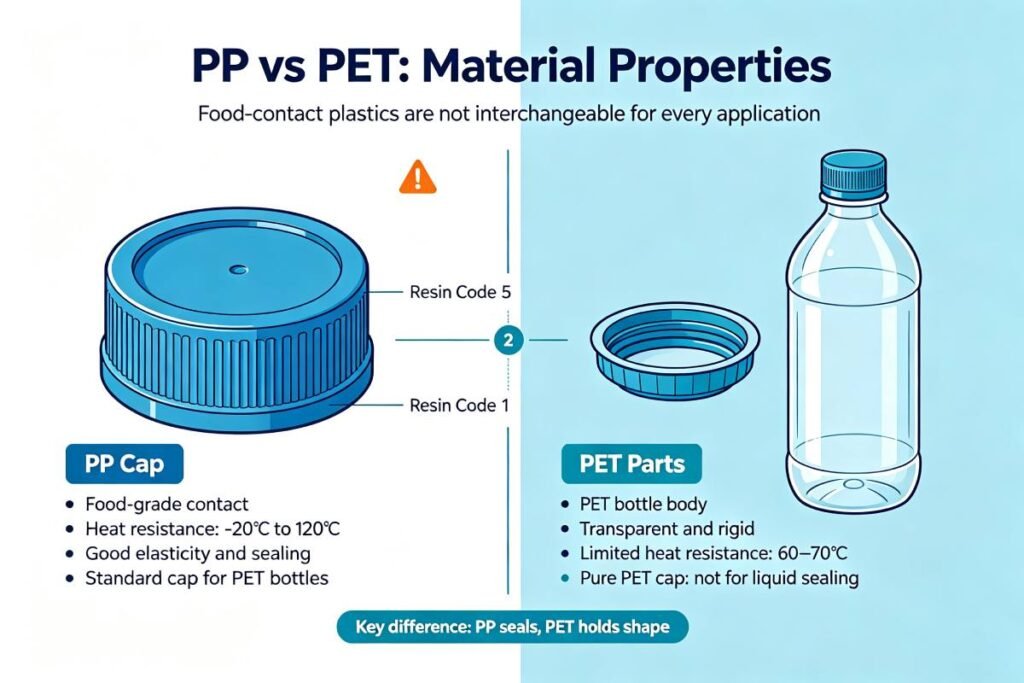
PET (Resin Code 1)
PET is widely used for transparent bottle bodies. It has good transparency and rigidity, but poor elasticity.
- Max heat resistance: 60‑70℃. Not suitable for hot‑filling or microwave heating.
- Pure PET caps are rarely used for liquid food sealing. PET is hard and non‑resilient; threads will slip or crack after repeated opening and closing. PET is mostly used as outer decorative shell only, not as main sealing cap body.
PP (Resin Code 5)
PP is the mainstream material for food‑grade bottle caps.
- Heat resistance: ‑20℃ ~ 120℃. Good chemical resistance to acid, oil and beverages.
- Slight elasticity helps maintain tight sealing when temperature fluctuates. It is the standard matching cap for PET bottles in global beverage and food industries.
Common Matching Scenarios
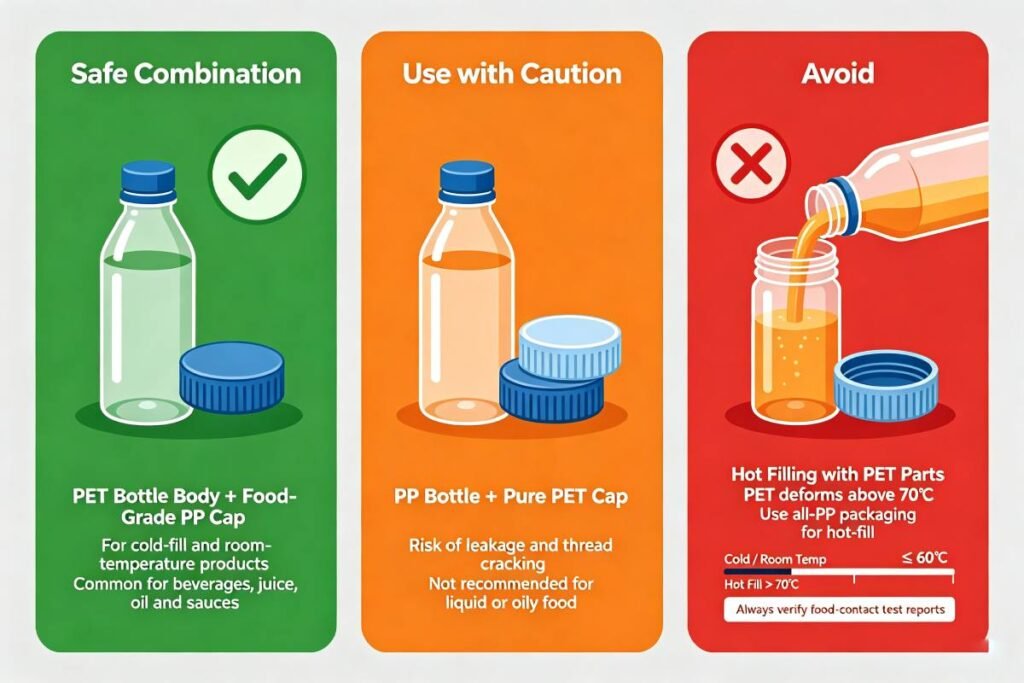
✅ Safe Combination: PET Bottle Body + Food‑Grade PP Cap
This is the most widely‑used standard combination in food packaging.
- PP cap’s flexible thread matches hard PET bottle neck. Thermal expansion‑contraction performance matches well, reducing leakage risk during transportation and temperature changes.
- Both materials comply with FDA 21 CFR 177.1520 and EU 10/2011 food‑contact regulations. Safe for room‑temperature and cold‑filled drinks, juice, honey, edible oil and sauces.
Note: Only for filling temperature ≤60℃. Do not use this combination for hot‑filling.
❌ Risky Combinations to Avoid
- PP bottle body + pure PET sealing capPET cap has no elasticity. Under temperature change, the cap cannot follow bottle deformation. It will easily leak, crack, and thread fragments may fall into food. Not recommended for liquid or oily food products.
- Pure PET cap as direct‑contact sealing cap for any liquid containerPure PET cap cannot provide stable sealing. High temperature will cause deformation and increase chemical migration risk. PET can only serve as outer decorative cover, with PP inner sealing layer required.
- Hot‑filling with PET‑related partsEven if you use a heat‑resistant PP cap, you cannot hot‑fill into PET bottles. PET bottle body will deform above 70℃ and release acetaldehyde, causing food safety risks.
Core Food‑Contact Safety Rules for Production
All direct‑contact parts (cap body, liner, seal gasket) must be food‑grade raw material, with valid food‑contact test reports. Temperature is the critical boundary:
- Room‑temperature / cold‑fill (<60℃): PET bottle + PP cap is fully compliant.
- Hot‑fill (>70℃): Do not use PET bottle or pure PET cap. Full PP packaging system is required.
For oily, high‑acid or alcoholic food: shorten shelf‑life. Avoid pure PET cap in direct contact with contents. PET bottles are designed for single‑use. Do not reuse PET bottles for hot liquid, even with PP caps.
Common Misunderstandings
- “Since both PP and PET are food‑safe, any mixing is fine.”
Food‑contact compliance is not the only factor. Sealing performance, thermal expansion and chemical resistance also determine whether the matching is practical. Pure PET caps are not suitable for liquid sealing.
- “PP cap is heat‑resistant, so it can be used with hot liquid in PET bottles.”
The cap’s heat resistance does not offset the PET bottle’s temperature limit. PET bottle will degrade under high temperature.
- “PET outer decorative cap will cause safety hazard.”
If PET is only outer decoration and does not touch food contents, with PP inner sealing layer, there is no food‑contact risk.
Practical Summary
- Best‑practice standard: PET bottle body + food‑grade PP cap, for room‑temperature and cold‑filled food & beverage packaging.
- Never use pure PET caps as direct‑contact sealing caps for liquid food.
- Strictly control filling temperature. Hot‑filling must adopt all‑PP packaging.
- Always verify food‑contact certification for caps, liners and bottle bodies.
Frequently Asked Questions (FAQ)
Q1: Can I use a pure PET cap directly on a PET food bottle?
A: Not recommended for liquid food packaging. Pure PET caps lack elasticity. Threads tend to slip, crack or wear out after repeated opening and closing. PET caps are only suitable as outer decorative covers; an inner PP sealing liner is required for real food‑contact sealing.
Q2: Is PET bottle + PP cap a safe food‑grade combination?
A: Yes, this is the industry‑standard safe combination for cold‑fill and room‑temperature food & beverage packaging. Both materials comply with food‑contact regulations. Please keep filling temperature ≤60℃, do not use for hot‑filling.
Q3: If my PP cap is heat‑resistant, can I hot‑fill into a PET bottle?
A: No. Even with a heat‑resistant PP cap, PET bottle bodies will deform and release acetaldehyde above 70℃. Hot‑filling requires fully PP packaging systems.
Q4: Are PP and PET materials chemically reactive when matched together?
A: No chemical reaction occurs between food‑grade PP and PET under normal room‑temperature and cold‑fill conditions. Safety risks mainly come from excessive temperature, poor raw material quality or improper storage, rather than material matching itself.
Q5: Can PET bottles with PP caps be reused for hot drinks?
A: PET bottles are designed for single use. Even with PP caps, they cannot hold hot liquid above 70℃. Repeated use for hot beverages will increase the risk of acetaldehyde migration.
Q6: What certifications should I check for food‑grade PP and PET caps?
A: All parts directly touching food need to meet FDA 21 CFR 177.1520, EU Regulation 10/2011 or China GB 4806.7. You should request test reports for material and migration from your supplier.
Get Your Wholesale Packaging Bottle Inquiry Solution
Tell us your requirement for capacity, color, logo printing. We will reply you within 24 working hours.