
Introduction
Lab testing and food safety certification are the basic standards for commercial squeeze bottles. Most restaurant buyers, catering chain operators, and food packaging distributors only focus on FDA compliance, leak-proof performance, drop resistance, and material safety data.
However, countless catering practice cases prove a common problem: many squeeze bottles pass all laboratory formal tests but perform poorly in busy commercial kitchens. Hard squeezing, unstable output, slippery grip, hand fatigue after long-term use, and residual material waste will directly reduce kitchen work efficiency, increase staff operating pressure, and even cause unnecessary food waste and customer complaints.
The core reason for this deviation is simple: laboratory static testing cannot simulate the complex and high-frequency working scenarios of commercial kitchens. This is why professional squeeze bottle ergonomic testing is an indispensable inspection link for formal catering packaging solutions.
Why Lab-Certified Squeeze Bottles Fail in Real Commercial Kitchens
Laboratory testing is carried out in an ideal environment: clean and dry bottle body, standard water as the filling medium, fixed grip posture, and low-frequency use. In contrast, commercial kitchen scenarios are full of uncertain factors that completely change the actual use experience of squeeze bottles.
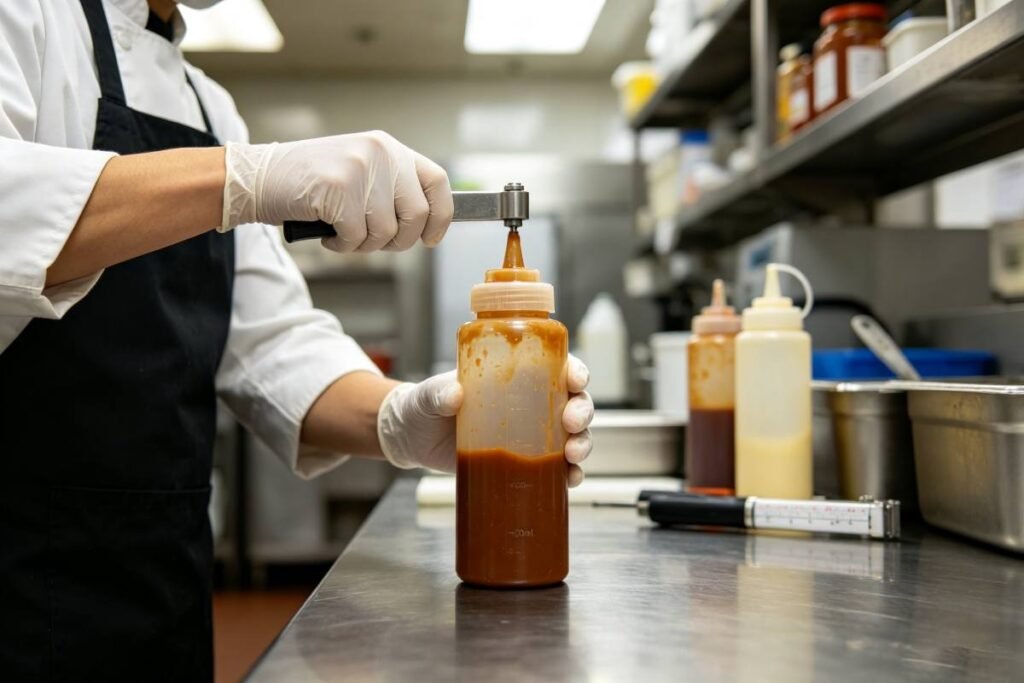
First of all, catering kitchens have high viscosity materials such as sauces, honey, cream, and animal fat. The fluidity of these materials is far lower than water. Bottles that squeeze smoothly with water may require twice or even three times the squeezing force when filled with real catering materials.
Secondly, the kitchen working environment is always accompanied by water stains, oil stains, and flour residues. The dry anti-slip effect tested in the laboratory will completely fail when the bottle body is stained with oil and water. Staff wearing kitchen gloves will face greater grip challenges.
In addition, commercial kitchens have continuous high-frequency use demands. Kitchen staff need to squeeze bottles hundreds of times during peak meal periods. Short-term laboratory fatigue tests cannot detect long-term problems such as poor bottle rebound, deformed bottle walls, and increased squeezing resistance after repeated use.
Finally, the liquid level change of the squeeze bottle will also affect the operating experience. The grip weight of full bottles, the squeezing difficulty of half bottles, and the residual discharge problem of nearly empty bottles are not included in conventional laboratory testing standards.
Core Factors That Determine Commercial Squeeze Bottle Ergonomics
Good ergonomic design is never simply “softer bottle body”. Excessively soft bottle walls will cause sudden collapse, material splashing, and inaccurate discharge, which is more likely to cause kitchen accidents.
A qualified commercial squeeze bottle needs to achieve a balanced optimization of material performance, structural design, and human operation habits, covering four core dimensions:
1. Scientific Squeezing Force Matching
The optimal squeezing force for catering squeeze bottles is designed for one-handed operation by adult kitchen staff. The wall thickness distribution of PP and LDPE materials is precisely controlled by professional molds. The upper, middle, and lower sections of the bottle body have different soft and hard degrees, ensuring labor-saving squeezing while avoiding bottle body collapse.
2. Stable Rebound Performance
After each discharge, the bottle body needs to rebound quickly and completely. Good rebound performance can balance the internal and external air pressure of the bottle, avoid negative pressure blockage of viscous materials, and ensure consistent discharge volume from the full state to the nearly empty state.
3. Anti-Slip Structural Design Adapted to Kitchen Scenarios
The anti-slip design of commercial squeeze bottles abandons overly deep grooves that are easy to hide dirt. Through matte texture, local anti-slip lines, and scientific bottle diameter design, it ensures stable grip under wet, oily, and glove-wearing conditions, taking into account both anti-slip performance and food hygiene and easy cleaning requirements.
4. Integrated Adaptation of Nozzle and Cap
The ergonomic experience of squeeze bottles is a systematic project of the whole set of bottle and cap. The caliber of the nozzle, the tightness of the flip cap, the self-closing valve design, and the hinge toughness directly affect the one-handed operation efficiency. A well-matched cap and nozzle can realize one-handed opening, precise discharge, and automatic drip stop, greatly improving kitchen efficiency.
Standard Ergonomic Testing Process for Commercial Kitchen Scenarios
To eliminate the gap between laboratory data and actual use, professional food packaging manufacturers need to conduct targeted scenario-based ergonomic testing for catering squeeze bottles. We have summarized a complete set of mature testing processes suitable for commercial kitchen scenarios:
Step 1: Simulate Real Catering Medium and Temperature Environment
Abandon pure water testing. According to the customer’s actual use scenario, fill the bottle with matching viscosity materials such as salad dressing, ketchup, and animal fat. Simulate the discharge state under normal temperature and refrigerated low temperature, because low temperature will increase material viscosity and squeezing difficulty.
Step 2: Full Liquid Level Cycle Test
Carry out operational tests in four states: full bottle, three-quarters full, half bottle, and one-quarter full. Record the changes in squeezing force, discharge uniformity, and residual material of the squeeze bottle in different liquid level states to ensure stable use throughout the whole service cycle.
Step 3: Simulate Kitchen High-Fatigue Operation Test
Arrange testers with different palm sizes to wear conventional kitchen gloves and perform 500+ continuous squeezing cycles. Evaluate the hand fatigue degree of long-term operation, the rebound stability of the bottle body after repeated use, and whether permanent deformation occurs in the bottle wall.
Step 4: Oil and Water Pollution Anti-Slip Test
Wipe the bottle body with edible oil and water stains to simulate the messy kitchen environment. Test the firmness of one-handed grip during inverted discharge, and count the slipping times and operation error rates to verify the practicability of anti-slip design.
Step 5: One-Handed Full Process Operation Verification
Complete the whole process of taking the bottle, opening the cap, inverted discharging, stopping discharging, closing the cap and placing the bottle with one hand. Screen out unqualified designs that require two-handed cooperation, easy cap dropping, and delayed discharge cutoff.
Convert Ergonomic Test Data into Formal Purchasing Standards
For catering chain enterprises and packaging distributors, intuitive ergonomic test results need to be transformed into clear and quantifiable purchasing specifications to ensure the consistency of sample proofing and mass production quality.
After the squeeze bottle passes the scenario-based ergonomic test, we will form a complete technical standard document, including bottle body material density, key wall thickness parameters, standard squeezing force range, rebound recovery time, anti-slip structure specifications, nozzle discharge accuracy, and fatigue use service life.
All finished products will be produced in strict accordance with the tested and confirmed sample standards to avoid quality differences such as inconsistent hand feel and unstable performance caused by mold adjustment and parameter changes in mass production.
Why Custom Ergonomic Squeeze Bottles Improve Catering Profitability
Many catering operators ignore that unqualified squeeze bottles will bring invisible cost losses. Laborious squeezing increases staff fatigue and reduces serving speed; unstable discharge causes excessive material waste; slippery and easy-to-fall bottles increase the risk of kitchen breakage and pollution.
Optimized ergonomic squeeze bottles can effectively reduce food waste, improve kitchen operation efficiency, reduce staff operation pressure, and maintain standardized and consistent flavor and portioning of dishes. For long-term operating commercial catering institutions, qualified humanized packaging is an important part of cost control and service quality improvement.
Frequently Asked Questions
-
1. Is a softer squeeze bottle always more ergonomic?
Definitely not. Excessively soft bottle walls are prone to collapse and material splashing during squeezing, leading to inaccurate portion control. Excellent ergonomics relies on reasonable wall thickness distribution and material matching, not blind softening.
-
2. Can we complete the test with pure water instead of real sauce?
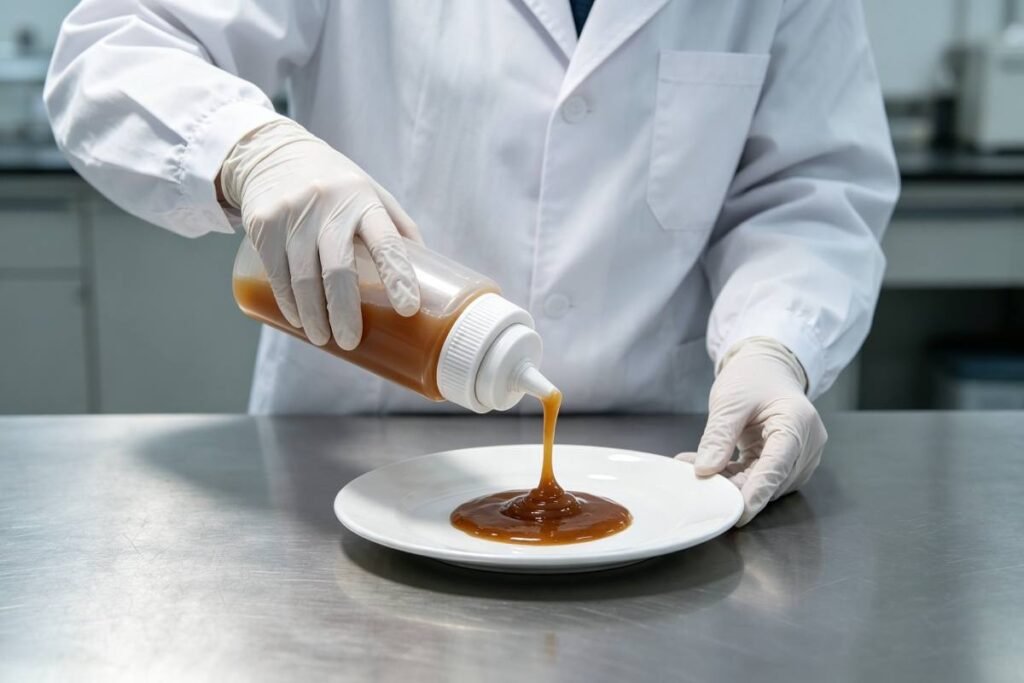
Pure water can only be used for preliminary basic leakage testing. Water has low viscosity and cannot simulate the squeezing resistance and discharge state of high-viscosity catering materials. Scenario testing with real materials is essential for final confirmation.
-
3. Does bottle capacity affect ergonomic performance?
Yes. Different capacities correspond to different bottle diameters and overall weight. Too large a diameter will affect one-handed grip, while an oversized full bottle weight will increase operating burden. We will match the optimal structural design according to the customized capacity.
-
4. How to ensure the ergonomic consistency of mass-produced bottles?
We will fix the mold parameters, material ratio, and wall thickness standards of the confirmed sample. Before each batch of mass production, we will conduct sampling ergonomic fatigue testing to ensure that the hand feel and performance of large goods are consistent with the proofing sample.
-
5. Are PP squeeze bottles suitable for high-viscosity animal fat and sauces?
Yes. Food-grade PP material has good oil resistance and structural stability. Combined with our optimized bottle body and nozzle ergonomic design, it can perfectly adapt to the long-term filling and repeated use of various high-viscosity catering oils and sauces.
Get Your Wholesale Packaging Bottle Inquiry Solution
Tell us your requirement for capacity, color, logo printing. We will reply you within 24 working hours.