
Introduction
For food and beverage packaging manufacturers and wholesale buyers, compliance food contact certifications are the most critical factor when sourcing PET bottles. Different countries and regions set independent food-contact regulations. Many overseas buyers will ask suppliers to provide relevant test reports before placing orders.
This article explains the most frequently requested certifications for food-grade PET bottles, compares the differences between each standard, and clarifies key questions like testing cycles and costs.
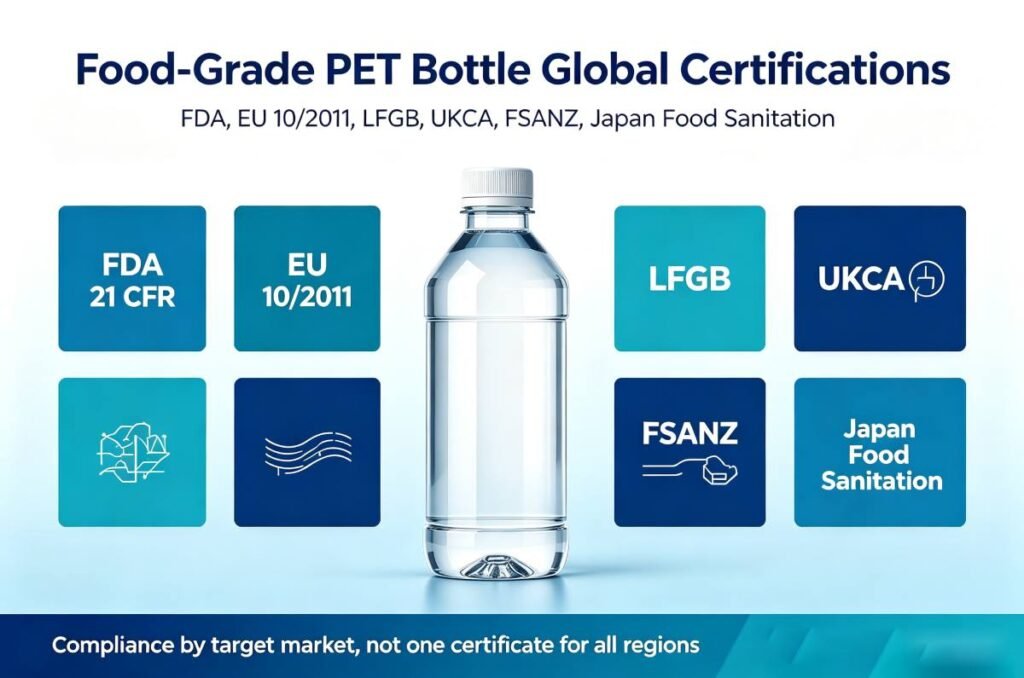
What are the widely requested certifications for PET food bottles?
1. FDA 21 CFR (United States Market)
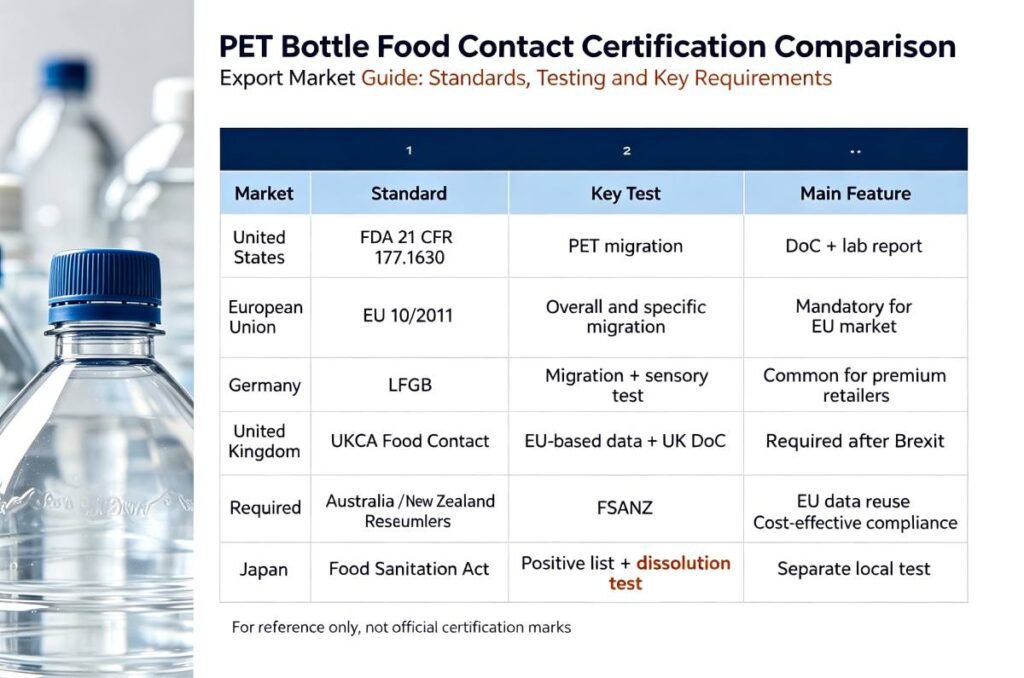
FDA is the standard required for products exported to the United States. For PET plastic bottles, the applicable clause is 21 CFR 177.1630.
- It controls chemical migration of PET resin under different food simulants.
- There is no official “FDA certificate” issued by FDA authority. The supplier provides third-party lab migration test report plus Declaration of Compliance (DoC).
- Suitable for beverage, sauce, edible oil PET bottles sold in USA market.
2. EU 10/2011 (European Union)
EU Regulation (EU) No 10/2011 is the mandatory plastic food contact standard for all 27 EU countries, working together with framework regulation EC 1935/2004.
- It sets limits on overall migration and specific substance migration for plastic materials.
- Mandatory Declaration of Compliance (DoC) must be provided for customs and retail inspection.
- Valid for France, Italy, Spain and most EU countries.
3. LFGB (Germany)
LFGB (Lebensmittel-, Bedarfsgegenstände- und Futtermittelgesetzbuch) is the strict German food and feed code. Many large German retailers and brands specifically request LFGB reports, even if EU 10/2011 is already available.
- Extra sensory test: check whether the bottle brings unwanted odor or taste into food.
- Stricter migration limits than basic EU standards, widely recognized as premium quality proof in European market.
4. UKCA (United Kingdom)
After Brexit, UK established independent food contact rules. UKCA food contact compliance can be built based on EU 10/2011 test data, but a separate UK version Declaration of Compliance is required. Large British buyers often require UKCA documentation.
5. FSANZ (Australia and New Zealand)
Australia and New Zealand share FSANZ food contact regulations. Most test data from EU 10/2011 can be reused, and the accredited laboratory can issue an FSANZ compliance report with extra review. It saves testing cost compared to full re-testing.
6. Japan Food Sanitation Act (Japan Market)
- Japan adopts a positive list system for food contact plastics. EU or FDA test reports cannot replace Japan’s local 溶出 (dissolution) test.
- All resin materials must be listed on Japan’s positive list, and dedicated migration dissolution test is required. This is a separate test project for Japanese customers.
Key Practical Questions for PET Bottle Testing
Do I need to run full testing for every shipment batch?
- No. Food contact migration testing is based on fixed raw material formula and product structure.
- If the PET resin grade, color masterbatch, additives, bottle structure and printing ink remain unchanged, the third-party lab report stays valid. You only need to re-test when raw material or formula changes.
- Each batch still needs factory internal quality inspection, but this is not full third-party migration test.
How much will these food contact tests cost?
Testing cost depends on standards you select. Testing multiple standards on one sample can cut 20%-30% of total cost.
- EU 10/2011: moderate cost
- LFGB: higher than EU standard
- FDA 21 CFR: medium cost
- Japan food sanitation dissolution test: highest cost among these markets.
Can one single report cover all countries?
No. Each region has its own test simulant, temperature condition and substance limits.EU report works for EU, but cannot be used for Japan market. FDA report meets US requirement, while German customers still may ask for LFGB extra testing.
Buyer Tips for Sourcing PET Bottles
When evaluating packaging suppliers, do not only check “food grade” marketing statements. Request these documents:
- Third-party laboratory migration test report
- Declaration of Compliance (DoC)
- Raw material COA certificate from resin supplier
- Production batch records for traceability
Conclusion
- For PET food bottle export, choose certifications according to your target market.EU 10/2011 is the basic requirement for Europe. German premium clients usually add LFGB. US market needs FDA 21 CFR compliance. Japan needs independent positive list and dissolution test.
- All test reports are valid for the same material formula, not batch-by-batch retesting. Proper certification documents help build trust and reduce customs detention risks for global buyers.
Frequently Asked Questions (FAQ)
Q1: What is the difference between EU 10/2011 and LFGB for PET bottles?
A: EU 10/2011 is the general plastic food contact standard for EU countries. LFGB is German stricter regulation, which adds sensory test for odor and taste transfer. Many German retailers require LFGB even with EU 10/2011 report.
Q2: Does FDA issue official certificates for PET bottles?
A: FDA does not release official certificates. Suppliers provide third-party lab migration test report plus Declaration of Compliance (DoC) to prove compliance with 21 CFR 177.1630.
Q3: Can I use EU test report for Japan market PET bottle export?
A: No. Japan uses a positive list system. EU or FDA reports cannot replace Japan’s dedicated dissolution and migration test. Separate testing is mandatory for Japanese customers.
Q4: Do we need to re-test PET bottles for every production batch?
A: No. The third-party migration test is based on fixed raw material formula. If resin, additives and bottle structure keep unchanged, the report remains valid. Re-test only when raw material formula changes.
Q5: What documents do overseas buyers usually ask for besides lab reports?
A: Buyers normally request Declaration of Compliance (DoC), raw material COA certificates, factory batch records, together with third-party migration test reports.
Get Your Wholesale Packaging Bottle Inquiry Solution
Tell us your requirement for capacity, color, logo printing. We will reply you within 24 working hours.