
Introduction
When you design packaging for sauces and seasonings, choosing the right plastic bottle material is one of the most critical decisions. PET, HDPE and PP are the three dominant food-grade plastic options widely used in condiment packaging. The wrong material can cause bottle deformation, leakage, product spoilage and huge batch losses. This guide breaks down the features of PET, HDPE and PP, their compatibility with cold filling, hot filling and pasteurization, cost differences and matching cap solutions. Brand owners and packaging buyers can quickly pick the best bottle material for their sauce products.
Core Properties of PET, HDPE and PP for Sauce Packaging
PET (Polyethylene Terephthalate)
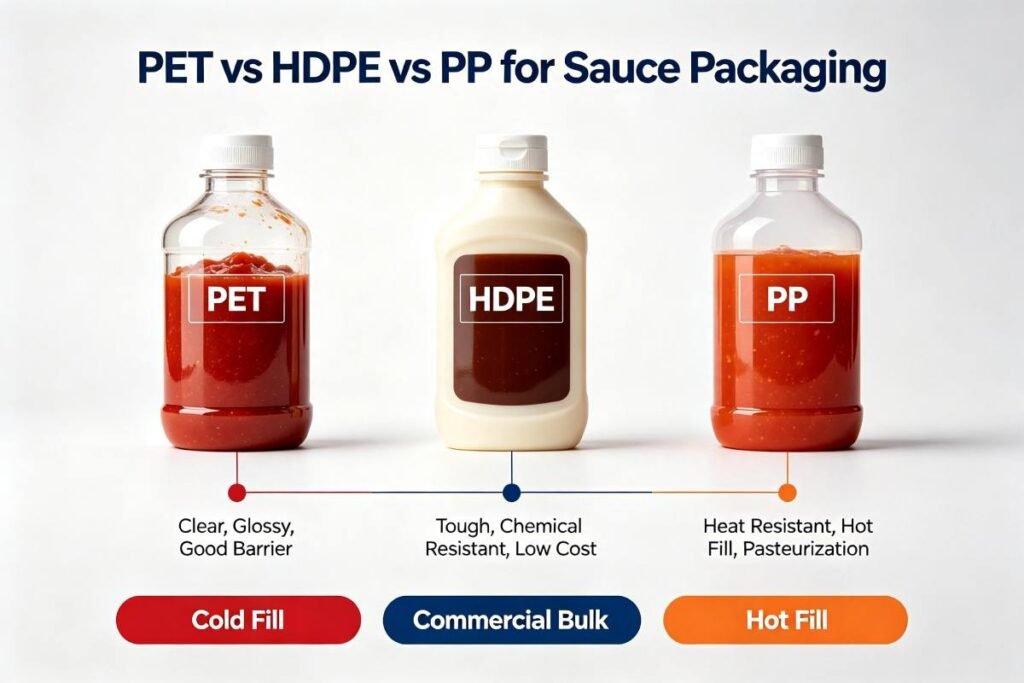
PET features high transparency, glossy surface and good rigidity. It has excellent oxygen and moisture barrier performance, which helps prevent sauce oxidation and discoloration. PET supports various custom shapes and looks premium for retail shelves.The main limitation is heat resistance. Standard PET can only withstand temperatures up to 60–70°C. It will soften and deform under high heat, so it cannot be used for high-temperature filling or pasteurization.
HDPE (High-Density Polyethylene)
HDPE delivers great toughness, drop resistance and chemical stability. It resists acids and alkalis from different sauces, and can be made into squeezable bottles.HDPE is opaque or milky translucent with a matte finish, so it is not suitable for brands that want to show sauce color visually. Its heat resistance is moderate and it cannot sustain high-temperature pasteurization.
PP (Polypropylene)
PP is the best heat-resistant option among the three materials. It can handle 100–135°C steadily. It maintains shape during hot filling and pasteurization without warping. It is food-safe and can be reused.Normal PP has slight haze, so its transparency is lower than PET. It may turn brittle under extremely low-temperature conditions.
Material Selection by Filling Process: Cold Filling vs Hot Filling
Cold Filling for Sauce
Cold filling refers to filling at temperatures below 60°C, such as salad dressing, ketchup, cold mixed sauces and refrigerated condiments.
- PET: Top choice for retail cold-filled sauce. Clear appearance displays sauce texture, good barrier property extends shelf life. Most squeeze retail sauce bottles use PET.
- HDPE: Ideal for large commercial bulk sauce containers. Prioritize durability and low cost, less focus on visual appearance.
- PP: Not recommended for cold filling only. Its heat-resistant advantage is unnecessary, and it costs more than PET.
Hot Filling for Sauce
Hot filling works at 85–95°C, used for freshly cooked sauces like chili sauce, garlic sauce and preservative-free condiments.
- PP: The only suitable material. It stays stable at high hot filling temperature and avoids bottle collapse or thread deformation.
- PET: NOT allowed. Standard PET softens and collapses above 70°C, leading to sealing failure and leakage.
- HDPE: Not recommended. It may deform at hot filling temperature and cause unstable sealing after cooling.
Material Selection for Pasteurization
Pasteurization is common for preservative-free sauces with a long shelf life, usually 80–90°C water bath or spray sterilization after capping.
- PP: Fully compatible. It resists high-temperature water bath without deformation, leakage or cracking. Bottle shape stays consistent after sterilization.
- PET: Unsuitable. High heat will twist the bottle and ruin the neck thread.
- HDPE: Not suitable. It tends to swell and deform during pasteurization, which causes leakage risks in storage.
Note: If your sauce is sold under cold chain with short shelf life and no sterilization, PET or HDPE can be used following cold filling rules.
Cost Comparison of PET, HDPE and PP Bottles
With same volume, same mould and virgin food-grade raw material, the cost ranking: PP > PET > HDPE
- HDPE: Lowest cost. Perfect for bulk commercial sauce packaging where cost control is the priority, appearance is not critical.
- PET: Mid-range cost, widely used in retail sauce packaging. Balanced performance and visual quality.
- PP: Highest cost. The extra price pays for high-temperature resistance. Only select PP when hot filling or pasteurization is required.
Matching Bottle & Cap Material Combinations
Poor matching between bottle and cap causes leakage and thread slipping. Here are industry standard combinations:
- PET bottle: Best match with PP caps. For premium lines, PET caps work. For squeeze ketchup, pair with HDPE nozzle flip caps. Avoid overly hard caps that crack PET neck threads.
- HDPE bottle: Best match with HDPE caps. Same thermal expansion rate, stable sealing for large commercial containers.
- PP bottle (hot filling & pasteurization): Must use PP caps. Bottle and cap expand and shrink together under heat, preventing loose seal after sterilization. Never use cheap PET caps here, they will deform and fail.
Quick Reference Table for Sauce Packaging Material Selection
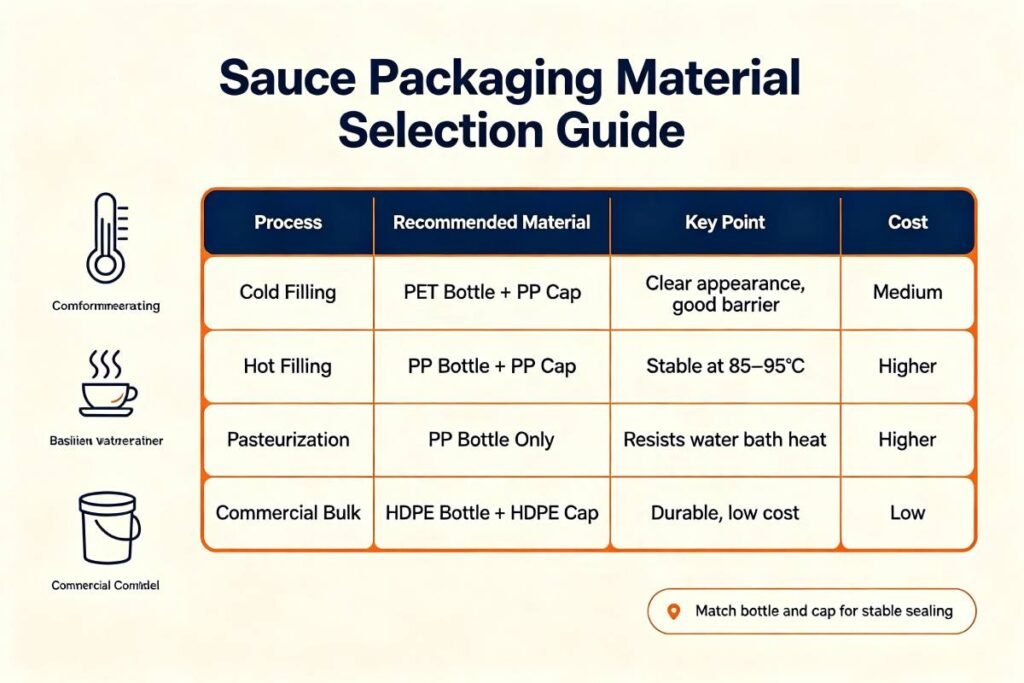
Retail transparent sauce, cold filling, no sterilization → PET bottle + PP cap
Large commercial bulk sauce, low cost, durable → HDPE bottle + HDPE cap
Hot filling, preservative-free sauce, pasteurization → PP bottle + PP cap
Cold filled squeeze sauce like ketchup → PET squeeze bottle + HDPE flip nozzle cap
Cold chain short shelf life sauce → PET first, HDPE for budget
FAQ
1. Can PET bottles be used for pasteurization?
Standard PET bottles cannot withstand pasteurization heat. They will soften and deform in high-temperature water bath. Only special heat-resistant PET works, but its high cost is rarely used for sauce packaging.
2. Why must we use PP caps for PP bottles in hot filling?
PP bottle and PP cap share the same thermal expansion coefficient. When heated during hot filling or pasteurization, they expand and shrink synchronously, maintaining stable sealing and preventing leakage after cooling.
3. Which material is best for squeeze sauce bottles?
For cold-filled squeeze sauce, PET squeeze bottle with HDPE nozzle flip cap is the most popular solution. If pasteurization is required, choose PP squeeze bottle with PP cap.
4. Is HDPE bottle food safe for edible sauces?
Yes, food-grade HDPE is safe for sauce packaging. It has good chemical resistance to acidic sauces. But it is opaque, so you cannot display the sauce colour inside.
5. What is the main difference between PP and PET for food bottles?
The biggest difference is heat resistance. PET is clear but cannot handle high temperature. PP can survive hot filling and pasteurization, but it is semi-transparent and more expensive.
Get Your Wholesale Packaging Bottle Inquiry Solution
Tell us your requirement for capacity, color, logo printing. We will reply you within 24 working hours.