
Introduction
Launching a custom plastic jar mold project is one of the most effective ways for packaging brands to achieve differentiated shelf displays, exclusive specifications, and perfect compatibility with filling production lines. However, most new custom mold failures do not stem from poor mold manufacturing accuracy — they result from incomplete pre-production specification confirmation, overlooked design defects, and mismatched production environment parameters.
Many packaging buyers only provide simple reference pictures and approximate sizes when opening new molds. This vague design method often leads to a series of costly problems after mold completion: poor lid sealing, jar body warping, uneven wall thickness, label wrinkling, unstable stacking, and even inability to adapt to automated filling equipment. Secondary mold modification, repeated sample testing, and production line adjustments will greatly delay product launch cycles and increase comprehensive costs.
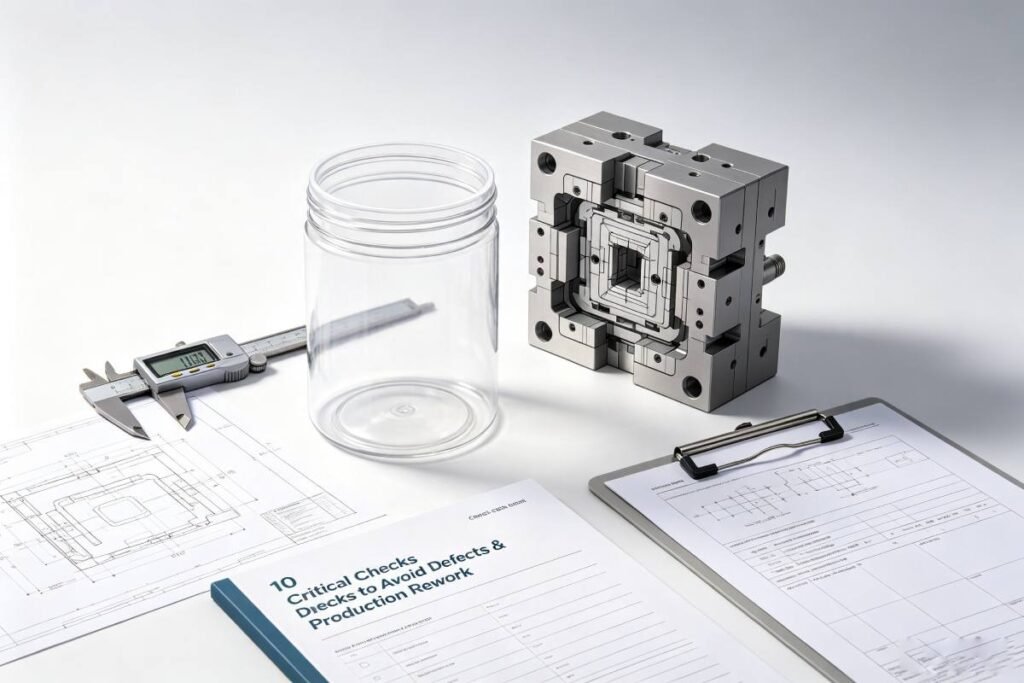
Based on years of PET and PP plastic jar customization and mold development experience, we have sorted out a 10-point full-process custom jar mold development checklist. Brand purchasers, product developers, and packaging engineers can complete all standardized confirmations before steel cutting to ensure one-time successful mass production of custom jars.
10 Essential Confirmation Items Before Custom Jar Mold Opening
1. Confirm Product Attributes and Actual Usage Scenarios
The first step in custom jar design is to define the core usage environment, not just appearance styling. Different contents and storage conditions directly determine the material selection, wall thickness standard, and structural design of the jar.
You need to clearly sort out: the specific filled product (food paste, nuts, powder, cosmetics, chemical daily necessities), product viscosity, acid and oil resistance, filling method (normal temperature filling / high temperature hot filling / low temperature cold filling), long-term storage environment, and cross-border transportation methods.
For food-grade export packaging, it is also necessary to confirm the target sales market in advance. Different regions have different certification standards such as FDA (USA) and LFGB (EU), which need to be locked in the initial mold design stage to avoid non-compliant materials leading to product export restrictions.
2. Distinguish Standard Capacity and Full Volume to Avoid Filling Errors
Capacity deviation is one of the most frequent problems in custom jar orders. Many customers only mark the nominal sales capacity but ignore the full brim capacity and reserved headspace required for actual filling.
In actual production, hot-filled products will produce thermal expansion, and foaming materials will generate gas during filling. If there is no reserved gap, overflow and sealing failure will easily occur.
Before opening the mold, it is necessary to confirm three core data: nominal selling capacity, maximum full capacity, and standard filling liquid level, and mark the unified tolerance standard on the engineering drawing to ensure that the batch of finished jars fully meets the capacity detection standards of supermarkets and e-commerce platforms.
3. Lock Jar Mouth Thread Standard and Support Lid Matching System
The caliber thread of the wide-mouth jar is the core structure that determines the sealing performance. Many custom mold projects have perfect jar body appearance, but serious leakage problems occur due to mismatched thread parameters.
It is necessary to confirm in advance: thread tooth type, inner and outer diameter of the jar mouth, sealing platform height, tamper-proof structure design, matching lid type and liner material. At the same time, lock the capping torque range and opening force standard to adapt to automated capping equipment.
If you have a customized lid sample, you must provide physical samples or complete dimensional drawings for mold fitting verification, instead of only referring to picture styles, to eliminate thread deviation risks.
4. Standardize Resin Material Grade and Custom Weight Parameters
Material determines the basic performance and production stability of plastic jars. Before mold development, it is necessary to clarify the core material parameters: PET/PP/HDPE/R-PET recycled material, transparency requirements, color matching standards, UV anti-ultraviolet additives, and recycled material proportion standards.
Wide-mouth jars have a large opening area, and the stretching ratio of blow molding is different from that of ordinary narrow-mouth bottles. Unreasonable material distribution will lead to thin walls at the shoulder and body of the jar, resulting in deformation and air leakage.
For high-standard customized jars, we will match the exclusive preform scheme according to the jar structure to ensure uniform wall thickness of the whole jar and stable quality of mass-produced products.
5. Complete DFM manufacturability verification of customized appearance structure
Many personalized creative shapes are beautiful in 3D renderings but lack production feasibility. Sharp corners, overly complex curved surfaces, ultra-large flat surfaces, and abrupt structural transitions will lead to sink marks, mold sticking, uneven demolding, and batch differences in finished products.
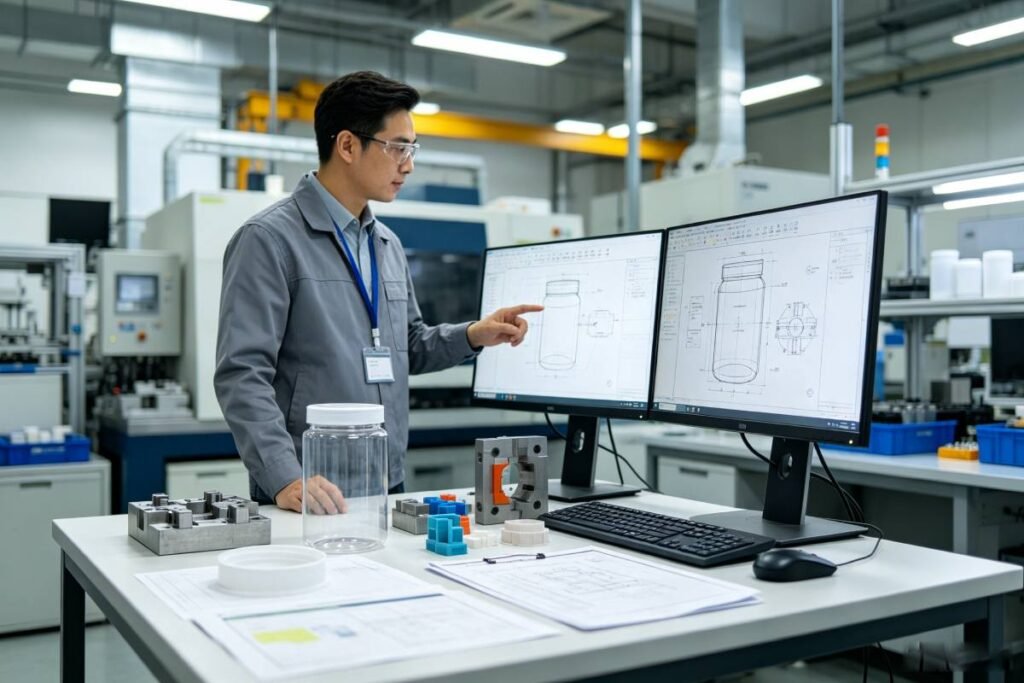
Our engineering team will conduct professional DFM manufacturability optimization for customer-customized shapes: retain brand exclusive aesthetic design, optimize unreasonable structural details, adjust demolding inclination and parting line position, and balance appearance effect and mass production stability.
6. Detect Structural Stress Points to Optimize Wall Thickness Distribution
Uniform wall thickness is the key to ensuring the durability and stability of plastic jars. It is necessary to focus on stress-bearing areas such as jar shoulder transition, flat side wall, bottom supporting ring, and stacking contact surface.
For products requiring hot filling and vacuum cooling, the jar body will shrink after cooling. Unreasonable wall thickness will lead to permanent deformation and affect later labeling and sales display.
Before mass production of molds, we will conduct stress simulation tests on the customized structure to optimize the wall thickness of high-stress areas and ensure the jar can withstand stacking pressure, long-distance transportation vibration and drop impact tests.
7. Reserve Standard Labeling and Printing Position in Advance
Decoration design cannot be processed as a post-production link. Different decoration processes (self-adhesive labeling, full-body thermal shrinkage sleeve, screen printing, hot stamping) have completely different requirements for the flatness of the jar body.
Before mold opening, it is necessary to confirm the decoration scheme in advance, lock the label size, barcode printing area, and forbidden printing area, and reserve a super flat labeling area for the customized jar body.
Avoid the common problem that the curved surface and deformed structure of the finished jar lead to label wrinkling, bubble generation, and blurry printing, which affect the overall product grade.
8. Adapt to Automated Production Line Parameters
Custom jars ultimately need to be adapted to the customer’s filling, capping, labeling and packaging production lines. Many customized molds have qualified product quality but cannot be normally produced on automated equipment due to ignored line parameters.
We need to confirm with the customer’s co-packaging team or production department in advance: conveyor guide rail spacing, filling nozzle size, capping head parameters, production line operating speed and carton packaging specifications.
On the premise of meeting the customized appearance, optimize the jar body size and structure to ensure smooth docking with automated equipment and improve production efficiency.
9. Formulate Clear Sample Inspection and Acceptance Standards
Unified acceptance criteria are the basis for judging qualified samples. Before trial production, both parties need to confirm a complete inspection standard document, including: dimensional tolerance, capacity error, sealing performance, stacking pressure resistance, drop resistance, appearance flaw standard, and batch consistency requirements.
It is recommended to use real product liquid for filling test verification. Pure water test can only verify dimensional accuracy, but cannot simulate the thermal expansion, viscosity and foaming characteristics of real products, resulting in unqualified actual use effect of qualified samples.
After the sample is confirmed to be qualified, freeze the golden sample as the unified standard for subsequent mass production
10. Clarify Mold Ownership and Engineering Change Specifications
The commercial specification of the mold determines the long-term use right of the customer. Before mold manufacturing, it is necessary to clearly agree in writing: mold ownership, mold storage and maintenance responsibilities, modification process, drawing version management and spare parts guarantee.
In the later stage of product iteration, if it is necessary to adjust the capacity, structure and appearance of the jar, standardized engineering change procedures shall be followed to avoid parameter confusion and ensure the consistency of each batch of modified products.
Standard Custom Jar Mold Quotation Submission Package
To improve mold development efficiency and avoid repeated communication, customers can sort out complete design documents before quotation:
- Reference samples or design renderings, and clear modification requirements
- Product filling attributes, production process and market certification requirements
- Exact customized capacity and overall dimension parameters
- Matching lid samples and sealing function requirements
- Decoration process scheme and label size specification
- Production line equipment parameters and annual order volume forecast
Choose Brotherpack for One-Stop Custom Jar Mold Development
As a professional plastic packaging manufacturer with complete mold development and production capabilities, Brotherpack provides one-stop services from design DFM verification, mold opening and manufacturing, sample trial production, mass production to after-sales mold maintenance.
We have a wealth of successful customization experience in food-grade PET/PP wide-mouth jars, cosmetic packaging jars and daily chemical packaging containers. Strictly implement the 10-point mold development inspection standard to help customers avoid all production risks, shorten the product launch cycle, and create exclusive high-value customized packaging.
If you have custom jar mold development needs, please contact our engineering team at any time. We will provide free design optimization and professional mold development scheme guidance.
Frequently Asked Questions About Custom Plastic Jar Mold Development
Q: How long does it take to develop a custom plastic jar mold?
A: Normally, the whole custom mold project takes 4–7 weeks. The timeline depends on jar complexity, drawing revision cycles, sample testing requirements. Simple round wide-mouth jars take shorter time; special-shaped jars with complex thread or hot-fill structure will need extra validation time.
Q: Can I keep ownership of the custom jar mold after production?
A: Yes. At Brotherpack, customers own the custom mold once full mold payment is completed. We provide long-term safe storage and regular mold maintenance service. You can decide to move the mold to another factory if needed.
Q: What if my custom jar fails leakage test after mold trial?
A: We will review thread geometry, sealing land dimension and lid matching. Our engineering team will adjust the mold inserts and produce new trial samples for re-testing before mass production. That is why pre-mold checklist confirmation is critical to avoid this issue.
Q: Is there a minimum order quantity for custom molded plastic jars?
A: MOQ depends on mold cavity design and resin material. Generally custom jar MOQ starts from 10,000 pcs. For stock mold jars, we support smaller trial orders.
Q: Can custom plastic jars be made with recycled R-PET material?
A: Absolutely. We can produce custom wide-mouth jars with food-grade R-PET. We will confirm recycled content percentage and compliance requirements in the early mold design phase for FDA or EU food contact rules.
Q: Do I need to provide 3D STEP files to start custom mold quotation?
A: STEP files are preferred. If you only have reference samples or pictures, our engineers can create 3D drawings and DFM report for you before steel cutting.
Get Your Wholesale Packaging Bottle Inquiry Solution
Tell us your requirement for capacity, color, logo printing. We will reply you within 24 working hours.